Thanks, Wilco, for agreeing to be interviewed by me today for my blog. I thought it’d be nice just if we just started with a bit about your background. Tell me about your early experience with wine and how you became interested in wine.

Wine was always around with my parents being wine drinkers and lovers, and our annual trip to France, which was a holiday, but the holiday was very much used for my parents to go and collect wine in France. And quite often we’d stay in a region where mum and dad would know that they’d find something interesting. We were quite often around vineyards there, because there is nothing really in the Netherlands. Not really, back in that day. And then when I was 14, well, 15, I left home and I was working in hospitality and ended up at the Amsterdam Hotel School. We were learning silver service in restaurants, cooking and lots of stuff. And there was a wine society in the Netherlands that helped the students during their wine tastings. They had a newsletter and that was when learning about wine became a bit more serious at the hotel school via that Dutch wine society. It may be now equivalent to WSET2 or something. So I did the wine tasting course through the hotel school with the Dutch wine society. I’m not even sure if that still exists. I think it’s now WSET. That really was my early wine drinking experience. I was fascinated because I did look at trying to study winemaking back in the day after hotel school. But there wasn’t really a path for Dutch people 35 years ago. And I just travelled the world, worked around the world, and met a Chilean wine maker in the end. And he said to me, you know, if you really want to pursue working in wine, you’ve got to go to Australia. I think it was in 2001. That’s where the excitement is right now. The world’s looking at Australia. So, I finished my travels. I was in South America. I went to New York, went back to the Netherlands, then I went to Australia on a one year working holiday visa. I said to my parents, I’ll be gone for a while because I’m going to study wine. So I arrived with my bags in Adelaide and knocked on Roseworthy’s door. That was the only university for studying wine I knew really. And they pretty much just laughed. It’s like, nah, you know, you’re Dutch. You’ve got no business here. So, I couldn’t study. And that was, February or March, the vintage already underway in the Barossa. I thought, I’ll go and see if I can find a job in the Barossa Valley, if I can’t study. I sat on the bus next to a girl who was going to work for Peter Lehman in the lab. She’d just finished a three-year course so really, there was just no way that I was going to get in the wine industry there so I thought I could get picking, but there was no accommodation, it was really hard. So I went back to Melbourne and worked in hospitality and went to university to study chemistry and to get a bit of background to come to New Zealand and study. That was my path into New Zealand.
Doesn’t sound like Roseworthy was very progressive in their attitude, that’s interesting. Once you were in New Zealand then, you studied winemaking here?
Lincoln. Mostly viticulture though.
Had you made-up your mind at that stage that you wanted to be a winemaker specifically, or you just wanted to be in the industry?
I just wanted to be in the industry, but while I was at university, I was way more interested in wine growing. I thought that was actually really exciting. Everybody there wanted to be a winemaker, I thought no, I’ll grow vines. Most of my papers were viticulture based. And that’s why I came to Martinborough as well.
So what happened after Lincoln?
After Lincoln, I came here. I started working for what became Burnt Spur, and that was then just being bought by, or an amalgamation between Martinborough Vineyards and Burnt Spur. So I worked for Paul Mason. And Claire Mulholland, she was at Martinborough Vineyards. And then, Claire left, Paul took over and I worked at Martinborough Vineyards for a bit longer and then met Rod Easthope. He was at Alana Estate. And he hired me as the Vineyard Manager.
But then Rod left and Chris Archer came. I was still vineyard managing. But then I went to Europe. I got married and I was off to do a vintage in Italy. I did vintage and then it was winter and I really wanted to go pruning but I couldn’t even get a pruning job. They really didn’t want anyone in their vineyards. So I went back to New Zealand. And worked at Bell Hill. And then Dry River came. And that was my path. There was plenty of opportunity in New Zealand. So much work here.
You spent quite a long time at Dry River…
Yeah, so that was 2009 when we left Canterbury and came here.
What would you say are the most important influences in your early development as a winemaker?
My time in Europe, I think really, with the people in Italy. They are really, really amazing. I think they have really a very different attitude to having the whole viticulture and wine making really integrated. They’re biodynamic, and I always was interested in that, organic, biodynamic. That was a big influence, really. I’d like to say Neil, Neil McCallum had too. His practices at Dry River were quite out there, well-developed, very unusual vineyard practices, very unusual winemaking practices. So that definitely shaped me, especially taking over at Dry River, not wanting to upset the boat and slowly, slowly just making changes because I’m not Neil. I don’t have that type of palate or that type of scientific rigor and approach to winemaking. My winemaking was very different. I really wanted to keep evolving, to keep pushing the boat out further all the time. You know, I remember Hugh at Escarpment was always super enthusiastic there because Larry always wanted to do something new. He always wanted to keep learning, keep pushing. So that’s what we started doing at Dry River. Just moving along and evolving. And that’s what we still do, really, never just having the recipes and still thinking this is the way to do it, and there’s no other way. Like, I really love exploring winemaking.

Neil McCallum at his retirement in 2011
Is there someone in the world of wine that you've really looked up to, perhaps as a mentor or thought leader?
No, not one person, but there are so many interesting people. I think the beauty about wine really is exactly that. There is no golden rule or golden age. There're so many people that have something that is of interest, whether it's just the general philosophy or about one variety or about their farming techniques. So there's never really been one person that I think, oh, I'm just going to hear what they do and do that. If I think it's amazing for their wine, but doesn't really work for me, then I'll be happy not to.
So, in the end, it's sort of, like developing your own personality and character in the wines. It's just got to fit you, really.
What about in the world of biodynamics? Have there been any people you'd say have been key influences for you there?
Oh, one person for sure. That's Alex Bodolinsky. He is an Australian biodynamic guru. He's passed away, but definitely him. What I really like about biodynamics, and Alex Bodolinsky was very influential there around just perception and, you know, how to change perspective. You look at something in a certain way, but you’ve got to learn to look at things from different angles and see a different world or just see through different eyes. And that is what biodynamics is to me. Learn the connection between myself and the vineyard and the wine and the people. So he's definitely been the most influential in my approach to biodynamics.

Often when I talk to people just generally about life and careers, and even in my own career in HR, we've often had these moments that turned out to be pivotal moments because we made a mistake or something didn't work. Is there a moment or two you can think of like that, where something didn't work as you'd hoped and you really learned something important from it.
Yeah, we just talked about 2012 vintage. Those sort of really out-there vintages, whether it's really cool or high rain or the really challenging vintages, they are beautiful learning moments. So for me, 2012 was pivotal in my career. And I looked at Helen's wines at Ata Rangi, I looked at Larry at Escarpment, and I look at Hiro, at Kusuda, and I was just here, and looking at their wines, looking at our wines, thinking, you know, we can do things differently. Really, that gave a lot of confidence. But in 2014, for example, we got Brettanomyces in the winery. They've had the issue before, but this was like a full-blown one. It was from a foreign tank that came in and was leaking. And it just buggered the Syrah. The 2014 Dry River Syrah was never released for that reason. So that was about, there was so much there. We had just started to depart from some of the regular practices at Dry River to things that would expose us to a bit more risk. A lot more relaxed about interventions, no filtration, and suddenly that little topping tank that came in from the outside, and that sort of really made us think, is this right? What can we do here to keep moving in the direction that we wanted to move without exposing ourselves to that type of risk? So yeah, 2012 and 14 were definitely interesting.
So, what's the approach to stop that sort of thing from happening? This is something from outside. Do you now have a more rigorous approach to looking at what you bring in?
Yeah, Second-hand tanks or, material from outside, like barrels, we pretty much know, or we'll be very rigorous in checking that. We had different ways to pick up microbial infections that we became better at and at an earlier stage. Before we were checking, but we had a different way of checking for Brettanomyces that Neil had always done. But by the time we checked the horse had already bolted, we were too late to stop it. So we do that earlier now, it's slightly different. So yeah, there's definitely, the more we don't do things and the less manipulative we are, the closer we watch the hygiene levels. We're just a lot more focused on making sure we know what's happening and then we can bend the rules
That's kind of a little bit of a balancing act then, is it between, if you really kind of want to be hands off in the wine making, you've got to be stricter in terms of your hygiene controls?
Or really late sulfurings, I'd like to sulfur generally now 14 to 16 months after for the first time. And then that's really high risk.
Fascinating. So thinking about the last 10 years of wine making and the ideas that you've had, have there been any key changes in your mind about how you think about things?
Yeah, Time. The biggest one is time. Like I think going beyond going the 12 to 14 months in the cellar and unsulphured, but on lees. Those are concepts that, you know, for me, the idea is to go past or transcend the archetype of a variety. You know, we make Chardonnay. But I don't want to make Chardonnay to compare to, say, an archetypal Chardonnay as this Burgundy we're drinking. I want Chardonnay just to go beyond that. And people think, oh, is this Chardonnay? Or is this Pinot Gris? So for me, that is very much time. And I think the wine really benefits from it from a complexity perspective and really take it away from its sort of aromatic varietal spectrum. So, a pivotal, different concept. And I think another one really is a very open and a free approach to each vintage. We can go into a vintage knowing what works because I've worked in the last 10 years and let's do that because I mean, we have a very good idea what the end result is. But for me, it's more about, we got a lot more rainfall this year. So let's just do it differently because I think we've got less skin to juice ratio. I'm just making something up. But be a lot more reflective on the last year's vintage or half a season and then just think, okay, what was the two seasons before? Because wine growing is really 18 months, prior. So what happened the year before that and the year before that? Because if we've got three years of drought, we'll probably have quite a stressed vine. So how do we make wine out of that? I think just be more reflective on what's happened prior and be open to make changes in the winemaking now. I think that's a bit more experience, right?
All right, so tell me about the current venture of Oraterra. What does Oraterra mean?
Well, first of all, Oraterra is for us a new way to express Martinborough Wine. You know, that first and foremost is moving away from Dry River where I think we have a certain framework. This gave the freedom to actually just have a different expression on wine. And a new evolution. Oraterra, as you know, the literal translation is “Golden Earth”. That is what the name is. We wanted to have something that could reflect the wines even if I'm not here anymore. it's like what we're really trying to express because for me a vineyard is not just farming grapes. We're trying to mine, we're trying to farm grapevines to mine the subsoil and express that in our wines. So, the Earth and the Martinborough area, that's Oraterra.
Okay. And how do you see that developing as a wine brand?
I think there's total classic elements that we'd like to still be a classic brand, not a hipster, the idea is that we're here for myself, my generation, and hopefully for future generations within the family. So we did have those conversations with our financiers. How can we as a wine brand be relevant now and relevant for 50 years, and go through all the trends, but still, not be resting on our laurels or, this is what we're maybe 10 years ago, 20 years ago, I really like to be dynamic as a business, but like a really awesome core.
I've been thinking about that a little bit just after my recent visit to Barossa. I went to Torbreck and Two Hands and Artisans as well. And I was thinking, “Are they still making these big sort of jammy kind of old-fashioned wines or what are they doing? And what I found was that they've definitely grown and their wines are much more focused on expressing the site. They're a bit more elegant and refined, but they are still Barossa wines and they're confident in their identity. They're not trying to be something else. So even though there's all this fashion for lighter wines and different things, they know what they are. They've learned, they've grown, they've changed, but they're still Barossa.
Yes, that's right.
And same here. You know, I think hopefully in 100 years there's still Martinborough and there's still a fingerprint in the wines that is Martinborough. The grey zones around there are sure, you know, there's always there. There's something there.
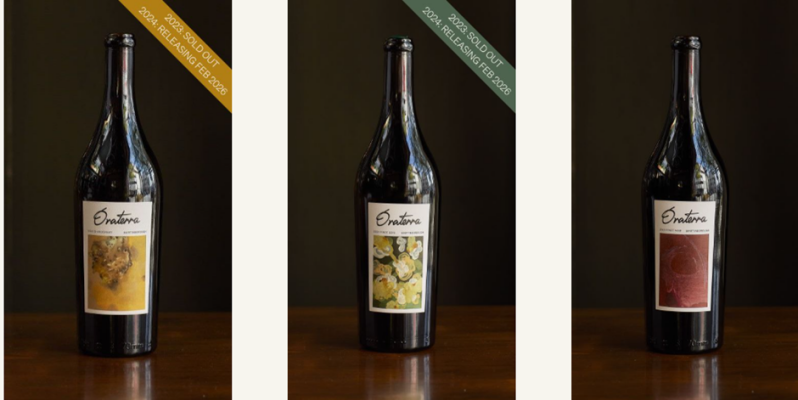
So, far you've released a Chardonnay, a Pinot Gris and a Pinot Noir from 23. What's in the pipeline and what excites you about them?
Yeah, that was really because this vineyard, the McCreanor vineyard has those 3 varieties, and that was the first vineyard that was in our ownership, so that's what we focused on. It still is for 24, the core range will be those 3 wines. But very soon after, I think we had such a beautiful 25, we started to do a little bit of experimenting with fermentation techniques or wine styles. We're looking at releasing a Blanc de Noir. But it’s a Blanc de Noir off Pinot Noir and Pinot Gris. It's a little bit of a copper colour that is sitting in amphora at the moment. And again, it's not about the crispiness and the prettiness. It really is about texture. So it's shorter in the winery than most, but still it'll sit on lees until January. And then we'll bottle that unfined, unfiltered as a wine, releasing in the winter. And we also have taken a different approach to ferments to bring a bit more prettiness out in wines. There's a lot of conversation around whole bunch, a wine that is more focused on the carbonic techniques, but still in brand new barrels and long elevages and that sort of stuff. So that's going to be interesting even for ourselves to see where that wine goes. But with these new vineyards, I wasn't going to do a single vineyard range. I need to know what they bring, what they're about. So the experience of growing these wines for the first five, ten years will probably give us an idea of how the different vineyards work before we come with an actual single vineyard range. But I've decided to take a different approach to winemaking and wine style really and come with something interesting there.
So you're using the grapes of Alexander?
That will be part of the 25, yeah. Because it's interesting here, lighter soils in the McCreanor vineyard, more sort of Martinborough Terrace typical. At New York street, inside, there's a heavier clay. The outside is a bit lighter. And then Alexander again is slightly heavier as well as a couple of quite heavy clay sites there. It’ll be really interesting to use some more whole bunch there.
Are you going to use their Merlot?
That’s going to Helen at Ata Rangi at the moment for their Celebre. And hopefully, in the coming year, I'll get a little bit of Pinot Gris back from her for that. But yeah, you saw their Chenin Blanc, beautiful. We've been talking about that for a few years when we took over the vineyard here. It's like, you know, how are we going to utilize some of the space? And I was like, oh, we need more white wine. So, there's been talk about Chenin Blanc, Pinot Blanc, dare I say it, Riesling. But definitely there's going to be more focus on white wine at some point.
It's interesting when you look at the global trends and everybody talks with some depression about the decline in wine consumption. But when you actually break it down, it's red wine consumption that's falling. White wine consumption is pretty much flat. And the same with rose. So the big decline is in red wine consumption, which I feel sad about because I'm a red wine lover. But I mean, obviously, when you think about big export markets, or historical export markets like China, so China's had all this, I think Nick Nobilo actually read it right, but he was just 20 years too early.
He was ahead.
And it's tragic, really, because, you know, Gewurztraminer is a lovely grape for Chinese food. But the Chinese weren't concerned about food and wine matching then because they didn't know anything about wine, it's all about the lucky colour and the prestige. And so all this investment's been ploughed in and all this export of red wine. But all that's fallen off now. Some of those grapes have been taken out. The red wine exports dropped off significantly. But white wine consumption is actually growing. And not only is China producing some decent white wines of their own now, particularly with Chardonnay and Riesling. In terms of imports, Riesling grew 13% in the last three years and Sauvignon Blanc grew 8%. What I attribute that to is that China has so many students doing WSET. They're becoming more literate about wine because they are so focused on learning. And now, it's catching on and they're starting to understand actually white wines work very well with Chinese food.
Yes, yeah, we were exporting more. Chardonnay, than Pinot Gris or Riesling to restaurants in China back in Dry River. They loved it.
Good, Yeah. So is there anything that you would have liked me to ask that I haven't asked that you want me to tell when I'm telling your story?
No, I think that was a good interview. They were good questions. I think it was really a nice conversation. thank you.
Oh, thank you Wilco, really looking forward to see how your journey with Oraterra progresses.
You can read more about Oraterra’s vision, people, vineyards and wines on their website. If you enjoyed this weekly blog, you can subscribe for free using the contact form, or just email info@wineinsights.org. To see all my daily content follow me on Facebook.
Add comment
Comments