A conversation with Jannine Rickards on intuition, Papatūānuku and crafting distinctive New Zealand wines.
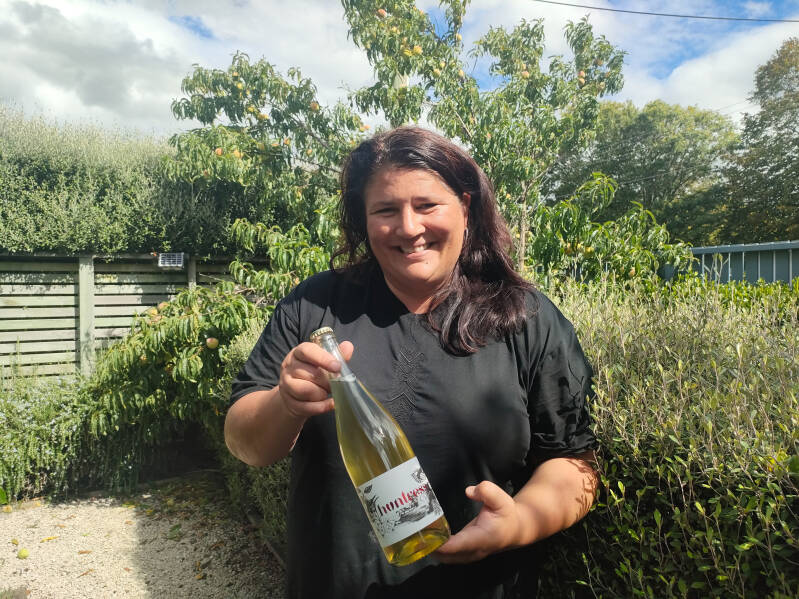
Jannine Rickards stands at the leading edge of a powerful shift in New Zealand wine — a movement where Māori values, land-based knowledge, and intergenerational stewardship are shaping some of the country’s most compelling wines. Through her Huntress label, she has become one of the clearest expressions of this growing influence: a winemaker whose work international critics consistently praise for its purity, intuition, and deep cultural grounding. Her wines are often described as carrying both the wildness and wisdom of Aotearoa, guided by principles of kaitiakitanga and a lived relationship with the whenua.
I first met Jannine not in a vineyard, but in my own home. She arrived with her mentor, Helen Masters of Ata Rangi, for a tasting I was hosting — a relaxed gathering where I’d asked everyone to bring something to share for lunch. Jannine walked in carrying something unmistakably her: a vibrant salad scattered with edible flowers, and thin slices of rare venison on French bread, meat she had hunted herself. It was beautiful, elemental, and quietly assured — a dish that spoke of whakapapa, resourcefulness, and a life lived close to the land.
That moment has stayed with me because it captured the essence of her craft. Jannine’s wines, like that offering, are shaped by instinct and respect, grounded in community, and alive with the rhythms of season and place. Overseas critics have noted the same qualities — the way her wines seem to hold both precision and wildness, structure and soul, all anchored in a worldview that sees land, people, and nourishment as inseparable.

Jannine Rickards, Huntress Winemaker
I had eagerly anticipated this kōrero with Jannine, partly because I’m on my own path of reconnection — I whakapapa Māori, but after a life lived largely as Pākehā, I’m still discovering what that truly means. My recent article on sustainable viticulture was the first time I tried to explore that journey through my work with wine, and something in the way Jannine weaves whenua, food, and story into her practice speaks directly to that search.
- When and how did you first become interested in wine?
My grandfather was always into wine, and bottles like Te Mata Estate and Cloudy Bay would be opened at family gatherings with a real sense of occasion. I was still on sparkling grape juice back then, watching it all with interest.
In the late 90s I started working at a luxury lodge on the Coromandel, and around the same time I was dating one of the chefs. Food and wine quickly became part of everyday life. If I wanted to move up from breakfast service, I needed to understand wine properly, so I enrolled in a correspondence certificate in viticulture and winemaking through Eastern Institute of Technology. I was also lucky to have a great mentor at the lodge who shared plenty of knowledge and helped spark a deeper enthusiasm. He gave me a bottle of Selaks Pinotage from my birth year which I held onto for quite some time before opening with family.
In between these times and during my student exchange year in the UK, I remember feeling homesick while visiting with friends Edinburgh city. I bought a bottle of Montana Sauvignon Blanc — the one with the square lip on the bottle — and we ended up having a surprisingly in-depth conversation about the flavours and what made it taste so distinctly “New Zealand.” It was one of those small but memorable moments where wine felt like a connection back home.
- What took you down the path of becoming a winemaker?
After working in fine dining and soaking up as much as I could about wine, I took on a part-time role on the North Shore with an importer of fine kai and wine — Vinotica — owned by Graeme Avery along with Wendy and Kevin Hoare.
They were bringing in all the delicious things that felt rare and exotic at the time — buffalo mozzarella (before NZ was making its own), beautiful European cheeses, chocolate, truffles, caviar. The wine cellar was just as exciting, full of top New Zealand producers and imports, especially Bordeaux. I remember the buzz around the 1998 release wines — there was real theatre in opening and talking about those bottles.
Graeme offered me a harvest position at Sileni Estates in 2003 and, true to form, I jumped at the opportunity. I was hooked pretty quickly. There’s something about harvest — the pace, the smell of ferment, the long days — that gets under your skin. I had some great mentors there (still friends today) and learned a huge amount over a couple of years, working across vineyard, winery, cellar door and front-of-house restaurant.
From there it was a bit of vintage hopping, some online study, and eventually a role at Ata Rangi that really set the direction. One step led to the next, and that path has shaped where I am now.
- Tell us about your career journey to the present day: the key decisions you had to make and the highlights.
Over the years I’ve learnt that relationships, authenticity and hard work go a long way. I feel genuinely grateful for the people I’ve met along the wine journey and for everything they’ve taught me. Each step — even the uncertain ones — has shaped where I’ve ended up. There’s not much point second-guessing past decisions; they’ve all led somewhere important.
I remember applying for roles after Sileni Estates and receiving encouraging responses from Martinborough, Marlborough and Central Otago. For whatever reason, I chose Martinborough. I’m certainly glad I did. Although I spent a few years on Te Wai Pounamu — and still love my community down there — there’s something about the wildness of the Wairarapa that feels like home.
I’ve never been very good at saying no to opportunities. I tend not to overthink them — if it feels right, I step in. Looking back, that openness has created its own sense of abundance. Opportunities have flowed because I’ve been willing to take them, and that’s something I’m quietly thankful for.
- Who were the important early influences in your approach to winemaking
I’ve learnt something from everyone I’ve worked with over the years — different perspectives, different approaches, all of it shaping how I see wine now. But I do feel especially grateful to some of the women who were so generous with their time and support, particularly Helen Masters at Ata Rangi and Kate Laurie from Deviation Road, both good friends and mentors to this day. Having strong, talented women leading the way — and speaking openly about the realities of the job — made a real difference to me. Watching how they combined leadership, instinct and hard work, without dressing it up as something glamorous, gave me a clearer sense of what was possible and the kind of winemaker I wanted to become.
In my first harvest I met Rosie Butler from Lime Hill, who was bringing fruit into Sileni Estates. The energy around the grapes was contagious — everyone genuinely excited about what was coming in the door. I also remember the enthusiasm of Christopher Keys, now at Gibbston Valley Winery, and the constant talk about Pinot Noir.
That excitement stuck with me. Very grateful to all of those who have employed me and shared their knowledge with me
- Sometimes the most important career lessons come from mistakes or misconceptions. Can you recall a particular mistake you have made in the past which became important in shaping your future as a winemaker?
Honestly, I made plenty of mistakes in the cellar in those first couple of years while I was figuring out how everything worked. Nothing teaches you faster than getting something wrong. I learnt very quickly to triple check everything in the winery.
I’m incredibly grateful for the patience and calm of the head winemakers I worked under. They never panicked when things went sideways — and I’ve tried to carry that same steadiness with me. Mistakes happen, especially when you’re exhausted, running on little sleep, and working long harvest days back-to-back. Patience is essential. Sometimes you only really learn by doing — and by getting it wrong first.
I’ve also learnt how important it is to find your people — those who share similar values and ethics. There’s not much joy in working somewhere that doesn’t align with who you are. When the values match, the hard work feels purposeful.
- What do you wish you'd known or learned earlier?
Work life balance, still figuring that one out…

- Let's explore your winemaking philosophy. On your website is the quote "Huntress represents the bringing together of fine wine, wild food and Papatūānuki, our Mother Earth". Tell us about how your personal history hunting and foraging together with your identity as a wahine Māori shapes your approach today.
For me, Huntress has never just been about making wine. It’s about connection — to whenua, to kai, to people, and to story.
I grew up with a strong connection to the land and sea, and hunting and foraging came later and influence how I understand the world. When you hunt or gather kai, you pay attention — to season, to weather, to the phase of the moon, to the health of the environment. You learn patience and respect. You learn that you are part of a system, not separate from it. That way of thinking flows directly into how I approach winemaking.
As a wahine Māori, my relationship with Papatūānuku isn’t conceptual — it’s ancestral. The land isn’t a resource to extract from; she’s a living entity with her own mauri. This is why organic farming is such an important part of the Huntress story.
Hunting and foraging also feed into the sensory side of wine for me. When you prepare wild food, you think about texture, energy, balance and how something was grown or gathered. Wine is no different. I’m interested in wines that feel alive, that speak clearly of their place, and that sit naturally alongside food. Fine wine doesn’t have to be disconnected from the wild.
Huntress is really the weaving together of those parts of myself — the fine wine world I trained in, the wild kai & connected kai, and my identity as Māori. It’s about honouring Papatūānuku through thoughtful farming and honest winemaking, and creating wines that feel grounded, expressive and generous
- What challenges for winemaking locally weigh on you currently?
I’d say weather. After a night of gale-force winds and sideways rain, seeing my garden mulch strewn across the lawn reminds me it’s the biggest challenge in farming—impacting crops, animals, and nearly everything we do outdoors.
- What excites you about the future?
I guess what excites me most is seeing more diversity in the wine industry. At a time when small businesses are facing real challenges here in Aotearoa, I’m optimistic that people are waking up to the importance of supporting local, organic, and sustainable businesses—ones that share mutual respect for each other, for the whenua, and for the environment. I truly believe in lots of little efforts, working together, that can make a big difference for our communities and for the future of our land.
- Tell me about your current release wines? What do these represent to you? Do we approach them as standalone wines with their own message, or do you see them as connected thematically.
The current release wines from Huntress really feel like markers of where the journey sits right now. Each one comes from a slightly different conversation with season, site and timing. I don’t set out trying to make wines fit a predetermined style — they’re more a response to what the vineyard gives and how I feel it wants to be handled that year.
Every wine stands on its own. They each carry their own personality and energy, and I like that people can connect with them individually. But at the same time, I definitely see them as connected. Together they tell a bigger story about Huntress — about gathering, about relationship with whenua, and about finding balance between cultivation and wildness.
Huntress has always been influenced by the ideas of hunting and foraging — paying attention, taking only what’s ready, and working with respect for the ecosystem you’re part of. So, while the wines might look different on paper, they’re linked by that same intent and way of working.
What I love about the current releases is that they show growing confidence. There’s less forcing outcomes now and more trust — picking decisions feel clearer, the cellar work is gentler, and I’m trying to let texture and energy lead rather than technique.
Looking ahead, the focus isn’t really on getting bigger. It’s more about going deeper. I’m interested in understanding sites more intimately, continuing regenerative thinking in the vineyard, and exploring ferment and maturation choices that allow wines to evolve calmly and honestly.
-
- What's next in the pipeline?
There are always ideas simmering — some wines underway, some still just thoughts — but increasingly I’m excited about how wine connects beyond the bottle. Shared tables, collaboration, wild food, bringing people together around seasonal experiences. Huntress is slowly becoming less about individual releases and more about an ongoing conversation between land, people and time.
……………………………………………………………………………………………………………………….
Over the week of this fascinating and reflective kōrero, I tasted three of the Huntress 2024 wines, and my impressions follow in the tasting notes below.

Huntress 2024 Petillant Naturel Matiki Riesling
Pale lemon-gold in the glass with a faint green tinge, the wine has a distinct lemon verbena aroma with a touch of kaffir lime and some funky autolytic notes. The entry is sweet, soft and creamy with lime ginger and honey-suckle flavours that give way to a firm phenolic grip, gently assertive acidity and a long slightly salty finish. Matiki is Te Reo Māori for summer but also refers to the wine as a collaboration between six Māori women. The first glass slid down with dangerous ease but I reassure myself on the second glass ,that the ABV is a modest 12.2%. Hua Parakore certified (see https://www.tewakakaiora.co.nz/whatishuaparakore) and of course Bio-gro organic as well. So damned moreish!
Huntress 2024 Mōkarakara Syrah
Fruit from a single vineyard in Hawkes Bay's Bridge Pa Triangle. Hand harvested fruit, wild fermented with 30% whole bunches and aged 10 months in French oak. Magenta purple in the glass with distinctly spicy aromas of white pepper and Chinese five spice, followed by plum and berry fruits and a hint of dianthus. On the palate, juicy dark berry and plum fruit and (for my rotendone sensitive palate) powerful white pepper spice, medium plus acidity and quite silky tannins, with a long spicy finish. Many will find this attractive drinking in its youth but for me it needs a few years for that pepper spice to soften to reach its pinnacle.
Huntress 2024 Pawero Pinot Noir
He momo motuhake (sui generis)! a fascinating dance of delicacy and power. The name Pawero in te reo Māori (not to be confused with Pāwero) comes from the context of working with harakeke, referring to the interweaving and cross‑lacing of fibres — a hint at the beauty and complexity within the wine.
Almost translucent ruby in the glass, you might be fooled into thinking it will be light and simple — but not at all. Earthy aromas of forest floor and riverside give way to bright cherry and raspberry fruit, lifted by pot‑pourri and spice. Medium rather than light‑bodied, the sweet cherry and raspberry fruit are interlaced with a touch of smoky oak and cardamom spice. The tannins are silky yet gripping, and a firm acid line carries those earthy and smoky notes through a long, satisfying finish. Delicious.
Final reflections
Taken together, these three wines feel like a distilled expression of everything Jannine spoke about over the course of our kōrero — individuality held within connection, confidence without force, and a deep, instinctive relationship with whenua that guides rather than dictates. Each wine stands firmly in its own character, yet all share that unmistakable Huntress tension between wildness and refinement, intuition and craft. Tasting them after our conversations made her words land with even greater clarity: Huntress is not simply a range of wines, but an evolving dialogue between land, people, season, and time. And in their energy, texture, and quiet honesty, you can sense the direction she is moving — deeper, more attuned, and ever more anchored in the values that shape her work.
About the author.
My lifelong passion for wine has been deepened through international wine travel, formal wine study (WSET3) and a career in adult learning. Through my Martinborough-based business in New Zealand, wineinsights, I provide exceptional wine tour, wine-tasting and wine education experiences for wine lovers and enthusiasts. My expertise is further enriched by my role as cellarmaster for the Martinborough Wine and Food Society, in New Zealand’s renowned Pinot Noir region and my strong wine industry connections.
If you enjoyed this weekly blog, you can subscribe for free using the contact form or by emailing info@wineinsights.org. To see all my daily content follow me on Facebook.
Add comment
Comments
Amazing! So much to reflect on here. And these wines look so interesting. I'd love to get hold of a bottle of that Matiki Riesling - where can I find that please?
Hi Kate, Huntress wines can be purchased directly on their website but your local retailer for single bottles is By the Bottle in Mt Eden.