Western Sicily is a region whose wine identity is changing faster than most people realise. For many readers, the name still conjures a single reference point: Marsala, the fortified wine that once powered British merchant fleets and Victorian drawing rooms. Marsala’s legacy is important—its rise and fall shaped the entire western half of the island—but it is no longer the region’s defining story.

Today, Western Sicily is in the midst of a quiet, confident renaissance. From Marsala in the west to Menfi and the limestone hills above Alcamo, producers are rethinking scale, re‑examining terroir, and reclaiming native varieties that had long been overshadowed by bulk production. Limestone ridges, marine breezes, and ancient vineyard sites are being matched with organic farming, micro‑vinification trials, and a new generation of winemakers who see Western Sicily not as a peripheral zone, but as a frontier of possibility.
This was my first time in the region, and the visits were arranged at the last minute—opportunistic rather than curated. Instead of a structured survey, what I experienced was an initial acquaintance, a first handshake with a landscape that deserves a deeper, more focused return. Yet even in this brief window, two contrasting visits—one in Alcamo, one in Menfi—offered a compelling snapshot of Western Sicily’s evolving identity.
Two Wineries, Two Scales, One Region in Motion
What struck me most was how opposite these two wineries were in scale, structure, and philosophy—yet how both expressed the same underlying momentum in Western Sicily.
Quattrocieli, in Alcamo, is small, organic, family‑run, and deeply personal. It is the kind of place where the vineyard and the people feel inseparable, where the wines are shaped by instinct, intimacy, and a desire to express the land with clarity and honesty.
Mandrarossa, in Menfi, is the premium face of one of Italy’s largest agricultural cooperatives. It is vast, meticulously organised, and research‑driven, with a scale that allows for precision mapping, long‑term experimentation, and a level of technical resource that few private estates could ever match.
Together, they form a natural diptych:
- Quattrocieli as the close‑up lens,
- Mandrarossa as the wide‑angle view.
Both are positive encounters, both are expressions of Western Sicily’s new confidence, and both will inform a more deliberate return visit in the future.
Quattrocieli (Alcamo): A Young, Organic Estate with a Clear Voice
Founded in 2015, Quattrocieli is a relatively young project, but one with a strong sense of identity. The estate began as a father‑and‑son venture—Leonardo and Giuseppe—built around a simple idea: to make wines that speak clearly of Sicily, without artifice or excess.
My visit was generously hosted by winemaker and estate ambassador Giuseppe Alcamo, whose combination of technical clarity and easy hospitality made this first encounter with Alcamo’s hills feel both grounded and personal. What became clear, even before I arrived, is that this isn’t unique to my experience: of all the wineries I contacted, Giuseppe was among the most immediately responsive, and the tone of his communication mirrored what you see on the Quattrocieli website — a hands‑on, human‑scaled approach to welcoming guests. His messages weren’t just logistical; they showed a genuine interest in who was coming and how he could shape the visit around their curiosity. That personal investment is clearly part of the estate’s ethos, and it’s a major reason Quattrocieli stands out in the wider world of enotourism.

L. Giuseppe Alcamo R. State of art bottling equipment
What stood out immediately in talking with Giuseppe was how deeply the family story is woven into the identity of the estate. Quattrocieli began as his father Leonardo’s dream — the desire to create wines that told the story of Sicily with honesty and clarity — and at a time when many young Sicilians chose to leave the island in search of opportunity, Giuseppe made the opposite decision. After completing his university studies, he returned home to invest in his own roots and in the future of Alcamo. Even the label Jocu carries this sense of lineage: it is a tribute to his grandfather, who used to say that “the harvest is like a game,” a reminder that work, joy, and family have always been inseparable in their approach to wine.
Estate & Terroir
Quattrocieli farms around 20 hectares across four distinct zones—Alcamo, Calatafimi, Salaparuta, and Gibellina—each with its own soil profile. Sandy‑calcareous slopes, clay hillsides, and chalk‑rich pockets give the team a palette of textures and structures to work with. All vineyards are certified organic, and the approach in the cellar is deliberately restrained.
Philosophy & Winemaking
The focus is firmly on native varieties—Catarratto, Grillo, Zibibbo, Insolia, Nero d’Avola—supported by a small amount of Syrah. The wines are clean, expressive, and quietly characterful, with a through‑line of freshness and transparency. Fermentation relies completely on native yeasts naturally present on the grapes and unfolds spontaneously without additions. Their ranges (Jocu, Fluente, Coralium, Aurante) move from playful to more serious expressions, but always with a sense of place.
Quattrocieli: Alcamo in Microcosm
Quattrocieli is a small, organically farmed estate that offers an intimate, ground‑level introduction to Alcamo, where the connection between vineyard, winery, and people is immediate and unfiltered. As a lens on Western Sicily’s wider evolution, it shows how the region’s renewal is being shaped not only by large, ambitious projects, but also by focused, human‑scale estates working quietly and precisely within their own local landscapes.
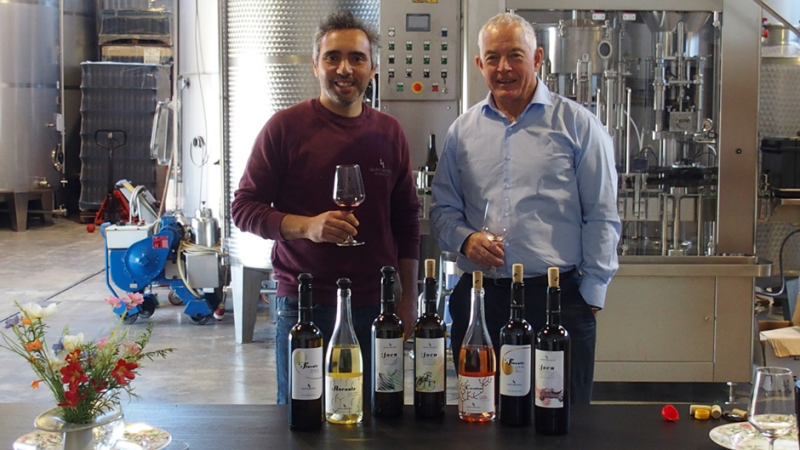
Giuseppe led me through a generous tasting of the Alcamo wines as follows:
Fluente Insolia DOC Alcamo 2025
One of the oldest Sicilian indigenous varieties with possible early Greek origins (7-8th century BC). Grapes grown on clay and limestone soils, natural ferment in tank, 11% alcohol.
Bright lemon in the glass with an expressive fruity nose of orange blossom and white peach. On the palate light and fresh with bright citrus, peach and almond flavours medium length a delicious easy “drink now” style
Aurante Zibibbo, IGT Terre Siciliane 2025
Zibibbo is the Sicilian name for Muscat of Alexandria. From grapes grown in clay and limestone, natural ferment, 6 months in tank before bottling. 12.5% alcohol.
Light-medium lemon gold in the glass with an aromatic, musky nose with citrus, jasmine and herbal notes. On the palate its dry with fresh acidity and a phenolic edge to the peach, yellow apple and basil flavours with a lick of salt and lime on the finish.
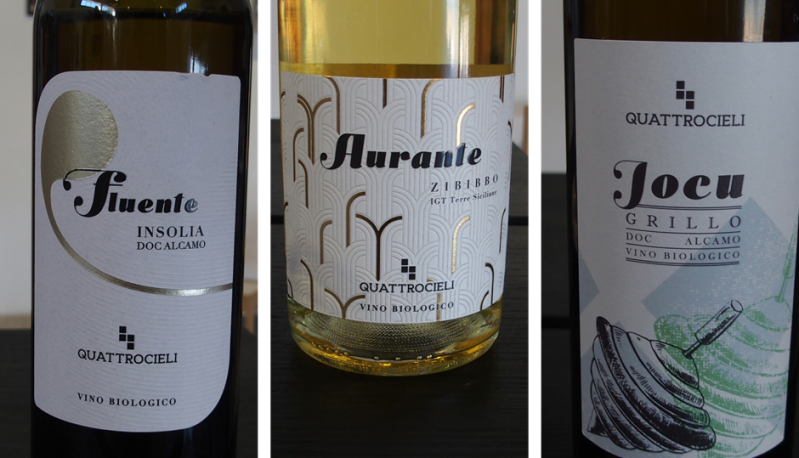
ocu Grillo DOC Alcamo 2025
Grillo is a cross between Zibibbo and Cataratto intentionally bred in 1873 as a high sugar variety to improve the quality of Marsala but increasingly favoured for dry wine production in recent decades. A careful selection of the best bunches of hand harvested grapes grown on sandy calcareous soil at 450 m elevation where diurnal range slows ripening and maintains freshness, tank fermented and aged 6 months, 12% alcohol.
Bright lemon-gold in the glass with sweet honeysuckle and orange blossom aromas supported by fruity notes of pear and yellow apple. On the medium-full bodied palate there are some tropical fruit notes with an orange pith edge, the finish is long fresh and dry.
Jocu Cataratto DOC Alcamo 2025
The signature white grape of Sicily and most widely cultivated, this wine is from hand harvested grapes grown in the same elevated vineyard as the Grillo above, natural ferment in stainless with 6 months aging. 12% alcohol.
Green tinged lemon gold in the glass with a lovely ripe tropical fruit note on the nose reminiscent of longan with its smoky musk and gardenia florals. On the palate there is a slightly bitter grapefruit edge to that same longan fruit that drives to a fresh and satisfying finish.
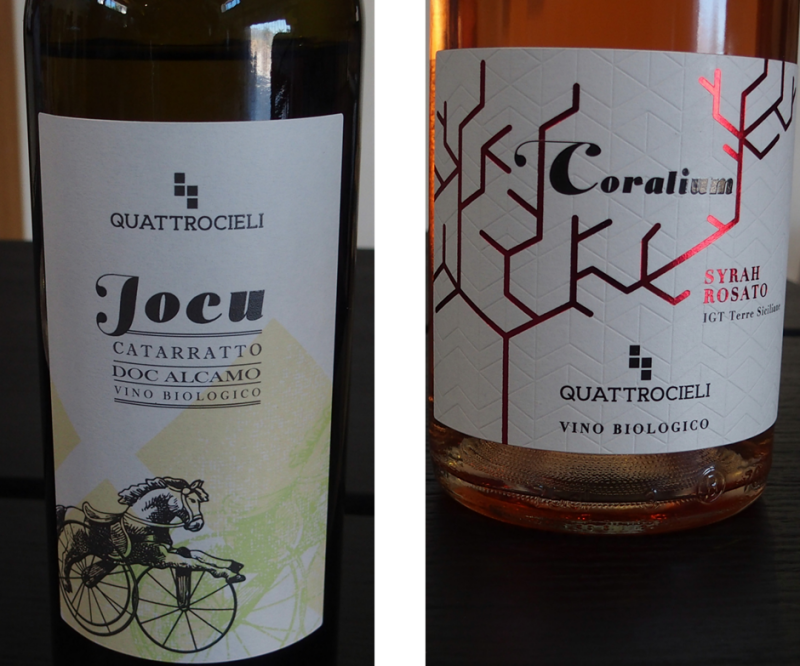
Coralium Syrah Rosato IGT Terre Siciliane 2025
Made using the Saignee method, just 12% alcohol.
Orange salmon in the glass with a red berry and watermelon nose and hint of pepper spice. On the palate quite intense flavours of prickly pear, watermelon, cucumber and berries with a pink pepper note in the finish. Easy to drink but with the substance to match a range of foods, making this the perfect summer lunch wine.
Fluente Syrah IGT Terre Siciliane 2023.
From organic Syrah grapes grown at the Gibellina commune, fermented and aged in tank 12 months followed by 4 months in large format oak before bottling, 13% alcohol.
Purple ruby in the glass and unmistakably Syrah on the nose with characteristic black and blue fruits, violets and distinct pepper spice. On the medium-bodied palate, Doris plum, blackberry, and Dawson cherry fruit flavours are supported with pepper and cinnamon spice and a touch of vanilla on the smooth-edged finish. Delicious.
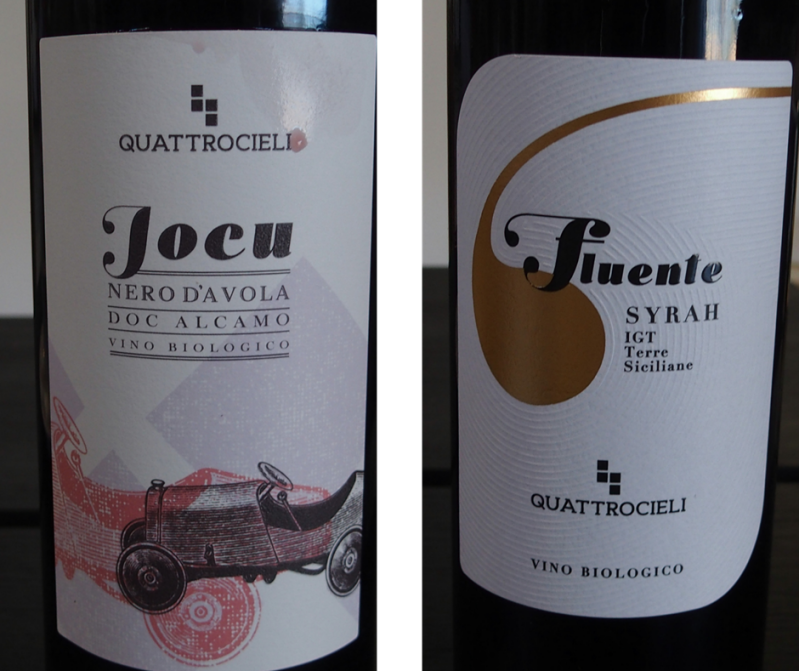
Jocu Nero d’Avola DOC Alcamo.
Perhaps the most well-known grape with a reputation in some circles for being difficult to ripen. Organic grapes on 20-year-old vines at Gibellina, hand-picked, destemmed with a warm natural ferment in stainless followed by aging of 11 months in tank and a further 6 months in French oak. 12.5% alcohol.
Bright ruby in the glass with a slightly meaty -edged nose of raspberry, red currant and plum. On the palate there is a distinct balsamic note overlaying the red berry and plum fruit, with some dark chocolate and licorice too, good length, and drying tannins on the finish but not unpleasantly so.
Taken together, the wines make it clear that Quattrocieli’s ambitions are not rhetorical flourishes but lived practice. They are not elaborate or heavily worked; instead they are pure, characterful expressions of their varieties and soils, shaped by organic farming and a light hand in the cellar. Each bottle carries something of Alcamo’s limestone, wind and sun, but also something of the family themselves — the clarity of Leonardo’s original vision, the rootedness of Giuseppe’s decision to stay in Sicily, and the generosity and sincerity that marked my visit. In their simplicity and honesty, these wines achieve exactly what the family sets out to do: to capture, in every bottle, the colours, aromas and soul of their land.
Mandrarossa (Menfi): Precision, Scale, and a Community Reimagining Western Sicily
If Quattrocieli offers an up‑close, hands‑on encounter inside a working winery, Mandrarossa is the wide‑angle view of what Western Sicily can achieve when scale, research, and community align. It is the premium expression of Cantine Settesoli, a cooperative founded in 1958 by 88 growers who wanted to break free from the low‑value bulk market that had defined the region for generations. Today, Settesoli includes around 2,000 growers farming 6,000 hectares, making it one of the most significant viticultural communities in Italy — and arguably one of the most influential in the Mediterranean.
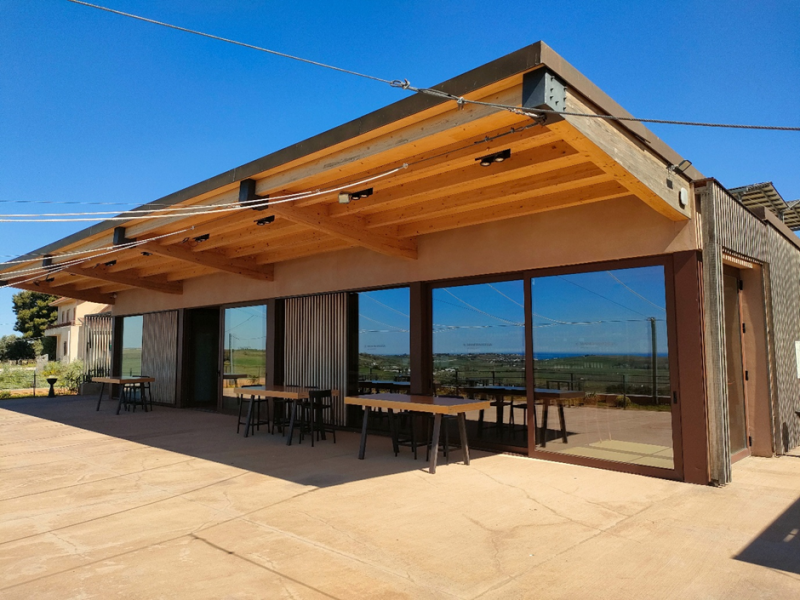
A stunning Menfi landscape reflected in the windows of an equally stunning Mandrarossa cellar door
A Cooperative With an Unusual Level of Ambition
What makes Settesoli unusual is not its size, but its long-term strategic vision. From the 1980s onward, the cooperative invested heavily in:
- soil mapping,
- clonal research,
- vineyard zoning,
- micro‑vinification trials,
- and grower education.
This was decades before “terroir” became a marketing term in Sicily. The goal was simple but radical: to understand Menfi’s vineyards at a level of detail normally associated with small, prestige estates.
The Birth of Mandrarossa
By the late 1990s, the cooperative had identified a series of high‑potential sites — limestone ridges, breezy coastal slopes, and elevated clay hillsides — that consistently produced fruit of exceptional quality. In 1999, these vineyards were ring‑fenced to create Mandrarossa, a dedicated premium brand with its own identity, winemaking team, and stylistic direction.
This wasn’t just a label; it was a statement that Western Sicily could produce wines of precision, freshness, and site expression, even at scale.
Terroir: A Landscape of Contrasts
Menfi’s geography is one of the most varied in Sicily. Within a short drive you move from:
- chalky white limestone outcrops,
- to rolling clay hills,
- to sandy coastal vineyards shaped by sea breezes,
- to higher inland slopes with cooler night-time temperatures.
This diversity allows Mandrarossa to work with both native varieties — Nero d’Avola, Grillo, Inzolia — and international grapes that have found a natural home here, such as Chenin Blanc, Petit Verdot, and Fiano. The result is a portfolio that is broad but not unfocused: each wine is tied to a specific soil type, exposure, or micro‑zone.
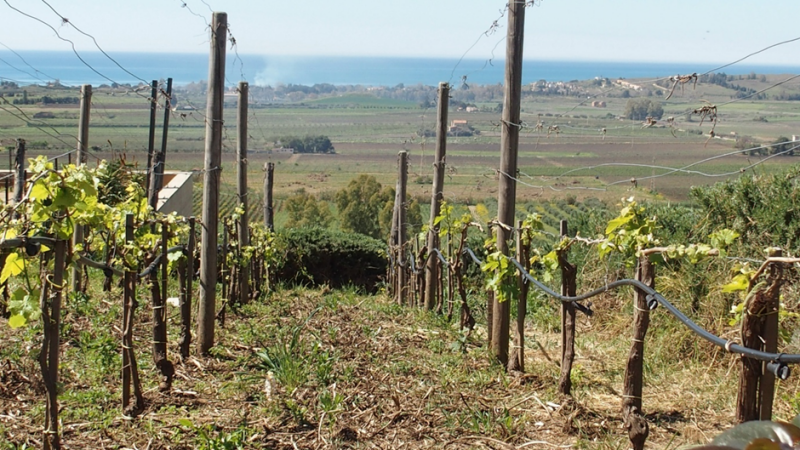
Sauvignon Blanc vines slope towards the Menfi coastline
A Modern, Research‑Driven Winemaking Philosophy
Mandrarossa’s style is clean, contemporary, and technically assured, but not anonymous. The winemaking team works with:
- small-lot vinifications to preserve site character,
- gentle extraction for reds,
- cool fermentations for whites to retain aromatic clarity,
- and a growing emphasis on single‑site bottlings that highlight Menfi’s limestone and clay slopes.
Collaborations with consultants such as Alberto Antonini and Pedro Parra have further sharpened the focus on terroir, particularly in identifying hillside parcels that produce wines of structure and longevity.
A Community Project With Real Impact
Perhaps the most compelling aspect of Mandrarossa is its social dimension. The cooperative model means that improvements in quality translate directly into improvements in the lives of thousands of families. Better farming practices, higher grape prices, and long-term vineyard planning have helped stabilise a rural economy that once relied heavily on bulk wine and seasonal labour.
In this sense, Mandrarossa is not just a winery — it is a regional development engine, one that has helped reposition Western Sicily on the global wine map.

Wonderful hosts and guides for my visit.
Mandrarossa: Menfi in Panorama
Mandrarossa is the premium, research‑driven expression of Menfi: a large‑scale, community‑rooted project that offers a panoramic view of what Western Sicily can achieve when deep viticultural study, grower organisation, and long‑term planning come together. As a counterpoint to the region’s smaller, human‑scale estates, it shows how Western Sicily’s renewal is equally shaped by ambitious, collective efforts capable of elevating entire landscapes and the communities that farm them.
My visit to Mandrarossa was guided with warmth and clarity by two key staff members, whose deep knowledge of the vineyards and long involvement with the cooperative brought the scale of the project into sharp human focus. Their explanations of the soils, exposures, and grower relationships made it clear how much of Mandrarossa’s identity rests on the people who farm these hillsides, and how the collective vision of Menfi is carried forward through both technical precision and genuine pride in the land. It was a delight to be led through a tasting of the following signature wines.
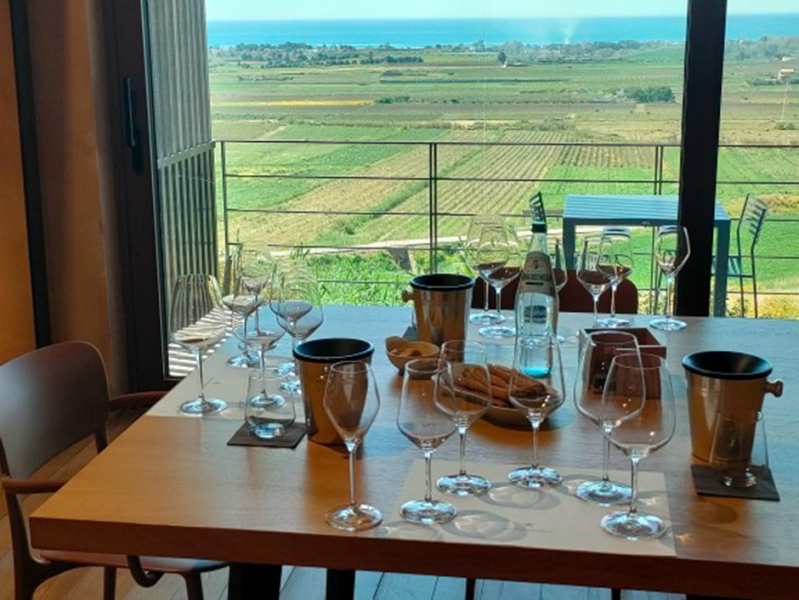
Panoramic outlook for a memoriable tasting
Calamossa – IGT Terre Siciliane NV
Charmat method sparkling made from equal proportions of Zibibbo, Grecanico & Carricante, 3 months in tank and then 3 months in bottle before release. 12.5% alcohol
Pale lemon straw in the glass with aromas of white flowers and peach, fresh and clean on the palate with a slight salinity, moderate length, an easy drinking uncomplicated and enjoyable wine to enjoy as an aperitif or unadorned seafood.
Bertolini Soprano (Vini de Contrada) Grillo 2024
From a single vineyard with calcareous soils near Menfi aged one month in concrete and 11 in oak tonneau, 13.5% alcohol.
Pale lemon straw in the glass with bright aromatics of orange blossom, feijoa and pear. On the palate it is quite layered and expressive with a rich fresh entry of mandarin, apricot and mango that gives way to a more subtle salt licked guava or feijoa on the mid palate and quite a long mineral finish with a creamy texture.
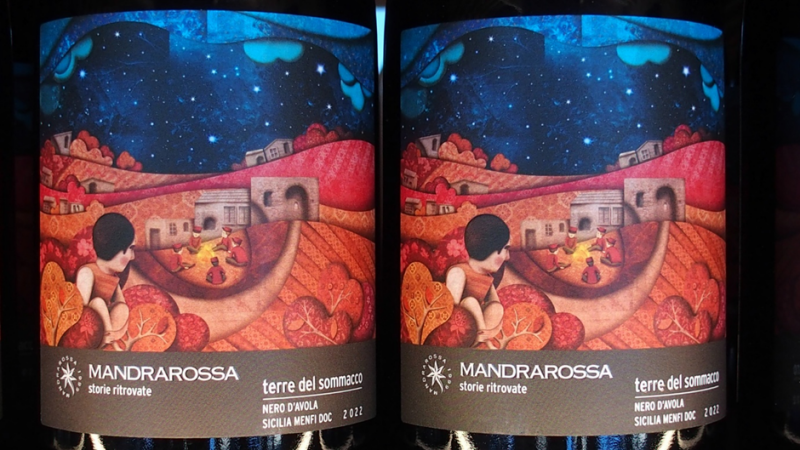
Terre del Sommaco (Vini de Contrada) Nero D’Avola 2022
From a single vineyard inland from Menfi with limestone soil, the wine spends 8 months in cement followed by 19 months in used oak tonneau. 14%
Deep ruby purple in the glass with aromas of sweet and sour cherry, blackberry, lavender and mint. On the palate there is plenty of ripe dark fruit underlaid with some firm powdery tannins and a distinctly spicy red pepper edge, great freshness and energy. Cries out for food!
Cartagho Nero D’Avola 2021
From limestone and sandy soils fermented in cement then aged 12 months in oak barriques.
Mulberry and boysenberry aromas are lifted with notes of violets and lavender. On the full-bodied palate there are layers of red black and blue fruit, even some blood orange, dark chocolate, clove spice and coffee grounds, the tannins are plush but firm and there is a juicy acidity that lingers with a slight bitterness on the finish. Would pair grilled red meat perfectly.
Taken together, these wines show Mandrarossa operating at full clarity of purpose: technically assured, expressive of their individual contrade, and shaped by the deep viticultural research that underpins the entire Menfi project. From the bright, uncomplicated ease of Calamossa to the layered precision of Bertolino Soprano and the structural depth of the Nero d’Avola bottlings, the range demonstrates how a large, community‑rooted enterprise can still deliver wines of character, freshness and place. What impressed me most was how seamlessly scale and identity coexist here — the cooperative’s scientific rigour and long‑term planning are evident, yet the wines retain an immediacy and honesty that reflect the growers who farm these hillsides and the team who guided my visit. In their breadth and refinement, these wines articulate a panoramic vision of what Western Sicily can achieve.
Western Sicily: First Encounters, Emerging Truths
This journey through Western Sicily — from the intimate, family‑rooted perspective of Quattrocieli to the panoramic, research‑driven vision of Mandrarossa — revealed a region defined not by a single style or philosophy, but by a shared commitment to expressing land, heritage and possibility. What unites these contrasting experiences is a sense of renewal: small estates refining identity through precision and authenticity, and large collectives elevating entire landscapes through science, organisation and community. Together, they form the opening chapters of a broader Sicilian story, one that widened further during my visit next day to Planeta at Ulmo. This, the subject of my next article will explore how one of Sicily’s most influential producers interprets not only the west, but the island’s full mosaic of regions — and how these diverse expressions continue to shape one of the Mediterranean’s most compelling wine cultures.
About the author
John Penney is a wine experience guide based in Martinborough, New Zealand. His lifelong passion for wine has been deepened through extensive international wine travel, formal wine study (WSET3) and a career in adult learning. Through his Martinborough-based business wineinsights, he provides exceptional wine tour, wine-tasting and wine education experiences for wine lovers and enthusiasts.
Add comment
Comments
Thank you for taking the time to visit us and for writing such a thoughtful and well-crafted article. We truly appreciate the care you put into telling not only our story, but also the evolving story of Western Sicily's wine scene.
It means a great deal to us that you recognized the values at the heart of Quattrocieli: our family's passion, our commitment to organic farming, and our desire to express the true character of our land through every bottle.
We are honoured to be part of your journey through Western Sicily and look forward to welcoming you back for another glass of wine and many more conversations. Thank you again for your kind words and support!
Thank you so much Giuseppe for your generous hosting and kind validation of my writing. It was truly a pleasure and an inspiration!
Thank you for visiting us and for sharing our story in such a thoughtful and beautifully written article. We deeply appreciate the care and attention you devoted not only to Mandrarossa, but also to the evolving wine scene of Western Sicily.
It means a great deal to us that you captured the values at the values of Mandrarossa: energy, professionality, and attention to sostenability.
We are happy to be part of your trip to visit the south West coast of the amazing island of Sicily, and we look forward to welcoming you back to discover new projects and wines.
all the best,
Roberta
Thank you Roberta for your generous sharing of insight and hospitality over wonderful wines. I can't wait to return!