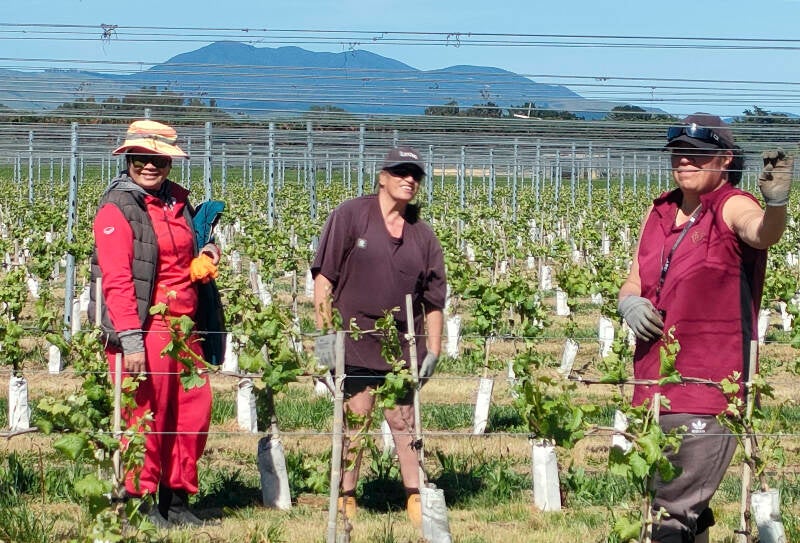
New Zealand wine has earned its reputation for environmental leadership (as I explored in an earlier article here). SWNZ’s near‑universal adoption is a genuine achievement, and the industry deserves credit for building a sustainability culture that is both practical and commercially valuable. But sustainability is not a single‑circle concept. In classical sustainability theory, resilience sits at the intersection of three Es: Environment, Equity, and Economics. New Zealand wine has led on the environmental front, but leadership is not arrival. Environmental sustainability is a moving target, and its long‑term viability now depends on how well we strengthen the human foundations beneath it.
This matters because the Economic E is structurally dependent on the Equity E. Labour stability, skill retention, brand identity, vine health, regional viability, and the increasingly critical economics of cellar‑door sales all rely on how people are treated, trained, housed, paid, and valued. When the Equity E is weak, the Economic E becomes fragile — because the industry’s commercial strength depends on human continuity and authentic hospitality, not simply corporate scale or short‑term yield. A vineyard can be impeccably certified and still be economically vulnerable if its labour model is precarious, its contractor oversight opaque, or its succession pipeline broken.
New Zealand wine has reached a point where environmental sustainability alone cannot carry the economic future of the industry. The global market is tightening ethical supply‑chain scrutiny. Immigration settings are shifting. Labour expectations are rising. And the structural vulnerabilities in our workforce model — long masked by audit culture and contractor outsourcing — are becoming harder to ignore.
Human sustainability is not a reputational add‑on. It is the missing pillar that underpins the industry’s long‑term economic resilience. Strengthening the Equity E is now the most important economic decision New Zealand wine can make.
The Mirage of Social Sustainability
The industry has begun moving in this direction. SWNZ’s new People Standard is a welcome step, requiring members to show evidence of written employment agreements, health and safety compliance, and legal work status. These are necessary foundations.
But the framework still leans heavily toward an employer‑centric, compliance‑driven philosophy. When SWNZ Standard 7.3a defines success as ensuring employees have “agreements containing the minimum employment entitlements,” it unintentionally elevates the statutory baseline into a sustainability achievement. Minimum wage, basic contracts, and standardised paperwork become markers of excellence rather than legal obligations.
This creates a familiar “audit culture” trap: immaculate digital records can pass a desktop audit even when the lived reality on the ground is far more complex. Paperwork becomes the proxy for sustainability, while the human dynamics of the workforce remain largely unexamined.
A recent conversation with two winemakers brought this into sharp focus. Both believed the new People Standard was voluntary and essentially a tick‑box exercise with no meaningful audit behind it. Their assumption wasn’t careless; it was a rational response to a system that has long equated sustainability with documentation rather than practice. When growers think a standard can be met by uploading a few PDFs, it shows how deeply audit culture has shaped expectations. And it highlights a real risk: if the industry treats social sustainability as a compliance form rather than a lived responsibility, the vulnerabilities exposed in past contractor cases will persist—and may worsen under the new legislative settings that lower wage thresholds and remove mandatory employer training.
The Contractor Blind Spot
Growers are not solely to blame for this. SWNZ audits the vineyard business—not the contracting companies that supply much of the labour. Yet recent history shows that this distinction offers no real protection. When contractors fail, growers are exposed.
Below are brief summations of three cases that illustrate the structural vulnerability.
Case 1: Double Seven Services (Marlborough)
This contractor falsified records, charged unlawful recruitment fees, and used illegal piece‑rate structures that left workers underpaid. Growers relying on contractor paperwork had no visibility of the exploitation occurring in their own vineyards. When the case became public, the reputational damage extended beyond the contractor.
Case 2: ICM Horticultural Contracting (Hawke’s Bay)
Workers from Papua New Guinea were subjected to wage theft, unsafe conditions, and misleading employment promises. Again, growers were not the direct employers, yet their vineyards became the site of exploitation. The reputational fallout landed on the region, not just the contractor.
Case 3: A Prestigious Hawke’s Bay Estate
In this case, a contractor supplying seasonal labour to a well‑known winery was penalised for systemic exploitation. The winery had no direct employment relationship with the workers, yet the public narrative quickly linked the brand to the contractor’s behaviour. This case demonstrated that even elite producers cannot outsource accountability. Transparency and oversight are essential—not because growers are doing anything wrong, but because the system exposes them.
These cases are not historical footnotes. They are warnings. And they show why growers must have visibility over contractor practices—not to police contractors, but to protect their own brands and the people working on their land.
The Macro-Political Squeeze
These vulnerabilities sit within a wider national context. For decades, viticulture has relied on flexible, low‑cost labour through the Recognised Seasonal Employer (RSE) scheme and the Accredited Employer Work Visa (AEWV). Recent AEWV rollbacks—lowering wage thresholds, reducing required work experience, and removing mandatory migrant‑rights training for employers—have eased short‑term business pressure. But they also lower the regulatory floor at a time when international markets are tightening ethical supply‑chain scrutiny.
Premium markets such as the UK and Europe now enforce strict modern slavery legislation. A single high‑profile labour breach can damage a brand overnight. Bernard Hickey’s description of New Zealand’s “migrant worker exploitation economy” may be uncomfortable, but it reflects a structural reality: when industries depend on tied migrant labour to suppress natural wage growth, the true costs of business are shifted onto vulnerable individuals and regional infrastructure.
Again, this is not a moral judgement on growers. It is a structural critique of the system that they operate within.
Benchmarking Against Global Best Practice
To understand the gap between our current framework and global expectations, it is useful to compare SWNZ’s People Standard with the Sedex Member Ethical Trade Audit (SMETA), widely regarded as an international gold standard.
| Dimension | SWNZ People Standard | SMETA (Global Best Practice) | Implication for NZ Wine |
|---|---|---|---|
| Wages | Requires legal minimums. No reference to living wage. | Benchmarks against locally indexed living wage. | Minimum wage ≠ sustainability. Workers remain economically vulnerable. |
| Employment Agreements | Checks for existence of contracts. | Audits contract content, clarity, and worker comprehension. | A contract can exist without protecting the worker. |
| Supply Chain Accountability | Relies on self‑declaration from growers. Contractors not audited. | Requires unannounced audits of contractors and joint liability. | Growers exposed to contractor failures. |
| Worker Voice | Internal dispute policies required. | Independent, multilingual whistleblower channels mandatory. | Workers may not feel safe raising concerns. |
| Housing | Ensures basic compliance. | Evaluates cultural connectivity, mental well‑being, digital access. | Housing can be compliant but isolating or harmful. |
| Training | Focuses on environmental compliance. | Evaluates how payment structures influence worker behaviour and asset health. | Piece rates can undermine vine health if poorly supervised. |
| Health & Safety | Documentation required. | On‑site verification of actual practice. | Paper compliance can mask unsafe conditions. |
| Migrant Protections | Relies on AEWV/RSE compliance. | Requires independent verification of recruitment, fees, and conditions. | NZ’s legislative rollbacks increase risk exposure. |
This comparison matters because it shows the difference between legal compliance and sustainability. Poverty‑line wages, desk‑based contractor audits, and internal dispute policies are no longer seen as sustainability achievements. They are seen as minimum legal compliance.
Te Ao Māori: A Home-Grown Sustainability Lens
New Zealand does not need to invent a new social sustainability model; we already have one in Te Ao Māori. Although Māori viticulture is relatively recent, the values that underpin Māori worldviews—kaitiakitanga, manaakitanga, whanaungatanga, and rangatiratanga—have guided relationships between people and land for generations.
These principles naturally integrate human well‑being into environmental stewardship in a way our current frameworks do not. They offer a genuinely indigenous sustainability lens that treats workers as part of a living ecosystem rather than just labour inputs. When workforce practices are anchored in these values, the industry moves beyond compliance and into a model of shared responsibility, mutual uplift, and intergenerational resilience.
Surely, here is an invitation to draw from the deep wellspring of our own cultural strengths.
The Succession Dilemma: When Whakapapa Meets Quarterly Returns
Human sustainability looks different in the family‑owned sector, and it is here that the stakes are highest. Many of the pioneering estates planted in the 1980s and 1990s now face generational crossroads. In conventional business terms, succession is an asset transfer. Through the lens of whakapapa, it is something deeper: an unbroken chain of identity and responsibility connecting ancestors to future generations.
When these estates are sold to large corporate portfolios, the severance is not only cultural. It is operational. The logic of stewardship is replaced by the logic of quarterly returns. Decisions that once balanced land health, community relationships, and long‑term brand building are re‑weighted toward short‑term financial performance. Sustainability becomes a cost centre. Brand equity becomes an expendable asset. Viticulture becomes a spreadsheet.
This is not an abstract fear. It is already visible in regions where corporate consolidation has accelerated. The rule of accountants introduces a new set of incentives: minimise labour costs, maximise yield, compress training budgets, and prioritise volume over distinctiveness. These pressures are not malicious; they are structural. But they create a trajectory that leads inevitably toward homogenisation, reduced resilience, and a race to the bottom.
The irony is that the very attributes that make New Zealand wine valuable—regional identity, authenticity, stewardship, intergenerational knowledge—are the first casualties of this shift. Once lost, they cannot be rebuilt through marketing. They depend on people, continuity, and care.
Sweat equity offers one of the few viable counterweights. By designing long‑term incentive models—fractional ownership, profit‑sharing, or phased buy‑ins—family estates can attract and retain high‑calibre domestic talent even when cash salaries cannot match corporate levels. This is not charity; it is strategic. It preserves regional diversity, protects brand identity, and keeps stewardship of the whenua in the hands of those committed to its future.
Succession is not simply a family matter. It is a sustainability matter. And it is one of the most urgent human‑resource challenges facing the New Zealand wine industry today.
Bridging to Part Two
This part of our discussion has traced the structural and cultural forces shaping the human sustainability frontier: audit culture, contractor oversight, immigration settings, global expectations, Te Ao Māori values, and succession pressures.
Part Two next week moves from structure to practice. It examines how labour decisions made in the vineyard rows and cellar doors directly shape vine health, brand value, and long‑term economic resilience—and how many New Zealand producers are already pioneering solutions.
About the Author
John Penney is a wine writer, educator, and the founder of wineinsights.org, a boutique wine tourism and education business based in Martinborough, New Zealand. Prior to immersing himself in the viticultural landscape, he spent a forty-year global career in senior corporate and public sector Human Resources leadership.
Add comment
Comments