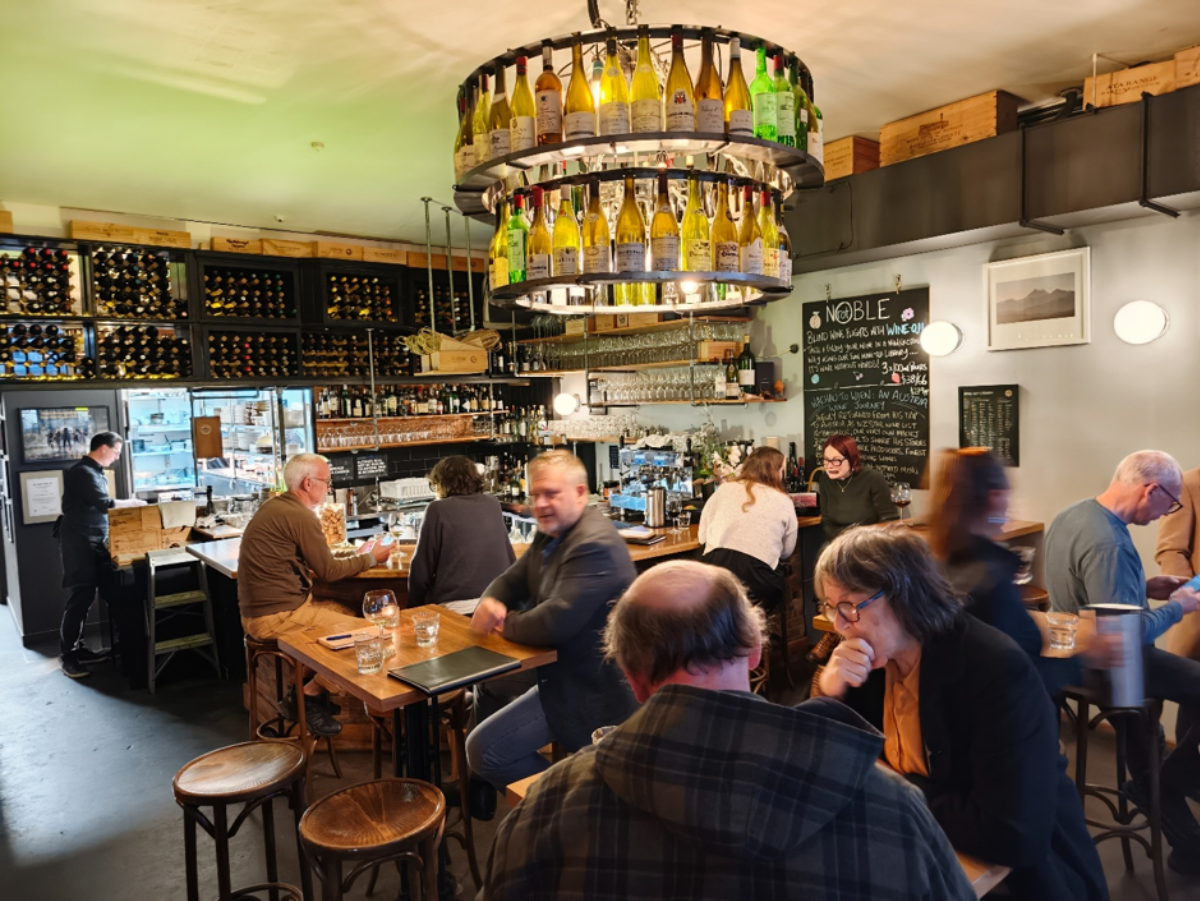
Ten years after opening its doors on 1 June 2016, Noble Rot Wine Bar stands as one of Wellington’s most influential hospitality institutions — a place where deep wine knowledge, technical excellence, and genuine hospitality have shaped a decade of loyal community and national recognition. The origins of Noble Rot are famously humble: two friends, Josh Pointon and Maciej Zimny, met in 2012 while studying for the WSET Diploma, forming a Monday tasting group that still runs today. Their shared obsession with wine — sharpened through study, structured tastings, and a promise made over a bottle of Barolo — eventually led them to the perfect site at 6 Swan Lane, where Noble Rot opened after months of planning, renovation, and sheer determination.
From the beginning, the concept was clear: Wellington needed a true wine bar — a place that championed wine without pretension, offered depth and discovery, and created a home for both seasoned enthusiasts and curious newcomers. The founders built a venue that combined an 800‑plus bottle wine list, with between 80 and 100 available at any time by the glass; temperature‑controlled storage and service, and a food programme capable of matching wine with both small plates and full restaurant dining. Their vision quickly resonated. Within its first few years, Noble Rot earned multiple Cuisine Magazine awards for Best Wine Experience in New Zealand (2017–2019) and Chef’s Hats across several years, cementing its reputation as one of the country’s leading wine destinations.
A decade on, Noble Rot has evolved — not by abandoning its founding principles, but by expanding them into a broader, more resilient ecosystem. Josh Pointon, one of the original founders, has since stepped away from the business, while Jessica Wood, originally Restaurant Manager and Sommelier, now leads the venue as General Manager, bringing continuity, deep institutional knowledge, and a steady hand to the guest experience.
The pandemic years forced many hospitality businesses into survival mode, but Noble Rot responded with creativity and long‑term thinking. Noble Wines, a sommelier curated fine wine consultation and supply service was already established and uniquely positioned to navigate the challenges of lockdown and blossom into what is now a permanent and thriving arm of the enterprise. More recently, Maciej acquired the iconic Truffle Imports, folding it into the group and strengthening the retail and distribution side of the business. Alongside these sits The Wine Safe, a specialist wine‑storage service that complements the wider operation by ensuring cellaring excellence beyond the walls of the bar itself. Together, these elements form a fully integrated Total Wine Experience — a connected ecosystem spanning on‑premise hospitality, retail, education, storage, and curated wine distribution.
Despite this growth, the heart of Noble Rot remains unchanged. The bar continues to champion small producers, both from New Zealand and around the world; continues to offer one of the country’s most extensive and carefully curated wine lists; and continues to serve wines from rigorously temperature‑controlled storage — a detail that has always set it apart. The original ethos — precision, generosity, and a commitment to sharing great wine without pretension — still defines the guest experience today.
For me, that constancy is part of what has made Noble Rot such a touchstone over the years — and it’s where my own story with the bar begins.
My personal engagement

Tasting at Noble Rot during my research.
My own connection with Noble Rot began not long after returning to New Zealand in 2015, following a decade living in Asia. I was then based in Wellington, and sometime the following year I started hearing increasingly enthusiastic mentions of a new wine bar tucked away in Swan Lane — a small side street just off Cuba Street, with all the bohemian energy, cafés, vintage shops, and creative bustle that define that iconic Wellington strip. One sunny spring Saturday, hosting a visitor from Australia, I decided to see what all the excitement was about. We sat outside in the warmth, poring over the astonishingly extensive wine list before ordering glasses of Alsatian Grand Cru Gewürztraminer — something I had never imagined being able to enjoy in New Zealand by the glass. It was also my first encounter with the Coravin, an experience that ultimately led me to buy one the following year in France at La Cité du Vin. I wasn’t yet in the habit of keeping tasting notes, but I will never forget the exhilaration of that afternoon.
In 2017 my wife and I moved to Martinborough, and while that meant our visits were no longer as frequent as they might have been had we stayed in Wellington, Noble Rot remained a touchstone. We celebrated her birthday there that same year, returned for a memorable Christmas Eve dinner with our friend Graeme, and enjoyed more than one Magnum Wine Club gathering within its warmly lit walls. It was also where I completed my WSET Level 3 Certificate. Since then, my international travel has become increasingly wine‑focused, taking me to notable wine bars around the world — yet Noble Rot remains equal to the best of them, and head and shoulders above most. [See here for my earlier musings about what makes a great wine bar.].
And so, it was with genuine anticipation that I sat down with Maciej and Jess last week to talk about Noble Rot today, and to learn more about them as people and consummate wine professionals.
Noble Rot – Principles and People
When we sat down together, I began by asking Maciej to talk about the philosophy that has guided Noble Rot from the beginning — the same philosophy that still underpins the experience today. Much of this is already familiar to regulars: the commitment to precision, the insistence on temperature‑controlled storage and service, the championing of small producers, and the belief that wine should be both deeply serious and joyfully accessible. But hearing Maciej articulate it again, ten years on, underscored how central that ethos remains to everything they do. He later shared more about his own background, which I will come to shortly, but it was clear from the outset that the intellectual and sensory rigour of Noble Rot is not an accident; it is the product of a very deliberate, very sustained way of thinking about wine.
Maciej Zimny – Foundations, Influences, and the Making of a Hospitality Leader
Before our conversation turned to Jess and her own path, I wanted to spend time with Maciej’s story — not only because he is the remaining founder still at the helm, but because understanding his background helps explain the remarkable consistency and longevity of Noble Rot itself. What emerged was a portrait of someone whose approach to wine and hospitality is shaped by equal parts warmth, discipline, and long‑view thinking.
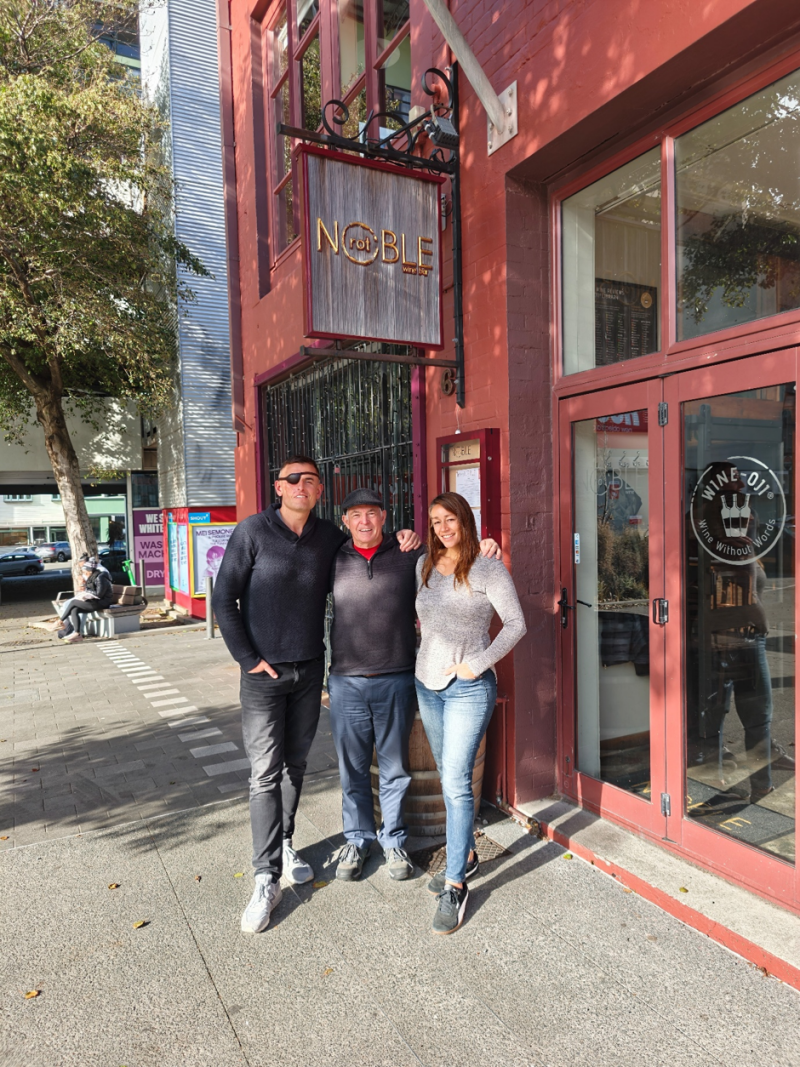
With Maciej and Jess outside the Noble Rot entrance in Swan Lane
Maciej’s journey began far from the world of grand cellars and fine wine lists. Growing up in Poland, he entered hospitality at just fourteen, working in a local restaurant and initially imagining a future as a chef. But it quickly became clear that his natural disposition — open, welcoming, instinctively attuned to people — made him far better suited to the front of house. It was while waiting tables that he first encountered wine as part of the dining experience. These were simple wines, a far cry from the bottles he now works with, but they sparked a curiosity that has never left him. Even then, his interest was not in wine as an isolated object of study, but in wine as part of a social moment — something that connects people, elevates a meal, and shapes the rhythm of hospitality.
That early spark led him to pursue a five‑year Master’s degree in Hospitality and Management in Poland, grounding him in the technical, operational, and human dimensions of the industry. From there he sought out countries with deeper wine cultures — Germany, Italy, and later Australia — absorbing not only the wines themselves but the service philosophies that surrounded them. By the time he arrived in Wellington in 2012, he had already accumulated a decade of experience across multiple countries and styles of hospitality, and he carried with him a clear sense of what great service required: knowledge, yes, but also motivation, engagement, and a genuine interest in people.
Education has always been central to his development. His “trilogy” of qualifications — the WSET Level 4 Diploma, Court of Master Sommeliers certification, and his Master’s — reflects a commitment to rigour that sits beneath the relaxed, generous manner guests encounter on the floor. He is quick to credit key influences, particularly Jancis Robinson and Jamie Goode, whose writing shaped his understanding of wine as something to be made accessible without losing intellectual depth. That balance — precision without pretension — is now woven into the DNA of Noble Rot.
Equally important has been his twenty years of observing, learning, and refining. Maciej speaks often about watching industry leaders and top sommeliers, not only for their technical proficiency but for the subtler qualities that create memorable guest experiences: the warmth of a greeting, the timing of a recommendation, the ability to read a table, the discipline behind seemingly effortless service. Listening to him, I began to understand more clearly why Noble Rot has not only survived but thrived for a decade in an industry where many venues struggle to make it to their second year. It is the combination of an outgoing, people‑centred personality with a systematic, almost forensic attention to detail — all directed toward one purpose: delivering an exceptional guest experience.
Toward the end of our conversation, I asked him a question that often reveals something deeper about a person’s relationship with wine: if it were time for his last glass, what would he choose? His answer was telling. The wine itself, he said, would matter far less than the company — that the moment be shared with people around him. But if the company were assured and cost no object, he would choose a bottle of 1990 Domaine Dujac Morey‑St‑Denis. It was a response that captured the essence of his philosophy: wine is at its best when it brings people together, and the technical and sensory beauty of a great bottle is ultimately in service of that shared experience.
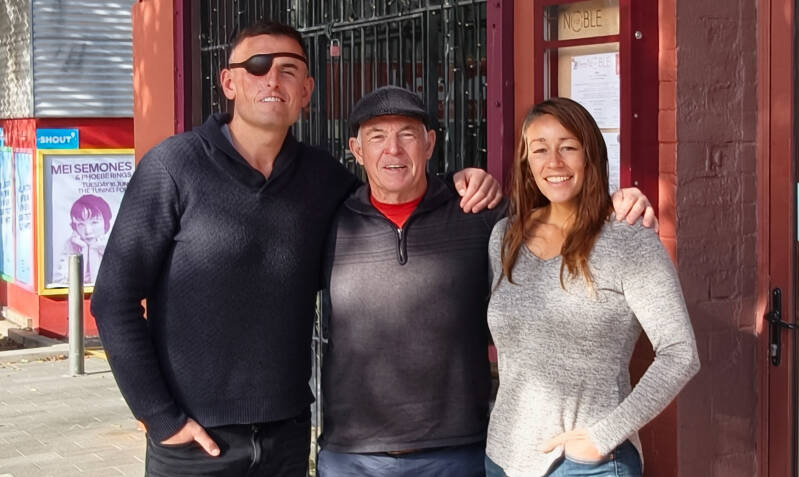
The author with Maciej and Jess at the entrance to Noble Rot
Jessica Wood – Formation, Philosophy and the Making of a Sommelier
From there, our conversation turned to Jess and her own path into the world of wine. Jess’s path into wine reflects both intellectual curiosity and a profoundly human approach to hospitality. Originally from the UK, she grew up in hospitality — her mother was a chef — and the industry was woven into her life from an early age. It wasn’t until she moved to Australia, with its famously open wine culture, that her focus shifted decisively toward wine. That interest deepened further when she relocated to New Zealand and began working on the Wellington waterfront, eventually completing WSET Levels 2 and 3 in 2018. She joined Noble Rot in January 2019, the same year she earned Court of Master Sommeliers certification and commenced study for the WSET Diploma, which she completed in 2021 after Covid delays. Her progression from Restaurant Manager and Sommelier to General Manager reflects not only technical expertise but also the calm, assured leadership style that now anchors the front‑of‑house experience.
Her influences reveal the depth of her philosophy. In 2022, representing New Zealand at the ASI Sommelier Bootcamp in Kuala Lumpur, she met Marc Almert, the 2019 ASI World’s Best Sommelier. What struck her was not his title but his humility — “staying humble, sharing knowledge, contributing to the ecosystem of fine wine and hospitality on a global level.”
Her second influence is Gaston Hochar, founder of Lebanon’s Château Musar. Jess admires Musar not only for its unique wines but for its unapologetically individual vision. For her, Musar embodies the power of story in wine: “Our role is to take guests on a journey that’s unforgettable and thought‑provoking, in an approachable, enjoyable way.”
Her third influence is the one closest to home: Maciej. She calls him her greatest mentor and partner in wine — guiding her through WSET and CMS studies, encouraging her career, and sharing values in hospitality. Today, their partnership extends across Noble Rot, Truffle Imports, and The Wine Safe, which they own and operate together.
Education has shaped Jess in other ways too. Completing the WSET Diploma sharpened her instinct to ask why a wine tastes the way it does — tracing its character through geology, geography, history, politics, viticulture, winemaking, sociology, and marketing. Yet she is equally clear that books alone are not enough. “Winemakers, especially in New Zealand, are enormously generous with their time,” she says. Vineyard visits and barrel tastings have given her irreplaceable knowledge: “You create a different connection with wine when your head is not in the books.”
When asked what she would choose for her last glass, Jess’s answer was pure joy: if money were no object, 1989 Giacomo Conterno Barolo Riserva Monfortino with good company. But if it were the last day on earth, “the final wine on that day would surely be the best, whatever it is.”
PIWIs, Climate Change, and Market Reality
As our conversation move on to wine business challenges we touched on the rise of PIWI varieties — disease‑resistant grapes that have gained significant traction in Europe as growers respond to climate change, shifting disease pressures, and the desire to reduce chemical inputs. It is a subject I have written about elsewhere, and one that is increasingly relevant as wine regions push beyond the traditional 20–50° latitude band.
Maciej’s perspective was both pragmatic and open‑minded. In a few weeks, Noble Rot will receive a shipment of Polish wines, including one made from Solaris, a PIWI variety that has proven remarkably successful in Poland and across parts of Northern Europe. He is curious to see how New Zealand customers respond.
He has tasted a number of PIWI wines over the years and believes that, when matched to the right climate and growing conditions, they can produce excellent results — particularly in regions outside the classic fine‑wine latitudes. From a viticultural standpoint, there is much to admire: disease resistance, reliable ripening, and the potential for dramatically reduced spray regimes.
But as he noted, the key question is not always can they make great wine, but can you sell it.
PIWIs face a formidable challenge: centuries of familiarity and consumer recognition attached to varieties like Chardonnay, Riesling, Pinot Noir, and Cabernet Sauvignon. Maciej does not consider PIWIs “second‑tier” grapes — far from it — but he is realistic about the time it will take for them to achieve comparable market acceptance. The quality is increasingly there; the barrier now is education, storytelling, and consumer confidence.
The upcoming Solaris release will be a useful test case, and Maciej is keen to revisit the conversation once customers have had the chance to taste it.

Noble Rot’s familiar entrance and one of its defining interior touches.
The Challenges of the Present Moment
Our conversation also turned to the challenges facing Noble Rot today, many of which reflect the broader pressures on Wellington itself. The city is in the grip of a sustained and unusually deep recession, driven in large part by layoffs and job insecurity in the public sector — a cornerstone of local employment. Further cuts have already been signalled by the current National‑led coalition, and the uncertainty has rippled through the city’s economy. Wellington has also experienced the steepest decline in residential property values in the country, eroding the sense of financial buoyancy that rising house prices once provided, even for those still in steady work. Rising food costs have flowed directly into restaurant pricing, and a number of hospitality businesses have closed under the strain.
Jess was pragmatic but upbeat about the cyclical nature of this economic storm. Both she and Maciej emphasised that their focus remains firmly on maintaining standards — the quality of the cellar, the precision of service, the integrity of the food programme — even when the trading environment is difficult. For them, consistency is not just a value; it is a strategy.
We also discussed the broader cultural shift in drinking patterns among younger generations. Hardly a day passes without another gloomy headline about declining alcohol consumption, but Maciej and Jess shared my view that the story is more nuanced. While younger people may be drinking less in volume, they are drinking better. Quality matters more than quantity, and with that comes a heightened interest in the experience of wine — not just what is in the glass, but the story behind it, the connection to place, and the sense of discovery that accompanies it. This aligns perfectly with Noble Rot’s ethos: wine as a conversation, an education, and a shared moment of insight.
The Challenge of Valuing Professional Service
Another challenge we discussed was one that extends well beyond Noble Rot: the persistent reluctance among many New Zealanders to pay for high‑quality service. It is a cultural pattern that has long shaped the hospitality landscape here. Unlike in parts of Europe or North America, where service is recognised as a skilled profession and priced accordingly, New Zealand has historically undervalued the craft of hospitality. The result is a structural tension: diners expect excellence but are often unwilling to pay the true cost of the labour, training, and expertise required to deliver it.
This dynamic contributes to a cycle that is difficult for many venues to break. Lower pay and limited career pathways lead to high staff turnover; high turnover discourages investment in training; and inconsistent training leads to inconsistent service — which in turn reinforces the perception that service is not something worth paying for. It is a loop that drags down the reputation of the industry.
Noble Rot is a striking exception. Both Maciej and Jess spoke about the importance of treating hospitality as a genuine profession — one that demands knowledge, discipline, and ongoing development. Jess’s own career is a testament to what is possible when a venue commits to nurturing talent: from her early days in hospitality in the UK and Australia, through WSET Levels 2 and 3, Court of Master Sommeliers certification, and ultimately the WSET Diploma, she has built a level of expertise that is rare in New Zealand dining rooms. That depth of training is not incidental; it is part of the culture of Noble Rot, and a key reason the venue has maintained such a consistently high standard of service over the past decade.
In a national context where professional hospitality careers are still fighting for recognition, Noble Rot demonstrates what can be achieved when service is valued, invested in, and taken seriously.
Unmatched Range, Uncompromising Selection
On a follow-up visit, a colleague and I each tasted two wines from the current by‑the‑glass selection — one from the regular list and one from the Coravin programme. These brief notes both capture a moment in the glass on that occasion and a taste not only of the wines but of the Noble Rot ethos.

From the regular by the glass selection:
Vini Contrada Fiano di Avellino DOCG 2023
From the Campania region of Southern Italy grown on sandy soils.
Light lemon-straw in the glass with an initially shy nose of jasmine, citrus zest and herbs but with slight warming and aeration released additional stone fruit notes. The palate is fresh and zingy and clean with a mineral structure and a lick of lemon balm on the finish.
Chateau de la Font du Loup Cote du Rhone Signature 2021
A step up from a lot of rather ordinary Cote du Rhone GSM blends. Ruby in the glass with plush red fruit, some black pepper spice and a hint of leather and herbs on the nose. The palate is medium-full bodied with a plush entry of ripe red and black fruits, firm but supple tannins, some cocoa and old leather and a satisfying finish with adequate freshness .
From the Coravin by the glass selection:
Stephane Robert Domane Du Tunnel St Peray Roussanne 2018.
Roussanne is a challenging grape to grow but this is a rousing example of the rewards it offers. Bright lemon in the glass with rich aromas of peach, mandarin flowers, subtle herbs and honey. The palate is lushly round, generous and ripe with a slight oiliness yet underpinned by minerality and freshness that gives perfect balance and a surprisingly fresh finish.
Bodegas y Vinedos Artuke Finca de los Locos Rioja 2021
Mostly Tempranillo with some Graciano and a tiny amount of Viura from Rioja Alavesa. Deep ruby purple in the glass with ripe dark fruit aromas, a touch of brown spice, and a hint of herbs. The medium-full bodied palate is juicy with ripe berry fruit, and fine supple tannins without the dusty element so common in Rioja and a lovely minerality on the spine that gives a lift to the fruity finish.
Looking Ahead – Continuity, Culture, and the Next Decade
As our conversation drew to a close, I found myself reflecting on what Noble Rot has come to represent — not only for Wellington, but for New Zealand’s wine culture more broadly. Although I moved to Martinborough at the end of 2016 and my visits since then have been more occasional than regular, each one has carried a certain weight. Noble Rot has always been a place where knowledge and generosity meet; where wine is treated with both seriousness and joy; where the technical and the human are held in equal balance. Even from a distance, it has remained a touchstone — a venue that has shaped my own journey in wine and one I continue to measure others against.
Looking ahead, it is clear that Noble Rot’s next decade will unfold in a very different environment from the one in which it was founded. Economic pressures, shifting drinking patterns, and the ongoing challenge of valuing professional service will continue to test the resilience of hospitality across the country. Yet speaking with Maciej and Jess, I was struck by how deeply their commitment to standards — to precision, to education, to the craft of service — remains intact. In an industry often defined by short cycles and constant reinvention, their long‑view approach feels almost radical.
Noble Rot has already expanded beyond its original footprint, evolving into a connected ecosystem that spans hospitality, retail, education, and storage. But its cultural role may be even more significant. At a time when New Zealand’s wine conversation is becoming broader, more curious, and more globally engaged, Noble Rot stands as a benchmark — a place where international perspectives meet local producers, where emerging trends are explored with rigour, and where the next generation of wine professionals can see what excellence looks like up close.
For all its evolution, the essence of Noble Rot remains unchanged: a belief that wine is ultimately about people, and that the best experiences are those shared around a table. It is a philosophy that has carried the venue through its first ten years, and one that will, I am confident, continue to guide it through the next. Even now, when I step through the door after weeks or months away, I feel the same sense of anticipation I did on my first visit — the sense that this is a place where something meaningful is always unfolding, one glass at a time.
About the Author
John Penney is a wine writer and educator based in Martinborough. He runs wineinsights, offering articles, tours, education and events focused on New Zealand and global wine culture. Read more at wineinsights.
Add comment
Comments