A tribute to Martinborough wine pioneer Clive Paton

On Sunday 16 August 2026, (just yesterday when I first began writing), I had the privilege of leading a landmark vertical tasting of Ata Rangi Célèbre, featuring an extraordinary lineup of 13 wines spanning from 1994 to 2024. This rare retrospective offered a profound look at one of New Zealand’s most distinctive red blends—a wine that has quietly cultivated a fiercely dedicated following. Historically, Célèbre has lived somewhat in the shadow of its legendary sibling, the internationally acclaimed Ata Rangi Pinot Noir, which remains a benchmark for the Martinborough region (see my article Three Decades of Ata Rangi Pinot Noir). Yet, as this tasting triumphantly demonstrated, Célèbre is a powerhouse of complexity and character in its own right, uniquely reflecting both the evolution of the estate and the brilliant longevity of Wairarapa’s late-ripening varieties.
My personal journey with this wine goes back to its very inception. The inaugural 1986 vintage was an unconventional blend of Merlot, accented with smaller portions of Syrah, Malbec, and a rare French-American hybrid locally dubbed 'Super Siebel'. I was fortunate enough to taste that maiden vintage in 1988—though it happened entirely by accident rather than design. In Te Reo Māori, Ata Rangi translates as “new dawn” and that roadside stall experience was a personal new dawn for me, awakening anticipation and appreciation for the profound viticultural treasures Martinborough would begin to reveal in the coming years.
At the time, I was living in Auckland, navigating my final year in New Zealand before making the move "across the ditch" to resettle in Sydney. During a brief visit to my parents in Masterton, with a free afternoon I took a spontaneous drive down the region's rural back roads. My route brought me into Martinborough, across Ponatahi Bridge and directly into Princess Street. Throughout the 1970s, having lived first in Masterton and then in Wellington, I had always thought of Martinborough as little more than a sleepy, uninteresting country outpost. I was completely oblivious to the viticultural revolution taking root in its stony soils since 1980.
It was thus with genuine surprise that I came to the vineyard established by pioneer Stan Chifney on the corner of Princess Street and Huangarua Road. Intrigued, I turned left, pulled into Chifney Wines, and shared a glass of Chenin Blanc with Stan himself. Continuing further down where Huangarua Road veers slightly at the Cambridge Road intersection to become Puruatanga Road, I noticed a rustic, roadside cellar door stall on the right-hand side. This was the humble birthplace of Ata Rangi, where I first met founder Clive Paton. Standing at that simple stall, he poured me a taste of that first 1986 Célèbre.
The wine was so captivating that I bought a case on the spot. Gifted with that case was an Ata Rangi branded Ah-So, which has rescued me from many difficult corks in subsequent years. A week later, I took a bottle of that Célèbre to a dinner in Remuera with an American financial markets expert. He was so impressed by its depth, structure and savoury fruit that he immediately tasked me with securing a case for him as well.
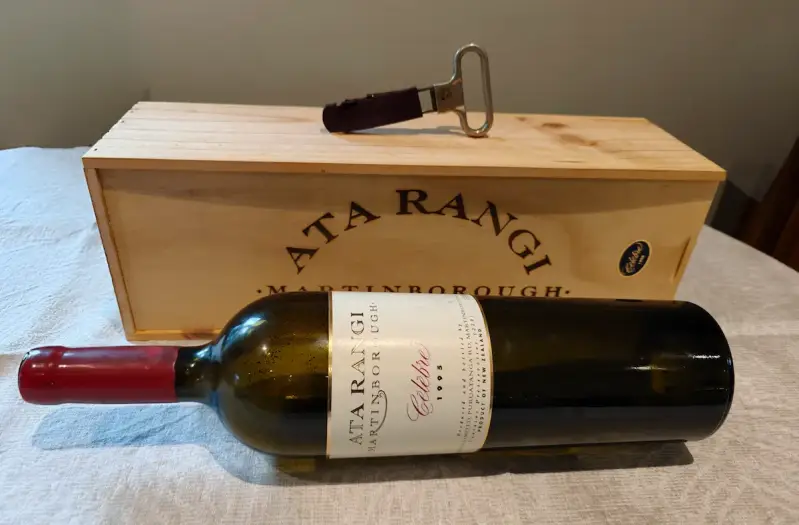
Artifacts of a Célèbre Affair: The Ata Rangi Ah-So gifted to me in 1988 along with the now empty 1995 Magnum bottle brought by Clive to the tasting and the wooden case for the 1998 Magnum.
Preparing the background research for this 30-year retrospective unearthed some fascinating insights that challenge common assumptions about this distinctive Bordeaux-meets-Rhône blend. Early wine commentators frequently failed to note the minor proportions of Cabernet Franc included in the blend, simply listing the entire Cabernets component as Cabernet Sauvignon. In truth, Cabernet Franc was almost always a minor partner in the wine. Furthermore, the records show that the Merlot component usually included some Malbec. Most intriguing of all is the historical persistence of the Siebel grape. Planted in the estate's infancy, a tiny proportion of this heritage hybrid has continuously survived alongside the Syrah, remaining a secret, unbroken thread woven into the fabric of Célèbre right through to the modern 2024 vintage.
The Long-Awaited Reunion: Provenance and Preparation
My Célèbre affair was subsequently interrupted by a twelve-year sojourn in Sydney. It was briefly rekindled in the early 2000s when I returned to New Zealand to work for Fonterra, only to be paused again by another ten years of working in Asia. Since my permanent return in 2015, however, the passion has resumed with a vengeance; I have purchased and cellared every vintage from 2014 onwards. I conceived the idea of this unique vertical tasting partly to celebrate my personal devotion to the wine, and partly as a tribute to Ata Rangi founder Clive Paton, for whom Célèbre has always held a special place. Over the course of fifteen months, I managed to acquire at auction regular bottles of the 1994, 1996, and 2006 vintages, alongside a magnum of the 1998. Ata Rangi generously supplied a bottle of the 2013, and Clive personally delivered a magnum of the 1995—an unexpectedly magnificent addition to our original lineup.
We were privileged to have Clive and head winemaker Helen Masters as our honoured guests and active participants. During the afternoon, Clive shared an amusing anecdote about how the wine received its name: “I grabbed a French dictionary, scanning the words, and this one stood out—so that became the name of the wine.”

The author with founder Clive Paton and head winemaker Helen Masters as the tasting begins
Assessing the storage history and closures of a 30-year span of New Zealand red wine always brings a degree of suspense. All of the wines from 2013 onwards had been perfectly stored in temperature-controlled cellars and were bottled under screw cap. The provenance of the 2006, also under screw cap and purchased at auction, was described as “excellent, stored in a temperature-controlled cellar.” The 1998 magnum, sealed under cork, originated from the auction of MW wine critic Bob Campbell’s personal cellar. Thus far, I had no major concerns about wine quality.
The 1994 and 1996 bottles, however, were both under cork and acquired at auction with provenance described as “good, stored in a dark, cool, passive cellar”—which, in my experience, is often a classic euphemism for “buyer beware.” Upon arrival, the 1998 and 1996 magnums and bottles appeared to be in good physical condition. The capsule of the 1994, by contrast, was heavily oxidised, and the bottle showed noticeable ullage.
The Opening Strategy: Pre-emptive Caution
To ensure every vintage showed its absolute best, I implemented a strict opening and testing strategy:
- The Modern Era (2013–2024): These screw-capped wines were opened roughly four hours prior to the tasting. I poured a 30ml sample from each for quality control; as expected, all were in pristine condition. The bottles were left standing open, with that small headspace allowing room for gentle aeration to coax out the wine's signature spice.
- The Transition (2006): At twenty years of age, this wine could potentially have been fragile. I unsealed the screw cap, removed a 30ml testing sample, and immediately replaced the cap until tasting time. It proved to be in magnificent condition.
- The Old Guard (1994, 1996, 1998): As insurance against fragility, I resolved not to pull the corks until shortly before the tasting, choosing instead to test them beforehand using a Coravin.
The 1998 and 1996 Coravin samples both proved completely sound. However, the 1994 gave rise to some alarm. The moment argon gas was injected, the pressure forced wine out from the sides of the cork and partially lifted it out of the neck. I quickly extracted the loose cork using a Durand, poured a rapid sample, and sealed the bottle with a temporary rubber stopper. The sample revealed a deep garnet hue with no excess browning. While the wine seemed a little diminished, it had by no means fallen over, so I elected to retain it for the flight.
Just before pouring, both the 1994 and 1996 were carefully decanted off their sediment into clean bottles. The 1998 magnum was uncorked at the same time but left in the bottle, while the 1995 magnum brought by Clive was opened just fifteen minutes before the tasting commenced.
General Observations About the Tasting
Despite living in the shadow of Pinot Noir, Célèbre is quintessentially a Martinborough wine and the variations in blend are reflections of “what the vintage gives” rather than from any desire for a standardised wine product. The heavier extractions with more assertive punch downs often associated with “Bordeaux blends” are eschewed in favour of freshness, aromatics, and approachability: nonetheless these are wines with widely recognised - though also underestimated - ageability: something this vertical would powerfully demonstrate.
Within those vintage and associated assemblage variations a consistent style emerged: structure with finesse, ripe but savoury fruit, appealingly floral aromatics with a distinct edge of spice and dried herbs. The experience and expertise of tasting participants including the sommelier team from renowned Wellington Wine Bar, Noble Rot and long-time members of the Magnum Society brought singular affirmation of the quality of the lineup, but no consensus favourites.
I also want to acknowledge with much appreciation the kindness of David and Sonia Wansbrough in holding this event in their home and providing a delicious and judiciously matched lunch to accompany the tasting.
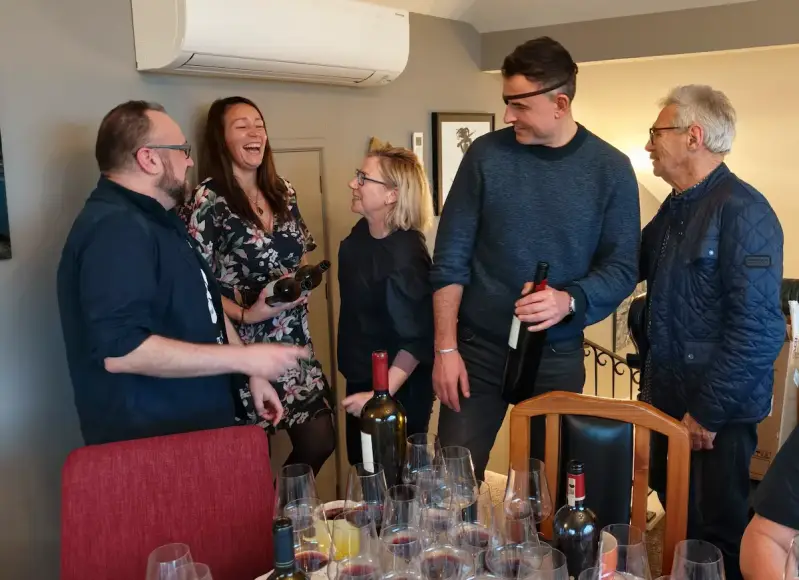
A candid shot of the Noble Rot team Marek (2026 Best NZ Sommelier), Jess and Maciej enjoying a light-hearted moment with Helen and Clive.
The following tasting notes are in the main my personal observations. I make no pretence to be a wine critic and have simply attempted to describe the wines rather than score them, but I confidently recommend every one of the wines under screwcap, and all of the older wines subject to good provenance. Technical information has been provided from the Ata Rangi website or archives, vintage information from a variety of sources. Wines were poured and tasted in order from oldest to youngest.
-
1994 Cabernet Sauvignon 60%, Merlot (+Malbec) 25%, Syrah 15%
Alc 13.5%
Dry late summer across Eastern NZ with a gentle dry autumn. Merlot was fully ripe without jamminess, Syrah was classical Nth Rhone in style with the signature white pepper edge and the Cabernet Sauvignon was finally harvested without harsh pyrazines but a distinct acid spine.
Vineyard Sources: Ata Rangi, Di Mattina, Champ Ali, and Fraser (Syrah)
Despite sub-optimal cellaring and a dried out cork the wine presented in the glass with a garnet hue and little overt browning. Fragrant potpourri and lavender aromas were followed by a palate of fading baked berry fruit, soft tannins, gentle acidity and sweet savoury herbs. One can only imagine how stunning a bottle with better provenance might have been, but this was in no way disappointing despite the dodgy cork.
-
1995 Cabernet Sauvignon 55%, Merlot (+ Malbec) 30%, Syrah 15%
Alc. 13%
A difficult early season with unsettled spring and early summer weather was rescued by a an unusually dry, warm and long autumn, allowing all of the thicker-skinned varieties to achieved full phenolic ripeness.
Vineyard sources: Ata Rangi, Di Mattina, Champ Ali, and Fraser (Syrah)
A structural masterclass demonstrated with astonishing youthfulness due to the larger format bottling and cork integrity. Ruby-garnet in the glass with aromas of cassis, dried plum, savoury herbs and a hint of pepper spice. The palate was lively with nicely resolved and integrated tannins, balanced acidity and an attractive dark berry fruit profile edged with wet leaves and dried herbs that lingered. (Magnum under cork)
-
1996 Cabernet Sauvignon 45%, Merlot (+ Malbec) 40%, Syrah 12%, Cabernet Franc 3%
Alc 14%
Warm summer conditions, drier than the norm were followed by a long, warm, but not hot, settled autumn. Merlot displayed pretty and elegant red fruit with some crunchiness, Syrah was floral and peppery, and the Cabernet Sauvignon retained a cool classical profile, barely managing to shed its green herbaceous markers. The resulting wine was built on structural finesse and I had high hopes.
Vineyard Sources: Ata Rangi, Di Mattina, Champ Ali, and Fraser (Syrah)
Light ruby garnet in the glass, appearing more evolved than the 95 in Magnum. Aromas of smoky berries, tobacco leaf, and a hint of pencil lead were coaxed from the glass. On the palate a beautifully poised structure of fine gently drying tannins and gentle acidity framed savoury red and black fruits, dried tea and good persistence. My personal favourite from the 90s.
-
1998 Merlot (Incl. Malbec) 40%, Syrah18%, Cabernet Sauvignon 38%, Cabernet Franc 4%
Alc 14%
One of the most severe El Nino droughts in NZ East Coast history led to a long hot dry summer which produced concentrated fruit with significant depth and prominent structure, especially allowing full ripeness of the Cabernet Sauvignon. April was warm and bone dry, and spiralling sugar levels was the main challenge. Merlot had a decadently sweet core of baked plum, Syrah shed its characteristic Martinborough white pepper for blackberry coulis and cracked black pepper, and the Cabernet Sauvignon achieved perfect ripeness with ripe cassis, black cherry and heavy firm and drying tannins begging for age.
Vineyard Sources: Ata Rangi, Di Mattina, Champ Ali, Arapoff (Syrah) and Fraser (Syrah)
Deep ruby garnet in the glass, the darkest of the wines from the 90s. Aromas of cassis, dried blackberry, pot pourri and leather. The initially blocky tannins are now fully resolved and integrated, there is a breadth of ripe berry and dried plum fruit with a distinct note of mocha or cocoa and an earthy warmth, the finish is long and savoury with mocha and dried herb persistence. For me this was the most Bordeaux-like in the lineup. (Magnum, under cork)
-
2006 Merlot (+Malbec) 50%, Syrah 30%, Cabernet Sauvignon & Cabernet Franc 20%
Alc 13.5%
Below average rainfall in a moderately cool summer was followed by a cool damp April. Merlot was more floral and red-fruited rather than fleshy, Syrah was more savoury with a whack of white pepper and the Cabernet Sauvignon struggled to strip its green notes, ending with a crunchy blackcurrant leaf character, chalky tannins and a marked acidic spine. This wine started life rather tightly wound and edging to austerity, but I’ve found with aging, previous examples have softened to reveal lovely tertiary complexity.
Vineyard sources: Ata Rangi, Di Mattina, Craighall (Merlot), Kahu (Cab) and Champ Ali (Cab Franc and Syrah), Boundary Road (Syrah) and Claddagh (Merlot and Cabernet). Hawkes Bay – Lucknow Estate (Syrah)
Bright ruby garnet in the glass with a garnet rim. The nose is gently aromatic with a faint whiff of cherry giving way to savoury dried herbs, tobacco, leather and cardamon. The relatively light-bodied palate shows beautiful integration and the wine in the mouth feels seamless with a gentle melange of sour cherry, dried plum, savoury herbs and a lick of balsamic on the satisfying finish.
-
2013 Merlot 55% (incl. Malbec), Syrah 35%, Cabernet Sauvignon 10%
Alc 13%
While 2013 had high Growing Degree Days (GDD), Martinborough's characteristic cold, crisp nights and April cooling slowed sugar accumulation down significantly. This allowed the fruit to achieve complete phenolic and tannin ripeness without high sugar accumulation. April was crisp cool and clear. Merlot was plush and ripe, Syrah had a harmony of fruit and spice but a distinct white pepper hit, and the Cabernet Sauvignon achieved classic cassis ripeness. No Cabernet Franc this year.
17 months aging in 20% new French oak barrels
Deep ruby-red edging garnet with aromas of dried rose, plum compote, spice and forest floor. The palate is structured with good freshness underpinning with sweet dark plum, currant, leather and spice flavours leading to a long savoury finish.
-
2014 Merlot (+Malbec) 55%, Syrah 35%, Cabernet Sauvignon 5% and Cabernet Franc 5%
Alc 13%
25 days on skins and 17 months aging in French oak 20% new
These varieties had to weather mid-April rains and while the Merlot was fleshy and round, the Syrah was decidedly cool climate styled with plenty of white pepper. The Cabernet Franc managed decent ripeness by the onset of the rains but the Cabernet Sauvignon had to hang through the wet period and struggled to achieve full ripeness.
Slightly darker in the glass than the 2013 with aromas of cassis, mocha, brown spice and a touch of pepper. The palate is bright with fine silky tannins underpinning plummy fruit, and there is a slightly gamey note with more prominent pepper heading into the finish.
-
2015 Merlot 48%, Syrah 30%, Cabernet Sauvignon 12%, Cabernet Franc 4%, and Malbec 6%.
Alc 13.5%
Aged 12 months in 22% new oak then a further 12 months in neutral oak
A very dry growing season with dry March and early April, but heavy rain fell from mid-April. The challenging spring limited crop size so this was an advantage to ripening before the rain. The Merlot was plump with a fleshy core of plum fruit, the Syrah edged from white to black pepper and the Cabernet just made it into the classic cassis and dried herbs rather than green stalkiness.
Bright ruby in the glass with a softly perfumed nose of dianthus, dark berries and a hint of star anise. The palate is soft round and mouth filling with silky tannins and lovely freshness gently framing plush dark fruit, cinnamon spice, milk chocolate and savoury herbs, complex, harmonious and long. This, for me, was a standout!
-
2018 Merlot 47%, Syrah 41%, Cabernet Franc 6%, Malbec 6%
Alc 13.5% TA 5.2 pH 3.63
2018 was a warm vintage, ideal for the later ripening varietals. The Merlot and Malbec portions from vines planted in 1984 and 1986 were the stars of this vintage with the slightly warmer nights delivering depth of flavour and fully ripe tannins. This was the first year without Cabernet Sauvignon.
The Merlot, Malbec and Cabernet Franc were co-fermented with a pre-ferment maceration for around 4-6 days until Indigenous yeasts did their magic over a 10-day period. The fermenters were then closed up and the wine was left to slowly macerate with the skins for a further 10 days. The earlier ripening Syrah was fermented separately with a shorter fermentation period to keep it bright and floral. Aged in French oak for 22 months prior to bottling to soften the tannins and allow the wine to slowly open and evolve.
Ruby in the glass with a pronounced ripe berry dominated nose, a touch of savoury dried herbs, dark olives and a whiff of cracked pepper spice. The palate is structured with ripe tannins balanced with a fresh acidity that lifts the ripe fruit. There is a brambly and mineral edge to the fruit that persists on the long iron-edged finish.
-
2019 Merlot 45%, Syrah 40%, Cabernet Franc 5%, Malbec 10%
Alc 13.5% TA 5.9 pH 3.58
This was a season of two halves with spring cold snaps and rainy periods interrupting flowering and contributing to poor fruit set and smaller berries. The same rainfall however set the soil moisture levels up for a perfect long dry summer and autumn. April concluded with an extended warm dry spell balanced by cool nights allowing picking decisions to be optimised for flavour and phenolic ripeness.
The Merlot and Malbec were fermented together, with a pre-ferment maceration of around 4-6 days until indigenous yeasts completed the fermentation over ten to twelve days, followed by a further ten-day maceration on skins. The Syrah was fermented separately with a shorter fermentation period to keep it bright and floral. Pristine Cabernet Franc was whole bunch fermented and adds an exotic high note to the blend. Aged in French oak for 22 months prior to bottling.
Bright ruby. A whiff of violets precedes an aromatic explosion of berry and plum fruit aromas, baking spice, and a hint of lavender. The palate is soft, round and mouth-filling with silky fine tannins, lovely freshness and a delicious unfolding of plum and berry flavours, cracked pepper spice and some cedary complexity. The long finish is balanced, clean and harmonious.
-
2020 Merlot 46%, Syrah 38%, Cabernet Franc 7%, Malbec 9%
Alc 13.5% TA 5.9 pH 3.58
A brilliant season for the late ripening varietals that make up the Célèbre blend. 2020 finished with a long dry spell in April that enabled the Merlot, Malbec, Cabernet Franc and Syrah all to reach perfect ripeness.
The Merlot and Malbec were fermented together, with a pre-ferment maceration of around 4-6 days until indigenous yeasts completed the fermentation over ten to twelve days, followed by a further maceration on skins for 10 days. The Syrah was fermented separately with a shorter fermentation period to keep it bright and floral. Pristine Cabernet Franc was again whole bunch fermented. The wine was finished with a further 22 months aging in French oak.
Bright ruby in the glass with youthful aromas of ripe berry and plum fruit and a touch of pepper spice. The palate is more muscular than the 2019 with a firm tannic backbone and bright acidity framing a layered fruit spectrum moving from Doris plum, black cherry and blackberry to more crunchy red fruits in the back of the mouth, driving to a long, dry, mineral-edged finish. This is a wine that will reward, no demand, patient cellaring.
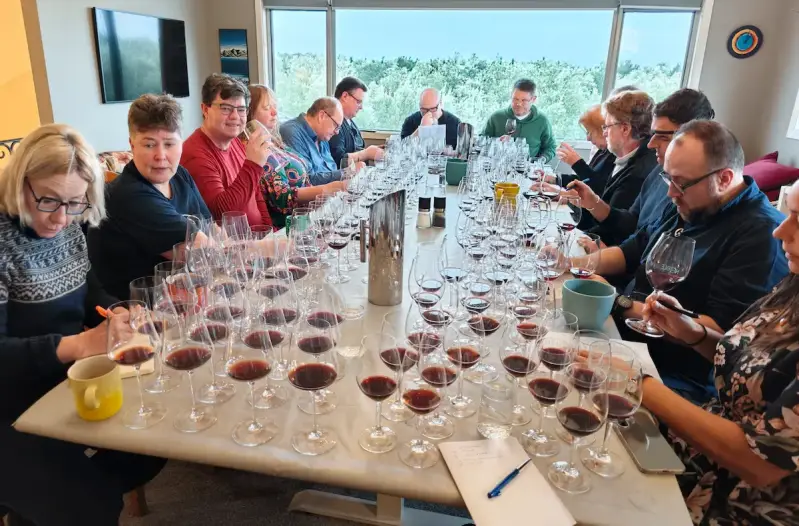
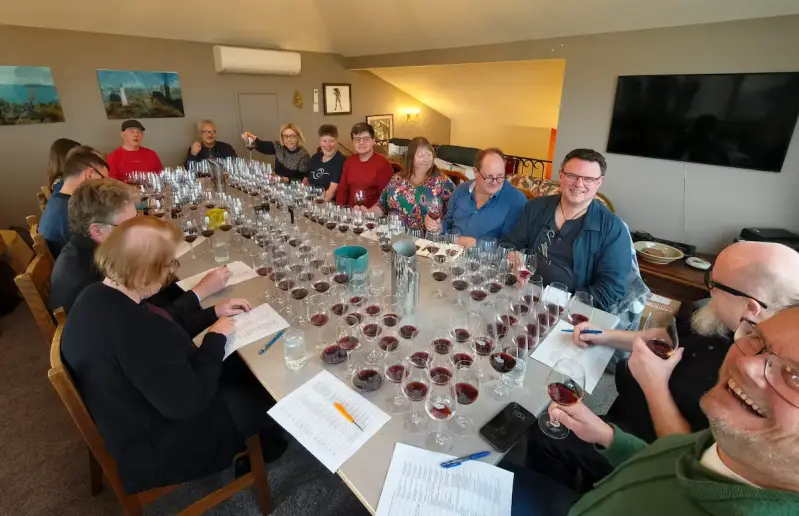
Deep contemplation underway
-
2021 Merlot 31%, Syrah 56%, Cabernet Franc 6%, Malbec 7%
Alc 13.5% TA 5.9 pH 3.55
A low yielding season, giving great intensity and fruit weight to the late ripening varietals of the blend. 2021 finished with a long dry spell in April that enabled the Merlot, Malbec, Cabernet Franc and Syrah to reach perfect ripeness.
Winemaking was much the same as for the 2020 above.
Darker ruby in the glass than the 2020 and with a distinctly different aromatic profile of kir royale, star anise, nutmeg and cracked pepper. The palate is structured with a broad dense core of dark ripe blackberry and plum fruit crisply edged with cracked pepper spice, bitter dark chocolate and smoky wood. The tannins are quite firm and slightly drying but well balanced with acidity. This is a big expression of the blend which needs time for the pepper spice to integrate and tannins to soften a little more.
-
2024 43% Merlot, 38% Syrah, 12% Cabernet Franc, 7% Malbec
Alc 14% TA 6.0 pH 3.57
The 2024 vintage is arguably the best in 45 years of Ata Rangi growing history. A wet winter was followed by drying winds and spring frosts. Fewer bunches materialised on the shoots, but a good flowering and fruit set resulted in small but fully formed bunches. A glorious summer followed by a dry autumn, with marked diurnal shift, warm days and cool nights this afforded beautiful skin and tannin ripeness, with perfect acidity. An excellent vintage that has materialised exciting wines with great longevity.
Winemaking again much the same as for 2020. The Merlot and Malbec co-fermented after a 4-6 day pre-ferment cold soak to extract colour and soft phenolics before fermentation, Syrah fermented separately for a shorter time to retain florality and brightness, the Cabernet Franc from a mix of younger and older vines, and the wine aged in oak for 22 months prior to bottling.
Bright deep ruby in the glass with an aromatic explosion of lush, sweet berry and plum fruit, a gentle touch of violets and dianthus and just the slightest hint of pepper spice. The medium-bodied palate is rich, layered and complex with an initial burst of pepper-tinged dark berry and red liquorice fruit giving way to sweet baking spices, subtle smoke and a stony minerality. The exceptionally fine and supple tannins, exquisitely balanced with perfectly judged acidity, drive to a long mouthwatering finish. A truly exceptional wine that will undoubtedly improve in the cellar and then maintain a delicious plateau for many years - but already just so damned delicious! Current release https://atarangi.co.nz/shop/p/ata-rangi-celebre-2024 @$50 retail.
The Whakapapa of a Taonga
Célèbre has always been more than a blend; it’s a thread woven through the history of a region, a winery, and the vision of one man. Revisiting three decades of this wine made it impossible not to return to Clive Paton himself — the farmer‑turned‑vigneron whose instinct, tenacity, and quiet conviction helped shape modern Martinborough. Standing at that roadside stall in 1986, pouring wine for strangers, Clive could never have known how deeply his creation would resonate with people who encountered it. Yet this tasting proved that his early intuition — that Martinborough’s stony soils could yield something profound beyond Pinot Noir — was absolutely right.
What emerged across these 13 vintages was not simply evolution, but continuity: a consistent thread of savoury fruit, spice, structure, and unmistakable Martinborough character. In tracing this whakapapa — the lineage of people, place, and practice that has shaped Célèbre — it becomes clear how faithfully the wine reflects Clive’s original ethos of authenticity and site expression, carried forward with equal dedication by Helen Masters and the Ata Rangi team.
Given how little reliable commentary exists for the earlier vintages of Célèbre, I hope this retrospective will serve as a useful resource for collectors, students, and anyone curious about the wine’s long arc of development. More important though, it stands as a tribute both to Clive himself and to the enduring spirit of exploration that has defined Ata Rangi from the very beginning to the present day. The true tribute however is the wine itself and the legacy it bears.
“E kore e ngaro te kākano i ruia mai i Rangiātea”
(The seed sown from the Clear Heavens will never be lost).
About the Author
John Penney is a wine experience guide based in Martinborough-Wellington, New Zealand. His lifelong passion for wine is shaped by extensive international wine travel, formal study (WSET Level 3), and a career in adult learning. He writes about wine from both technical and cultural perspectives, drawing on real-world tasting, wine travel, and extensive research. Through his wineinsights business he provides Wairarapa wine tours, wine tasting in Martinborough, and wine education experiences for wine lovers and enthusiasts. His portfolio extends to over 70 articles on a wide range of wine related subjects – if you enjoyed this one you can subscribe to receive these free in your email, just use the contact form.
Add comment
Comments