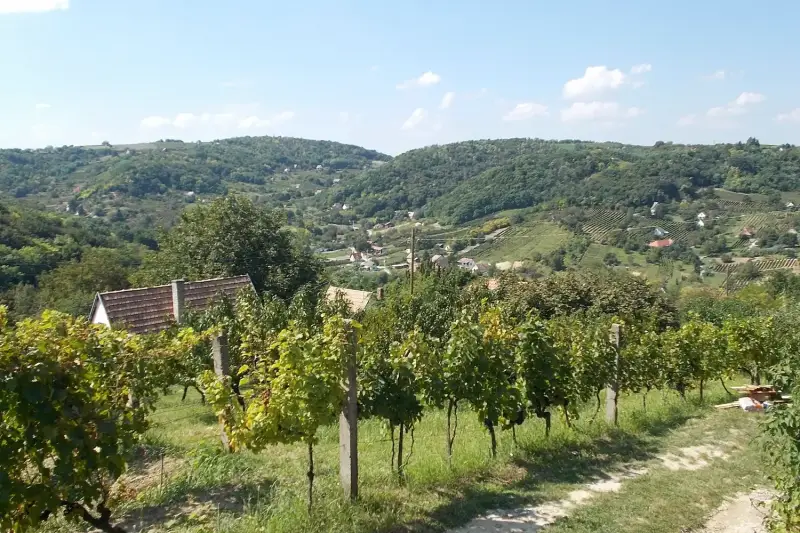
Last month I took a break from my Martinborough wine tours and exclusive Wairarapa wine experiences to explore some of Hungary’s most exciting wine regions. This week’s article on Szekszárd is the fourth in the series and follows last week’s account of my visit to Badacsony.
Szekszárd is one of Hungary’s oldest winegrowing regions, with viticulture dating back to Roman times. Through the Middle Ages and the Ottoman period, the area developed a reputation for fragrant, spicy, medium‑bodied reds, especially Kadarka, which became the defining grape of southern Hungary. By the 18th and 19th centuries, Szekszárd was widely recognised for its elegant red wines and its early versions of Bikavér, long before the blend was codified elsewhere.
The region’s history, however, has not been a simple arc of prosperity. Like most of Europe, Szekszárd was hit hard by phylloxera in the late 19th century, devastating vineyards and forcing a complete replanting. Kadarka survived, but its acreage shrank, and growers increasingly turned to sturdier varieties such as Kékfrankos.
The First World War, interwar instability and the Second World War brought further disruption. Many family estates lost land, labour or continuity. After 1945, the communist era reshaped Hungarian wine for nearly half a century: collectivisation, state farms and centralised production emphasised quantity over quality. Traditional family wineries were dismantled or absorbed, and Szekszárd’s nuanced, site‑specific red wines were replaced by uniform, industrial styles.
Yet even during this period, Szekszárd retained a cultural memory of finesse. Kadarka and Kékfrankos persisted in pockets, and local growers quietly maintained traditions that would later underpin the region’s revival.
The modern era began after 1990, when family estates were re‑established, vineyards reclaimed and a new generation embraced precision viticulture, lower yields and terroir‑driven winemaking. Today Szekszárd is one of Hungary’s most consistent and characterful red‑wine regions — a place where history, tradition and modernity coexist with quiet confidence.
Terroir: Landscape, Slopes, Soils and Climate
Szekszárd’s terroir is defined not by dramatic mountains or volcanic cones, but by gentle, undulating loess‑covered hills that rise above the town and run north–south in long rounded ridges. These hills are central to the region’s identity. Although the valley floor is broad and fertile, the best vineyards — including those of Sebestyén and Eszterbauer — sit on the mid‑ and upper slopes, where exposure, drainage and soil structure combine to produce wines of greater finesse and aromatic complexity.
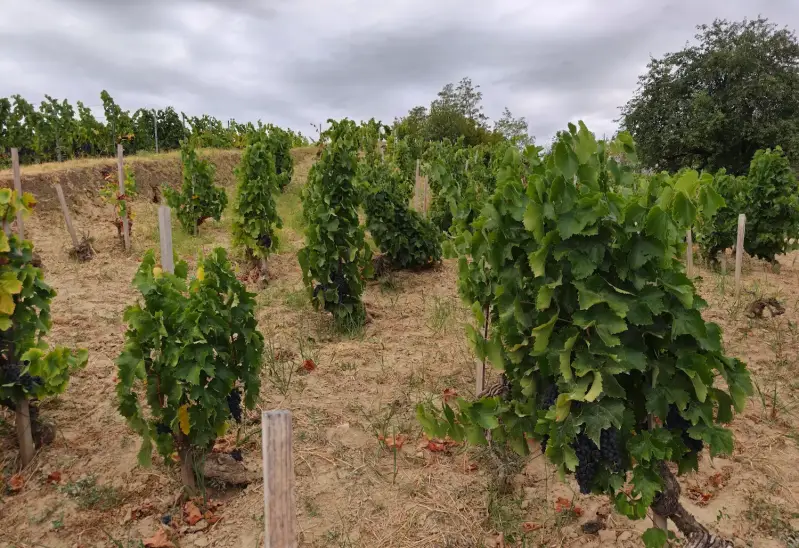
Old bush vine Kadarka on the loess slopes behind Estzerbauer
Loess is the region’s signature soil: a fine, wind‑blown sediment deposited over millennia. On lower slopes and flats, loess tends to be deeper, more homogeneous and more fertile, producing vigorous growth and softer, simpler wines. On the hillsides, the loess layer becomes thinner and more variable, influenced by underlying clay, marl and limestone. These shifts in texture and mineral availability give Szekszárd’s hillside wines their characteristic lift, spice and textural refinement.
The slopes also provide better drainage, encouraging deeper root systems and moderating vigour — essential for Kadarka, a thin‑skinned, delicate variety that thrives in well‑drained soils. Kékfrankos likewise responds beautifully to hillside conditions, developing finer tannins and more precise aromatics than on the flats. Even Bordeaux varieties show greater definition and balance when grown on the hills.
Exposure plays a quiet but important role. The orientation of Szekszárd’s hills allows growers to choose between warmer, sun‑bathed south‑facing parcels and cooler, breezier north‑facing ones. This flexibility supports a wide range of styles, from perfumed Kadarka to structured Bikavér and polished single‑varietal reds. The sub‑Mediterranean climate — warm summers, long ripening seasons and mild autumns — ensures reliable ripeness, while the slopes help preserve acidity and aromatic detail.
Taken together, Szekszárd’s terroir is subtle rather than dramatic: a balance of loess, clay, limestone and gentle gradients that favours fragrance over force. The hillside vineyards of Sebestyén and Eszterbauer exemplify this equilibrium.
Grape Varieties
Kékfrankos
Kékfrankos is the structural foundation of Szekszárd and the region’s most widely planted grape, covering roughly 1,000 hectares of the 2,300 under vine. It thrives on the loess‑clay slopes, where warm exposure and good drainage allow full ripeness while preserving natural acidity. In Szekszárd, Kékfrankos produces bright, red‑fruited wines with a distinctive thread of spice and firm yet fine tannins. Its sensitivity to site makes it the leading vehicle for the region’s modern, terroir‑driven approach: deeper loess gives softer, more aromatic expressions, while parcels with clay or limestone breaking through the loess produce wines with greater tension and length. Whether bottled alone or forming the backbone of Bikavér, Kékfrankos provides the architecture that defines contemporary Szekszárd.
Kadarka
Kadarka is the soul of Szekszárd — pale, perfumed and delicate, carrying centuries of cultural memory. Although it occupies far less acreage (around 200–250 hectares), its influence is disproportionate. Kadarka is demanding: thin skins, loose bunches and sensitivity to rot make hillside sites essential. On Szekszárd’s slopes, where loess is lighter and drainage better, Kadarka develops remarkable aromatic finesse: rose‑petal, redcurrant, subtle spice and a finely textured palate with surprising persistence. Modern growers have revived old clones, refined canopy management and embraced gentle extraction, allowing Kadarka to reclaim its place as one of Hungary’s most expressive red varieties.
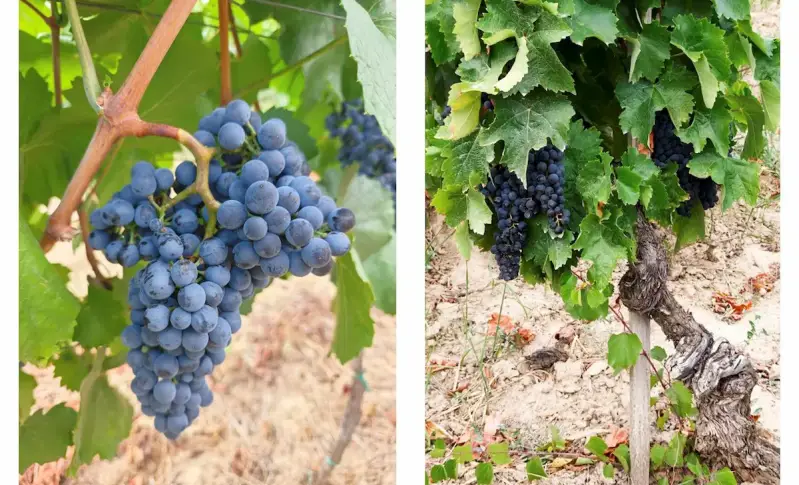
Left: Kékfrankos grapes in the Ivan vineyard of Sebestyén. Right: Old bush vine Kadarka at Estzerbauer.
Merlot, Cabernet Franc and Cabernet Sauvignon
Alongside native grapes, Szekszárd has long worked with Bordeaux varieties, which together account for roughly 1,000 hectares. Merlot ripens easily in the warm climate, contributing plush fruit and mid‑palate generosity. Cabernet Franc has emerged as particularly well suited to the slopes, producing refined, aromatic wines that complement the spice and lift of Kékfrankos. Cabernet Sauvignon, used more sparingly, adds depth, structure and longevity. These varieties allow Szekszárd to craft polished, contemporary reds without overshadowing the native grapes that define the region’s character.
Szekszárdi Bikavér
Szekszárdi Bikavér remains central to the region’s identity. By regulation, at least 50% of the blend must be Kékfrankos and Kadarka, with Kékfrankos always dominant. The remainder typically includes Merlot, Cabernet Franc and Cabernet Sauvignon. While both Szekszárd and Eger produce Bikavér across a wide stylistic spectrum, certain tendencies do emerge: Egri Bikavér often shows cooler‑climate structure and darker fruit, whereas Szekszárd — despite its warmer, more southern climate — frequently leans toward a brighter, more elegant expression shaped by loess‑based soils and supple tannins. The result is a style that is fragrant, spicy and texturally refined, and recognisably Szekszárd.
Modern Winemaking
Szekszárd’s revival began in the early 1990s, when family estates regained their vineyards and the region moved beyond the uniform, quantity‑driven production of the communist era. What followed was a quiet transformation. Growers returned to the slopes, re‑examined their parcels and began treating each vineyard as a distinct source of character rather than a component in a generic blend.
Lower yields, careful canopy management and renewed focus on hillside sites have allowed Kékfrankos and Kadarka to express the nuance that had been suppressed for decades. The region’s best wines now come from growers who understand how loess behaves on different sites, how clay or limestone influences tannin, and how exposure shapes ripeness and aromatic detail.
In the cellar, the philosophy has shifted toward restraint and clarity. Winemakers aim to preserve the natural fragrance and supple texture the slopes provide, favouring gentle extraction over muscularity. Stainless steel and temperature control help retain purity, while Hungarian oak — often from the nearby Mecsek forests — offers a subtle, regionally coherent structure for ageing. Many producers use spontaneous fermentations, larger barrels and longer maturation on fine lees, emphasising finesse rather than weight.
This collective shift has reshaped how Szekszárd presents itself. The introduction of a uniform bottle for Bikavér reflects a shared commitment to quality and regional identity. Today, the best producers — including Sebestyén and Eszterbauer — work with confidence rooted in both tradition and modern understanding, crafting wines that honour the past while speaking clearly to contemporary tastes.
Sebestyén Pince
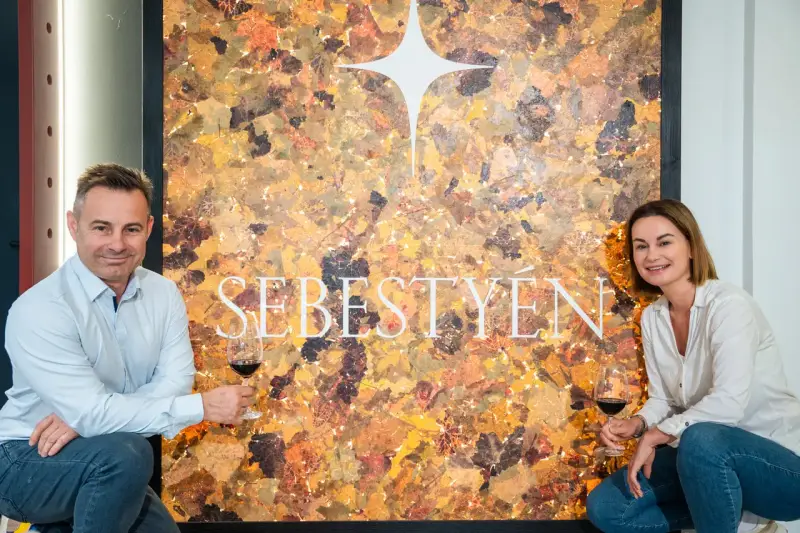
Csaba and Csilla Sebestyén in front of the winery's striking mural made from carefully preserved vine leaves.
Sebestyén is one of the defining voices of modern Szekszárd: a family estate built around the complementary strengths of siblings Csaba and Csilla Sebestyén. Their partnership mirrors the region’s blend of technical precision and expressive communication. Their rise has been steady and thoughtful, shaped by careful vineyard work, disciplined winemaking and a shared belief that Kékfrankos and Kadarka can speak with clarity and distinction when grown and handled with respect.
Although Csaba is the winemaker and vineyard lead, it is often Csilla who represents the estate to visitors. During my visit, Csaba offered a warm introduction before Csilla took over to provide a full tour of the winery and vineyards and led an in‑depth tasting. This reflects their natural division of roles: Csaba oversees the vines, harvest decisions, fermentations and stylistic direction, while Csilla manages the business, export relationships and communication. Together they form a balanced partnership in which technical focus and articulate storytelling reinforce one another.

The author with owner and winemaker Csaba Sebestyén in the beautifully curated Eszterbauer tasting room, where illuminated bottle displays and contemporary design create an elegant setting for experiencing the estate's wines.
The Sebestyén vineyards lie across several of Szekszárd’s most characterful hillsides, including parcels in Iván‑völgy, Porkoláb-valley, Görögszó and Szentgál. These slopes offer a mosaic of loess, clay and limestone, each contributing subtle differences in texture, tannin and aromatic profile. The estate treats these parcels not as interchangeable sources of fruit but as individual voices. Their single‑vineyard Kékfrankos bottlings demonstrate how sensitively the grape responds to site, while their Kadarka captures the variety’s elusive charm with pale colour, perfume and delicacy.
Sebestyén’s cellar work is traditional, hands‑on and deliberately restrained, with every decision aimed at preserving fruit clarity and the character of Szekszárd’s loess‑based slopes. All grapes are hand‑harvested with bunch selection, and red fermentations take place in open‑top vats at 27–30°C, with manual cap management and short maceration periods of 2–7 days. This gentle extraction keeps the wines lifted, spicy and vineyard‑driven.
Ageing is carefully calibrated to each wine. The single‑vineyard Bikavérs — Iván‑völgy and Porkoláb‑völgy — mature for 21–22 months in 500‑litre Hungarian oak barrels, a format chosen for subtlety rather than impact. Iván‑völgy uses a mix of new and used barrels, while Porkoláb‑völgy relies exclusively on second‑ to fourth‑fill barrels, emphasising purity and site detail. Mozaik, the estate’s non‑single‑vineyard Bikavér, follows a similar regime: 22 months in 500‑litre Hungarian oak, again with a mix of new and used wood. Across all these wines, the intention is consistent — balanced, sophisticated reds with only a touch of oak, allowing the blend and vineyard to speak clearly.
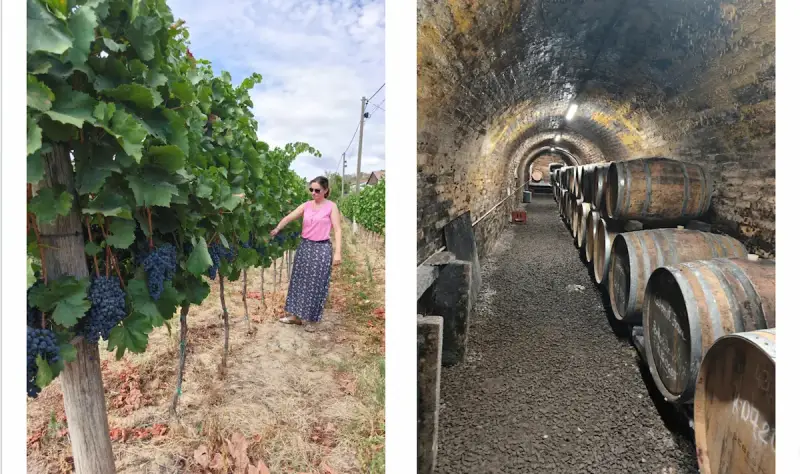
Left: Csilla Sebestyén among rows of Kékfrankos in Ivan valley. Right: Hungarian oak barrels for aging wine in the underground cellar
In contrast, the estate’s Kadarka is made in a deliberately light, vibrant style. After open‑vat fermentation at 28–30°C and a brief seven‑day skin contact, it is aged for nine months in stainless steel, with no oak at all, resulting in an airy, red‑fruited wine best enjoyed slightly chilled.
White and rosé wines are fermented in stainless steel and bottled early to preserve freshness and juicy fruit.
Overall, Sebestyén’s winemaking combines traditional Szekszárd techniques with precise, vineyard‑driven decisions: modest extraction, careful cap management, selective use of large‑format Hungarian oak and a clear stylistic aim — clarity, vibrancy and authentic regional character.
Wines Tasted
Sebestyén Szél 2025
A Provence‑styled rosé with depth, hand‑picked 59% Kékfrankos, 23% Cabernet Franc and 18% Merlot grapes fermented in stainless steel at 18°C for 8 days, then aged 5 months on fine lees. Pale salmon pink in the glass with bright aromas of white flowers, strawberry, pomegranate, red apple and a hint of exotic spice. Crisp and dry on the palate, with a citrus element adding complexity to the fruit core, lovely mouthfeel balancing freshness with depth, and excellent length.
Sebestyén Kadarka 2024
From five different traditional clones on vines up to 60 years old across Szekszárd, a short gentle maceration and fermentation in stainless steel followed by 6 months on fine lees before bottling. Pale translucent ruby in the glass with aromas of rhubarb, cranberry and rosehip tinged with clove spice. On the light‑bodied palate, raspberry, sour cherry and red apple flavours predominate with lively acidity, light tannins, and an easy‑to‑drink, chillable summer wine profile.
Sebestyén Görögszó Kékfrankos–Kadarka 2024
Kékfrankos with some Kadarka from neighbouring rows in the Görögszó vineyard (loess and red clay) – stainless‑steel fermentation, with only the Kadarka portion receiving 10 months’ ageing in used oak. Deep ruby‑purple in the glass, with aromas of violets, blackberry and dark cherries tinged with peppery spice. Beautifully poised medium‑bodied palate with silky tannins and good freshness, a delightful mélange of forest berries and plum fruit flavours, a hint of liquorice, and excellent length.
Sebestyén Porkoláb Bikavér 2021
Grapes from younger vines in the Porkoláb vineyard, which has loess and red clay soils with a high limestone content: 48% Kékfrankos, 22% Merlot, 10% Cabernet Franc, 10% Kadarka, 10% Cabernet Sauvignon. Hand‑picked grapes destemmed, fermented in open‑top vats, followed by a further 2–7 days’ maceration on skins before ageing 21 months in 500‑litre Hungarian oak barrels. Lifted aromas of spice, thyme and redcurrant, forest berry and sour cherry fruit. The palate is so elegant, almost ethereal, with herby red fruits and cinnamon spice, soft fine tannins, lovely fresh acidity, and a long mineral‑edged finish.
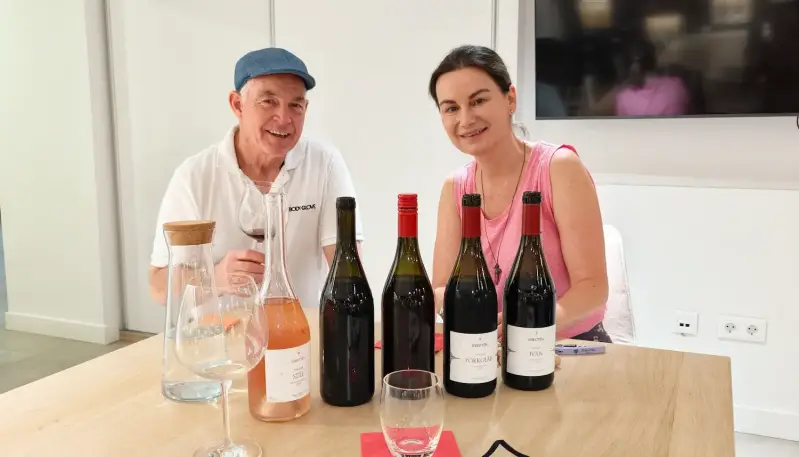
Enjoying tasting the Sebestyén wines with Csilla
Sebestyén Iván Bikavér 2022
49% Kékfrankos, 16% Merlot, 27% Cabernet Franc, 8% Kadarka from vines up to 73 years old in the Iván‑völgy vineyard (loess with calcite nodules). Hand‑picked, warm ferment in open‑top vats followed by a further 2–7 days’ maceration on skins and 22 months’ ageing in a mix of new and used Hungarian oak. Inky ruby‑purple in the glass with aromas of dark berries, Italian dried herbs, cedar and baking spice. The palate is more structured and richer than the Porkoláb but still decidedly more Burgundy than Bordeaux: medium‑bodied, with juicy dark fruit flavours and firm but fine tannins that drive a lingering, slightly drying finish.
Sebestyén’s wines show the full breadth of Szekszárd’s red‑wine tradition: clarity of fruit, precision of structure and a deep respect for vineyard character. Their interpretations of Kékfrankos and Bikavér are among the most refined in the region, combining gentle extraction with thoughtful oak use and a strong sense of place. Moving from Sebestyén to Eszterbauer offers a fascinating contrast — another multi‑generation family estate, but with a different stylistic centre of gravity, broader hospitality offering and a portfolio that ranges from stainless‑steel varietal wines to ambitious, new‑oak‑aged blends. The shift in tone, philosophy and expression between the two producers provides a natural next step in understanding the diversity and personality of Szekszárd.
Eszterbauer Borászat
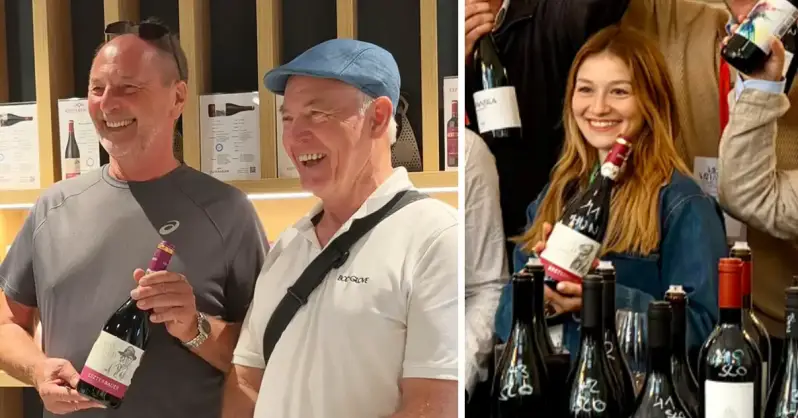
Left: with Janos Eszterbauer. Right: Vivien Csatári at United Nations of Blue Franks / VieVinum 2026
Eszterbauer is one of Szekszárd’s most characterful family wineries, with a lineage documented back to 1746, when the first known ancestor began cultivating vines in the region. The family has worked the land across nine generations, surviving war, confiscation and collectivisation before reclaiming their identity after the political changes of the 1990s. Today the estate is led by Janos Eszterbauer, who has restored family heritage to the centre of the winery’s philosophy — expressed both through the wines and the distinctive labels that honour past generations. Their vineyards span several of Szekszárd’s key sites — Görögszó, Bodzás, Baranya‑völgy Porkoláb-völgy and Palánki hegy — giving the estate a broad range of terroirs from which to assemble its blends.
Our visit was hosted by Janos’ daughter, Vivien Csatári, who represents the younger generation. Although she uses her mother’s surname, she is fully involved in the estate and acts as the English‑speaking bridge between visitors and her father. Janos accompanied the tasting but, speaking limited English, left Vivien to guide us through the wines, the family history and the philosophy behind the labels. Her clarity, warmth and professionalism made the visit one of the most engaging in Hungary, offering a vivid sense of how heritage and personality shape the estate’s identity.
What distinguishes Eszterbauer is not only the quality of its wines but the completeness of its hospitality. The estate has developed a welcoming, immersive visitor experience that reflects the warmth of Szekszárd itself. For events, their restaurant serves regional dishes that pair naturally with the estate’s wines, creating a sense of continuity between local cuisine and local terroir. Accommodation on the property allows guests to stay among the vineyards, turning a tasting visit into a deeper encounter with the landscape and culture of the region. This broader tourism approach has made Eszterbauer a key destination for travellers seeking both wine and atmosphere — a place where Szekszárd can be experienced through its wines, its food and its rhythm of daily life.
In the cellar, Eszterbauer follows a structured, variety‑driven approach shaped by long experience across their vineyards. Fermentation is typically carried out in stainless steel or temperature‑controlled vessels, with extraction kept moderate to maintain precision and balance. Oak is applied selectively, according to the structural needs of each wine.
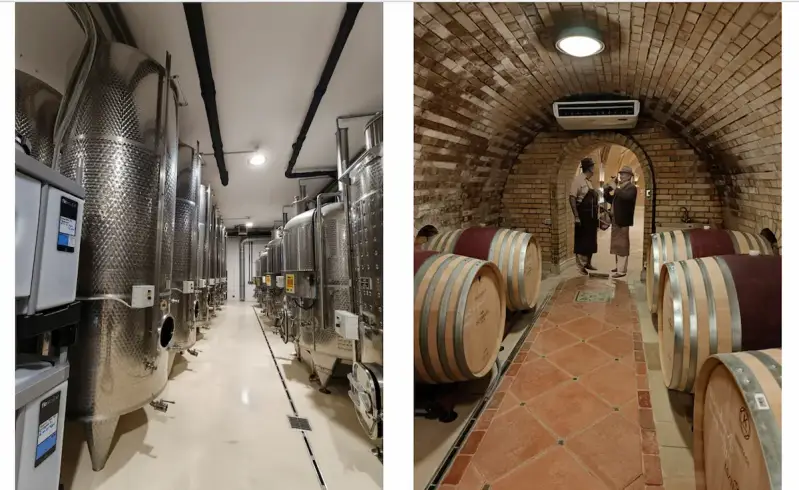
Left: Temperature controlled stainless fermentation tanks. Right: The cellar immerses you not just in the winemaking but also in the family history
Varieties such as Kadarka and Néró are produced without any barrel ageing — Kadarka because of its naturally lighter frame, and Néró because its high anthocyanin content and firm tannin provide ample structure without wood. Kékfrankos, the backbone of the estate’s identity, receives modest oak, generally in older or larger barrels, providing refinement without imposing overt wood influence. Bikavér blends from Görögszó, Bodzás and Baranya‑völgy are treated with restrained oak, using Kékfrankos as the foundation and supporting it with Cabernet Sauvignon and Merlot in a way that prioritises balance and cohesion.
At the top of the range, Eszterbauer produces more ambitious, Bordeaux‑influenced wines, including a cuvée that combines Merlot, Cabernet Sauvignon, Kékfrankos and Cabernet Franc, alongside varietal Merlot and Cabernet Sauvignon. These wines undergo significantly longer ageing — commonly eighteen months — in 100% new oak, representing the estate’s most structured and cellar‑worthy expressions. This tier demonstrates Eszterbauer’s ability to work confidently across the full stylistic spectrum, from stainless‑steel varietal wines to serious, long‑aged blends, while maintaining a consistent technical approach.
Across all levels, Eszterbauer’s winemaking reflects controlled fermentations, moderate extraction and proportionate oak use. The result is a portfolio that spans the breadth of Szekszárd’s red‑wine tradition while maintaining a clear thread of precision, fruit integrity and regional authenticity.
Wines Tasted
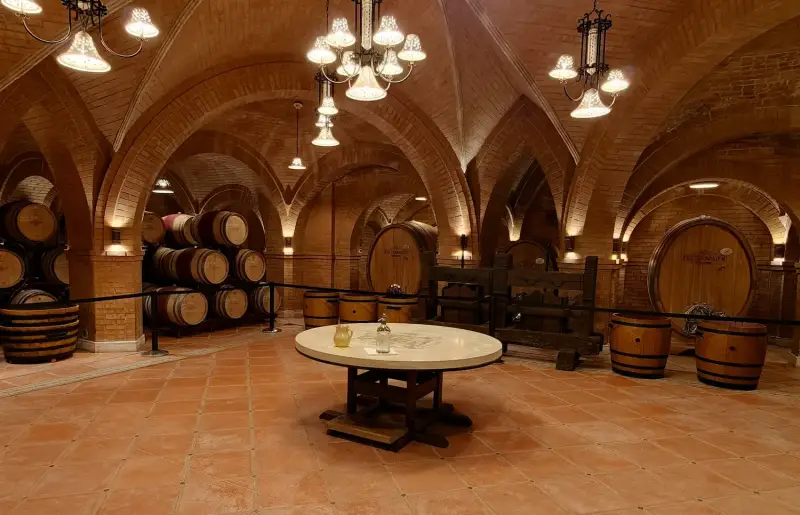
This Eszterbauer cellar tasting area blends functionality, hospitality and architectural beauty, creating a memorable setting in which to experience the estate's wines.
Eszterbauer Sisters Rosé
A special cuvée crafted mainly from Kékfrankos with a little Merlot for regional festivals, cellar‑door sales and selected Hungarian distributors. Pale crimson‑pink with pronounced raspberry, strawberry and redcurrant aromas touched with red apple. Fresh and light on the palate, with crisp acidity, crunchy fruit, a tiny hint of CO₂ spritz and a clean, dry finish.
Eszterbauer Nagyapám (“Grandpa”) Kadarka 2024
A homage to the grandfather of winemaker János Eszterbauer. From select Kadarka clones and old vines, spontaneously fermented and aged entirely in stainless steel. Pale magenta with lifted jasmine and violet over cherry, mulberry and redcurrant. Medium‑bodied with gentle tannins, crisp acidity and a black‑pepper edge over crunchy red fruits. The finish is long, clean and edged with pepper and dried herbs.
Eszterbauer P7 Kadarka 2025
A premium limited‑edition wine from seven outstanding Kadarka clones planted in 2010 on the Palánki‑hegy and Bodzás vineyards. Spontaneously fermented and aged exclusively in stainless steel. Magenta in the glass with more spice and riper red berries, plus blood orange and bergamot. Fresh yet firmer in structure, opening with time to dark cherry and strawberry fruit. The finish is long and layered, with pepper, Provence herbs and saline minerality lingering after the fruit fades.
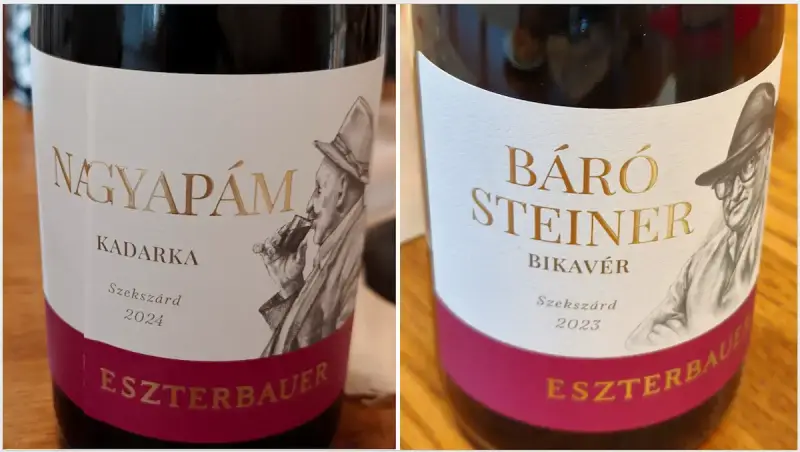
Eszterbauer “Báró Steiner” Bikavér 2023
Awarded 96 points at the Decanter World Wine Awards. A blend of 50% Kékfrankos, 10% Kadarka, 25% Cabernet Sauvignon, 10% Merlot and 5% Cabernet Franc from the loess slopes of Görögszó and Baranya‑völgy. Temperature‑controlled ferment, then twelve months in Hungarian and French oak. Ruby‑purple with aromas of spice, dark berries and Black Doris plums, plus bitter chocolate and smoke. Rich and soft on the palate, with ripe blackberry and plum lifted by bright Kékfrankos acidity. Long, silky and layered, with minerality persisting after the fruit fades.
Eszterbauer “Grand” Szekszárdi Cuvée 2021
The estate’s flagship red blend: 37% Merlot, 34% Cabernet Sauvignon and 25% Kékfrankos. Hand‑picked from Görögszó and Bodzás, destemmed, fermented in temperature‑controlled tanks, aged eighteen months in oak and a further 3.5 years in bottle. Dark ruby with cassis, roasted red capsicum, cedar and clove. Full‑bodied, smoky and concentrated with firm chalky tannins. Ripe plum and dark berry fruit meet spice and herb notes. The finish is complex and smoky, still integrating, and will reward further cellaring.
Eszterbauer’s wines reflect a different facet of Szekszárd: a portfolio shaped not only by stainless‑steel Kadarka and structured, oak‑matured blends, but by a vivid sense of family history that runs through every part of the estate. Their Kadarka expressions emphasise clarity, spice and varietal character, while wines such as Báró Steiner and the Grand Cuvée show a richer, more layered style built from Kékfrankos and Bordeaux varieties. Yet what truly distinguishes Eszterbauer is the way heritage is woven into the experience — from labels that honour past generations to the photographs and memorabilia displayed throughout the winery. Across the range, the estate balances modern precision with this deep familial narrative, producing wines that are expressive, welcoming and unmistakably tied to their vineyards and their story. Together, they offer a complementary perspective to Sebestyén — equally rooted in Szekszárd, but with a broader stylistic reach and a distinctive sense of warmth, continuity and generosity.
The Quiet Confidence of Szekszárd
Szekszárd reveals its character most clearly through producers like Sebestyén and Eszterbauer, two family estates that share the same slopes yet interpret them through distinctly different lenses. Sebestyén represents the region’s modern pulse: precise, vineyard‑driven wines that give traditional varieties a contemporary, almost Burgundian elegance. Their focus is on clarity, structure and the quiet sophistication that comes from disciplined, site‑specific winemaking.
Eszterbauer, by contrast, channels the region’s long memory. Their wines carry the imprint of family history — visible in the labels, the photographs and the stories woven through the estate — while still embracing the best of modern technique. The result is a style that feels warm, generous and deeply rooted, a reminder that Szekszárd’s identity is as much cultural as it is viticultural.
Together, these two estates show the breadth of what Szekszárd can be: refined yet welcoming, modern yet steeped in heritage, united by loess slopes and a shared belief in Kékfrankos and Bikavér as the region’s defining expressions. For travellers and wine lovers willing to look beyond Hungary’s headline regions, Szekszárd offers depth, authenticity and a sense of place that lingers long after the last glass.
About the Author
John Penney is a wine experience guide based in Martinborough–Wellington, New Zealand. His lifelong passion for wine is shaped by extensive international wine travel, formal study (WSET Level 3), and a career in adult learning. He writes about wine from both technical and cultural perspectives, drawing on real‑world tasting, wine travel, and deep research. Through his wineinsights business he provides Martinborough wine tours, Wairarapa wine tours, private wine tasting experiences, and wine education for wine lovers and enthusiasts.
Add comment
Comments