Last month I paused my Martinborough wine tours and exclusive Wairarapa wine experiences to explore Hungary, travelling first to Tokaj followed by Eger and then to Badacsony.
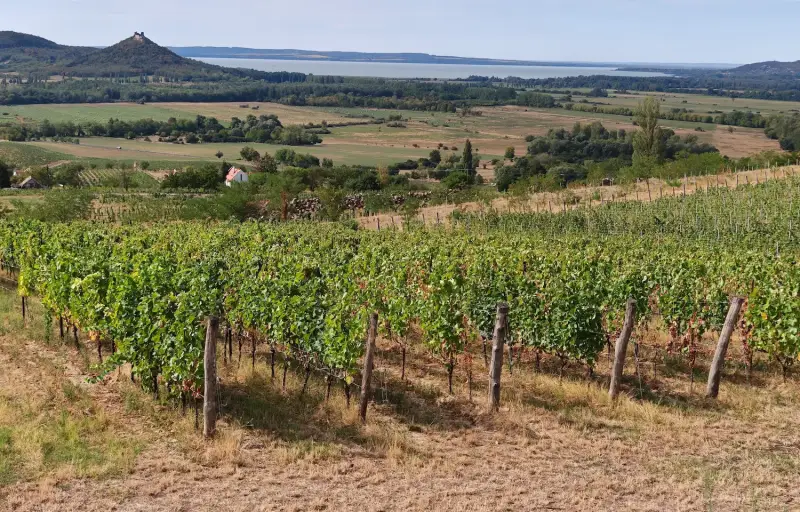
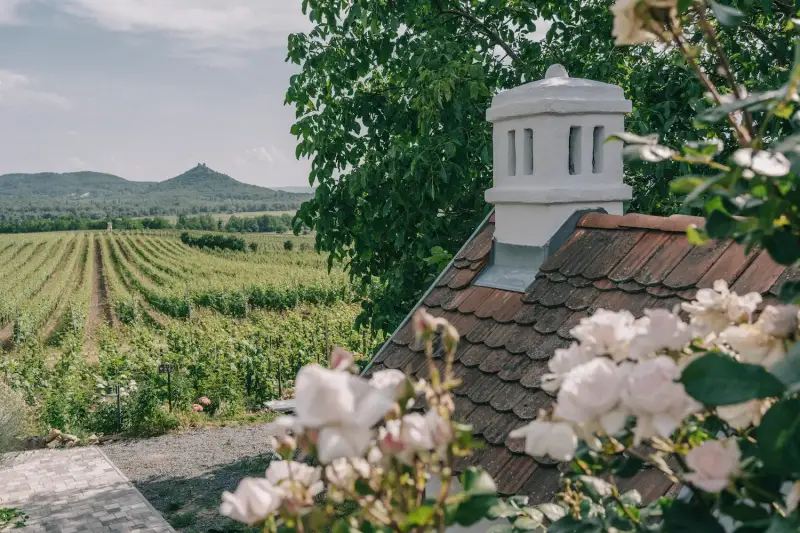
Badacsony is one of Hungary’s most visually distinctive wine regions, its identity inseparable from the landscape that defines it. On the northern shore of Lake Balaton, the country’s inland sea, the volcanic hills of Badacsony rise in a fractured arc above the water. In the foreground of the photo above, the terraces of Szent György‑hegy descend toward the lake, while across the valley the pointed cone of Csobánc stands in sharp relief. Just beyond the frame to the west lies Badacsony‑hegy, the region’s namesake butte — a steep, flat‑topped mass of basalt formed by ancient volcanic activity and sculpted over millennia into terraces of vines. It is not merely a backdrop but a geological force: fractured basalt, tuff, and volcanic ash that shape the flavour, structure, and tension of the wines grown on its slopes. Standing among the vines, you feel the meeting of volcanic ground and open water, a duality that defines Badacsony.
Where volcanic mass meets lake‑driven light and air
Lake Balaton itself is a climatic engine. Shallow, broad, and intensely reflective, it acts as a giant natural mirror, bouncing sunlight back onto the vineyards and extending the effective ripening season. The lake moderates temperature extremes, reducing frost risk in spring and slowing the onset of autumn cold. Winds move across its surface and up the volcanic slopes, ventilating the vines and helping maintain healthy canopies. This combination of reflected light, moderated temperatures, and constant air movement creates a microclimate unusually favourable for white varieties that need both ripeness and acidity. Badacsony is warm enough to bring late‑ripening grapes to full maturity, yet cool enough — especially at elevation — to preserve the tension and freshness that define the region’s best wines.
The soils deepen this climatic duality. Basalt is the dominant force: fractured, mineral‑rich, and heat‑retentive, giving the wines a firm structural backbone and a distinctive volcanic edge. Tuff, ash, and other pyroclastic materials contribute aromatic lift and a subtle smokiness, while pockets of loess and clay add breadth and mid‑palate weight. The slopes vary in steepness and exposure, creating a mosaic of micro‑sites where the same grape can express itself with markedly different textures and tonalities. This is a landscape that encourages contrast — sun and shadow, warmth and coolness, lake softness and volcanic severity — and the wines reflect that interplay with remarkable clarity.
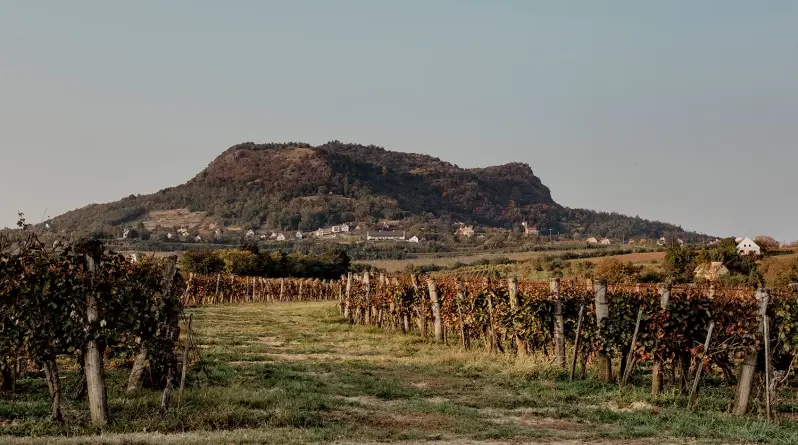
Szent György‑hegy vineyards (photo from Gilvesy press resources)
The Grapes That Define Badacsony
Badacsony’s modern identity is built on white wine, and at its centre sits Olaszrizling. Internationally, the grape is better known by its Austrian name Welschriesling, and that name carries baggage: for decades it has been associated with simple, everyday drinking, often produced at high yields and destined for unambitious, neutral wines. But Badacsony has quietly rewritten that narrative. Here, Olaszrizling responds to volcanic soils and lake influence with a level of character that surprises anyone accustomed to its more ordinary expressions. Lower yields, careful canopy management, and patient ripening transform it from a quaffer into a genuinely terroir‑expressive variety. In Badacsony, Olaszrizling shows a saline edge, a firm mineral line, and a textural depth that feels carved from the basalt itself. It retains its familiar citrus‑almond profile, but gains tension, structure, and a sense of place that few other regions coax from it. It is still recognisably Olaszrizling — but sharpened, deepened, and elevated.
Alongside it sits Kéknyelű, the region’s heritage curiosity: a late‑ripening, thick‑skinned grape that was once nearly lost but is now being revived by a handful of committed growers. Kéknyelű is demanding in the vineyard and idiosyncratic in the cellar, but when successful it produces wines of remarkable purity and verticality — a kind of distilled volcanic essence. Historically, Kéknyelű was co‑planted with Budai Zöld, which provided the necessary pollen for this female‑flowered variety. That tradition lives on genetically in Rózsakő, a crossing of Kéknyelű and Budai Zöld created specifically for Badacsony. Rózsakő retains some of Kéknyelű’s structural firmness but is easier to grow and ripen, making it a practical bridge between tradition and modern viticulture. Its flavours tend toward citrus, white flowers, and a faint herbal edge, with a mineral line that echoes its volcanic parentage.

Increasingly, Furmint is returning here. Once one of the most dominant white grapes of the region, it faded from the picture, first from phylloxera, then two world wars, followed by the communist era. A small number of growers are leading its restoration, bringing its familiar linearity and citrus‑driven focus to blends and single‑varietal bottlings. On the basalt terraces, Furmint feels taut and architectural, its acidity chiselled by the volcanic soils and moderated by the lake’s warmth.
Badacsony’s varietal landscape is broader still. Sauvignon Blanc has emerged as one of the region’s most successful international varieties, particularly in the hands of Robert Gilvesy. In many parts of Hungary, Sauvignon Blanc tends toward overt aromatics and grassy immediacy, but on the volcanic slopes of Szent György‑hegy it takes on a more restrained, mineral profile. Gilvesy’s versions are shaped by tension rather than exuberance: citrus‑driven, saline, and threaded with the volcanic line that runs through all his whites. They feel less like international Sauvignon Blanc and more like an interpretation filtered through Badacsony’s geology — precise, textural, and quietly expressive.
Pinot Gris (Szürkebarát), long associated with the broader Balaton basin, finds a particularly sympathetic home in the organic hillside vineyards of Szászi. His approach emphasises gentle extraction and aromatic nuance, producing wines that are soft‑edged yet structured, with a subtle spiciness and a rounded mid‑palate that complements the region’s more linear varieties. Pinot Gris here is neither Alsatian nor Italian in style; instead, it reflects the warmth of the slopes and the cooling influence of the lake, resulting in wines that are approachable but far from simple.
Local varieties also contribute to the region’s diversity. Zenit, a mid‑20th‑century crossing, can produce pleasantly aromatic wines with floral lift and easy charm. While rarely profound, Zenit offers a lighter, more playful counterpoint to the volcanic whites. And although Badacsony is fundamentally a white‑wine region, there are pockets of red varieties that add further texture to the landscape. Cabernet Franc appears in small quantities, often producing lighter, fresher expressions than in Villány or Szekszárd, shaped by the cooler lakeside climate. Even more local is Csókaszőlő, an old Hungarian red variety that has seen limited revival. When successful, Csókaszőlő offers bright acidity, red‑berry fruit, and a slightly rustic tannin profile — not a flagship wine, but an intriguing glimpse into Hungary’s pre‑phylloxera diversity.
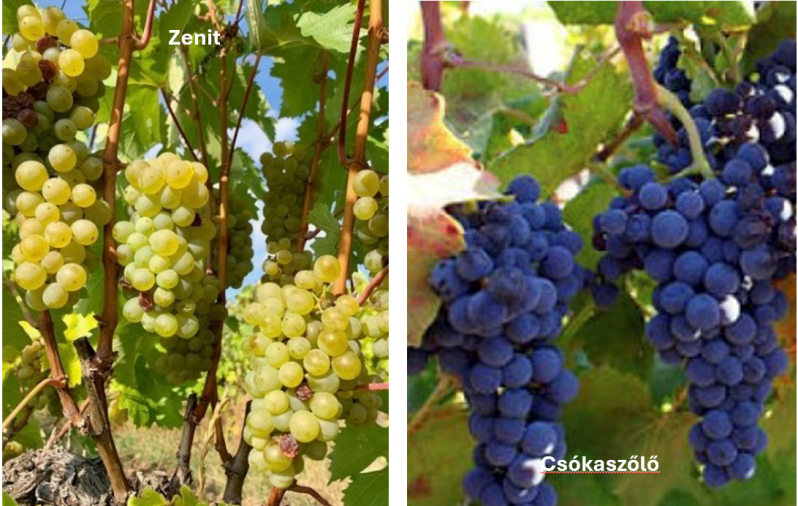
Together, these varieties illustrate the breadth of Badacsony’s viticultural palette. The region’s volcanic soils and lake‑driven climate allow both international and local grapes to express themselves with clarity, but the most compelling wines remain those that channel the basaltic tension of the hillsides — Olaszrizling, Kéknyelű, Furmint, and the producers who have committed themselves to revealing their full potential.
Badacsony’s contemporary momentum is best understood through the producers who have shaped its recent evolution, and two illustrate the region’s dual identity. Despite the warmth visitors feel in late summer, this is fundamentally a cool‑climate landscape: Lake Balaton moderates extremes, constant winds move up the volcanic slopes, and elevation preserves acidity, creating conditions far better suited to structured, mineral‑driven whites than to fully ripe, tannic reds. Within that framework, the region’s modern character has emerged through contrasting philosophies — one clean, disciplined, and outward‑looking, the other organic, hillside‑rooted, and deeply connected to local culture. Together, they show how Badacsony’s geology and climate can be interpreted in markedly different but equally compelling ways.
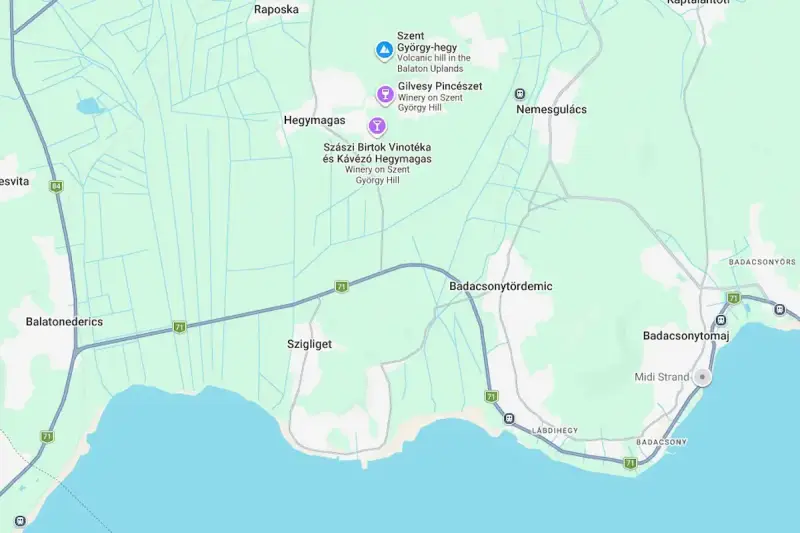
Badacsony wine region showing Gilvesy and Szászi on the slopes of Szent György‑hegy
Gilvesy: Clean Low‑Intervention Clarity
Robert Gilvesy brings an outsider’s perspective shaped by distance, return, and deliberate reinvention. Born in Canada to Hungarian parents, he first came to Hungary shortly after the fall of the Berlin Wall. When he visited Szent György‑hegy, the volcanic hill rising above Lake Balaton, he recognised a place with both historical depth and untapped potential. That early encounter stayed with him, and in 2012 he founded Gilvesy Winery on the slopes of Mount Saint George.
The estate itself is a reminder that Badacsony’s viticultural story stretches far beyond the present. Gilvesy’s cellar was originally built around 1680 by the Lengyel family and later became part of the Esterházy holdings. By the time Gilvesy took it on, the structure needed significant care. His background in architecture proved essential not as a stylistic flourish but as a practical discipline: between 2009 and 2012 he oversaw a meticulous restoration of the 17th‑century cellar, preserving its historical character while making it functional for contemporary, small‑lot winemaking. The result is a working space that feels both ancient and purposeful, a physical anchor for his philosophy of clarity and precision.
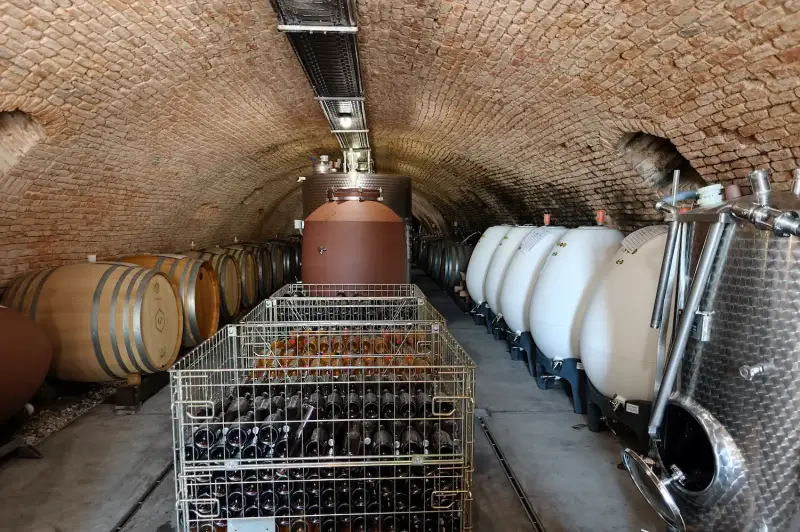
The neatly organised restored cellar and winery of Gilvesy
Gilvesy’s vineyards have been farmed organically since 2014, a commitment he frames not as certification‑seeking but as stewardship. The slopes of Szent György‑hegy are defined by eroded basalt and basalt tuff integrated into Pannonian loess, sand, and clay — soils shaped by volcanic activity eight million years ago, with the mountain itself emerging roughly five to six million years ago. These mineral‑rich formations impart the savoury vibrance and saline tension that Gilvesy sees as the hill’s signature. His “Salt of the Earth” stamp reflects this ethos: authenticity, fidelity to place, and a willingness to let the mountain speak without embellishment.
The varietal palette is deliberately focused: Riesling, Furmint, Olaszrizling, and Sauvignon Blanc. Each expresses the volcanic slopes differently, but all share a through‑line of purity and restraint. Gilvesy ferments with indigenous yeasts and works with a range of vessels — stainless steel, large neutral barrels, and other materials chosen for how they highlight natural characteristics rather than impose style. Sulphur is used sparingly and late; fining and filtration are applied only when necessary. The aim is not minimalism for its own sake but a disciplined search for transparency.
During my visit, this philosophy was evident from the first moments. We sat outside overlooking the basalt cones and the lake as Robert explained the geological history of the region — how volcanic upheaval millions of years ago created the fractured, mineral soils that define Badacsony’s best wines. As we tasted through his range, the conversation moved seamlessly between geology, farming, and winemaking: how organic cultivation sharpens the expression of site; how low‑intervention techniques preserve the mountain’s natural savouriness; how each parcel on Szent György‑hegy carries its own quiet architecture of flavour. The subsequent walk through the restored cellar made clear how deeply the estate’s past informs his present work.
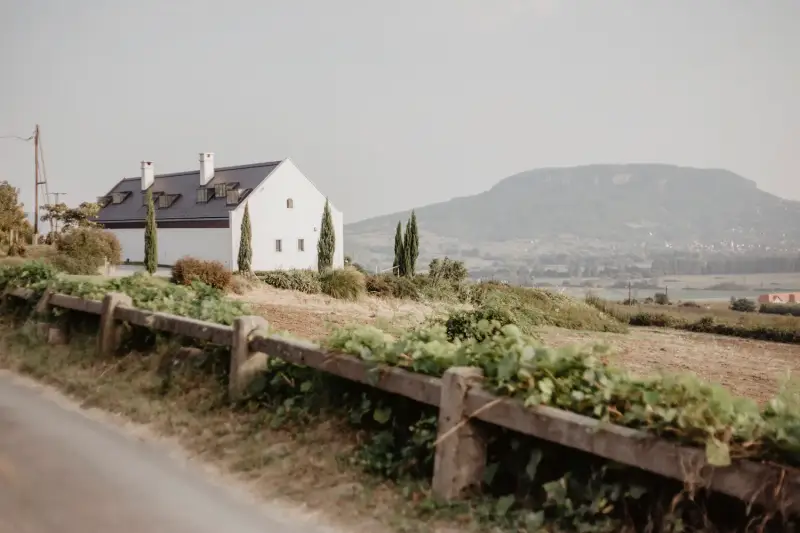
The Gilvesy homestead and estate with the Badacsony butte in the background (from Gilvesy press resources)
Wines Tasted.
Gilvesy Olaszrizling 2025
This was so much more than I expected and a taste of things to come. Organic grapes, stainless steel tank ferment, 8-10 months on lees. Deep lemon in the glass with aromas of yellow flowers, wet stone, smoke and peach. On the palate there is some weight and richness with a fresh minerally-acid spine and a long saline finish.
Gilvesy Pixu Olasrizling 2023.
Organic grapes from a cooler vintage fermented in ceramic eggs. Deep lemon in the glass with aromas of yellow flowers, citrus zest and smoke. In the mouth it has a wonderfully rich texture and depth of flavour, quite salty, bone dry and just so satisfying and long. Well Robert, you’ve converted me to Olaszrisling!
Gilvesy Pixu SABA (Sauvignon Blanc) 2022.
Organic grapes with a small proportion of whole bunches, wild ferment with in stainless unfiltered, unfined and no sulphur. Lemon in the glass with aromas of gooseberry, lemon and lime zest and fresh herbs. The palate is surprisingly round and textural but bone dry, the salty-edged minerality and acidity giving the wine lovely length and a complexity that invites contemplation. Not at all the party drink Savvy we have in NZ, rather something quite intellectual that you might drink while contemplating the meaning of life!
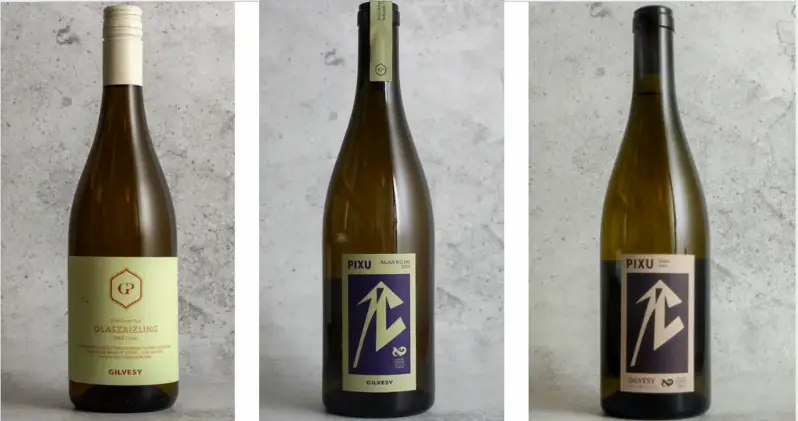
Gilvesy Varadi Furmint 2021
Organic grapes from the Varadi vineyard. Spontaneous barrel ferment and aging (500l Kádár Hungarian oak barrels). Intensely mineral nose with lemon notes and some spice. The palate is textured with a rosemary edge over some melon and there is a lime and salt minerality that drives purposely to a long fresh finish.
Gilvesy Sauvignon Blanc 2015.
Deep lemon in the glass with aromas of tropical fruit and smoky minerality, on the palate it is rich round and lingering with layers of salacca (Thai snake fruit), crème brulee and salt. Truly defies the drink young SB stereotype. What a treat!

The author with Robert Gilvesy in the restored cellar and working winery
Taken together, the wines show that Gilvesy’s strength lies not in a single flagship variety but in the clarity and depth he brings to Olaszrizling and Sauvignon Blanc. His low‑intervention approach — spontaneous ferments, ceramic eggs, indigenous yeasts, minimal sulphur, and a range of neutral vessels — is never an aesthetic of “wildness.” Instead, it produces wines that are strikingly clean, textural, and saline, shaped by the volcanic slopes rather than by cellar artefact. The Olaszrizlings, from the stainless‑steel 2025 to the ceramic‑fermented Pixu bottling, reveal how the grape can transcend its everyday reputation, becoming quietly profound and deeply satisfying. The Sauvignon Blancs, whether the contemplative, no‑sulphur SABA or the astonishingly complex 2015, demonstrate a style far removed from New Zealand’s exuberant fruit‑driven norm: savoury, intellectual wines with length and mineral drive. Across the range, Gilvesy’s work shows how organic farming, thoughtful vessel choice, and disciplined low‑intervention winemaking can articulate the volcanic character of Szent György‑hegy with both finesse and richness. His contribution to Badacsony is structural as much as stylistic: by restoring a 17th‑century cellar, farming with care, and pursuing a contemporary, outward‑looking vision, he has helped reposition the mountain as a source of whites with genuine distinction. These wines are rooted, confident, and expressive of a volcanic landscape that continues to reveal new dimensions under his stewardship.
Szászi: Organic Warmth and Heritage Varieties
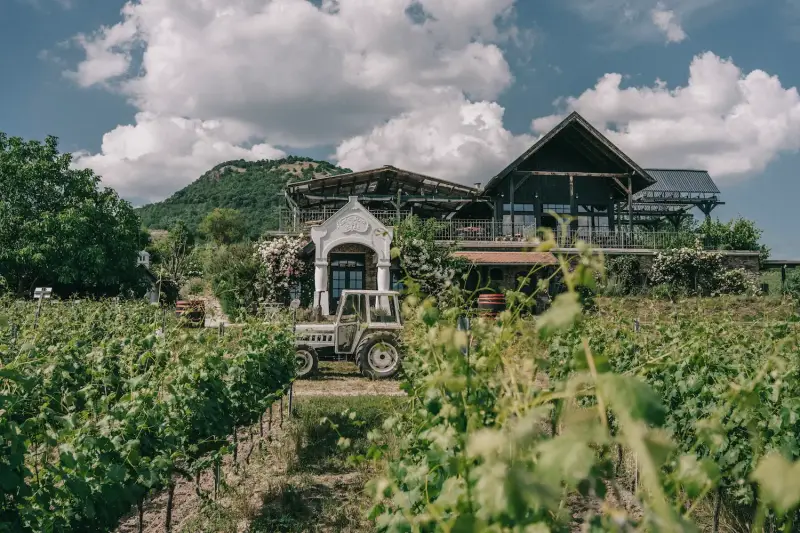
From the vineyards up to the Szászi Restaurant and Winery complex (credit Szászi press resources)
If Gilvesy represents Badacsony’s clean, disciplined, low‑intervention modernity, Szászi Birtok embodies the region’s organic hillside tradition — a philosophy rooted in family, landscape, and the belief that wine is inseparable from the place that produces it. Endre Szászi and his wife both grew up in the shadow of Szent György‑hegy, hiking its slopes, harvesting grapes, and absorbing the quiet romance of the basalt hill long before it became a recognised destination. When they built their family home here in 1999, the decision to replant the two hectares that came with it was less a business plan than an act of belonging. Over time, the vines grew, the family grew, and the estate expanded to 20 hectares across Szent György‑hegy, Szigliget, Hajagos, and Lesencetomaj — today forming one of Hungary’s oldest certified organic vineyard holdings.
Organic farming is not a marketing stance at Szászi but a generational commitment. From the beginning, the family worked without systemic chemicals, relying instead on foliar feeds, orange oil, sulphur, and meticulous hand labour from pruning to harvest. Their neighbours shared the same philosophy, creating a rare hillside community where organic viticulture is not an exception but a shared mindset. For Szászi, sustainability is not a technical protocol but a way of thinking: balance over intervention, quality over quantity, and respect for the land that will one day pass to their children.
The estate’s vineyards span a remarkable diversity of volcanic and sedimentary soils, each contributing its own personality to the wines. On Szent György‑hegy, basalt‑rich, clay‑washed Pannon forest soils give elegance and minerality. In Szigliget, rhyolitic tuff and clay from ancient geyser activity yield delicate, finely structured wines. The Hajagos slope, with its basalt‑strewn brown forest soil, produces firmer, more characterful expressions, while the dolomite‑based rendzina of Lesencetomaj brings freshness and crispness. This mosaic of sites allows Szászi to explore the gentler, aromatic side of Badacsony through varieties such as Pinot Gris, Olaszrizling, and Rózsakő — wines that complement the region’s more linear, saline styles.
Looking over the Szászi estate towards the Csobánc cone. (credit Szászi press resources)
My visit to the estate underscored how deeply the family’s identity is woven into its wines. The tasting was hosted by two of Endre’s children: Titanilla (Titi), who manages marketing and hospitality, and her brother Endre Jr (Endi), who oversees viticulture and winemaking. Titanilla’s background in wine tourism — including a residency and professional internship in California and a master’s thesis on enotourism’s role in regional development — is clearly shaping the estate’s approach to visitor engagement. Her work on the Global Artisan Vintner Alliance initiative reflects a broader ambition: to position Badacsony not only as a wine region but as a cultural landscape with international resonance. Endre Jr, originally drawn to journalism, found his path shifting as he became more involved in the family’s vineyards. His subsequent studies in viticulture and enology now anchor the estate’s farming and cellar work, bringing a thoughtful, grounded perspective to the wines.
Szászi Birtok’s commitment to hospitality is unusually comprehensive for the region. The estate offers accommodation and a highly regarded farm‑to‑table restaurant — a place where the organic philosophy extends beyond the vineyard into the broader experience of the hill. Although my focus was the wine rather than the dining, it is clear that Szászi sees tourism not as an add‑on but as an integral part of how visitors understand Badacsony’s character.
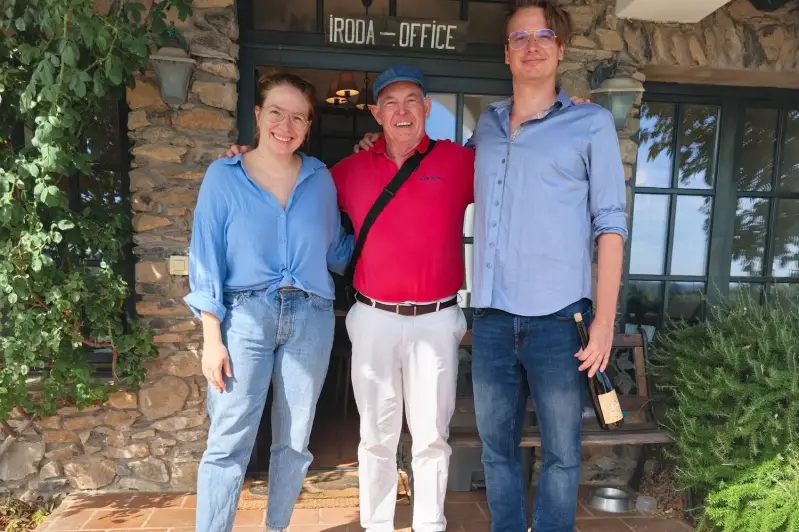
The author with Titi and Endi Szászi
The estate has not been immune to hardship. Phytoplasma disease (flavescence dorée) has forced the removal of most of their Kéknyelű and Rózsakő vines, a painful loss given the varieties’ historical significance on the hill. Yet the response has been characteristic: patient replanting, continued organic stewardship, and a focus on expressing the strengths of the remaining sites.
Wines Tasted.
Titi and Endi led me through an expansive tasting of eleven excellent wines, and it was an invidious task to select just five.
Szászi Gyöngyözőbor 2025
The first tasted in in the lineup, from 50% Cserszegi Fűszeres (a uniquely Hungarian cross of Muscat and Traminer origins), 45% Ottonel Muscat and 5% Zeusz (another Hungarian cross). Reductive spontaneous ferment in stainless, fermentation of the Cserszegi stopped early to retain some residual sugar, then carbonated to give a light, fresh, drink-young bubbles. Aromas of jasmine, grapes, and lychee, fresh on the palate with the slight edge that Muscat often gives to the grapey flavours. An easy party wine.
Szászi Rózsakő 2025
Rózsakő (literally "rose stone") is an incredibly rare grape variety grown almost exclusively in this region of Balaton, created in 1957 by crossing Kéknyelű and Budai Zöld. Light straw in the glass with aromas of white flowers, orchard fruits and some spicy minerals. On the palate apple flavours with a touch of kaffir lime and lemon zest.
Szászi Szent György-hegyi Olaszrizling 2025
Handpicked grapes fermented with native yeasts in stainless then aged for 3 months in 500l oak barrels. Clear light straw in the glass with expressive aromas of yellow flowers, apple, apricot, almond and herbs. On the palate has a gentle sweetness with some soft spice and salt minerality and a nice round creamy texture.
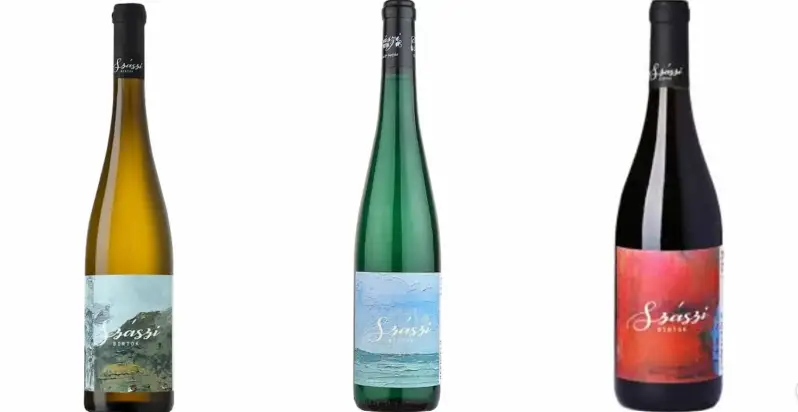
Szászi Badacsonyi Kéknyelű 2023
Another relatively rare grape from the region which only has female flowers so is usually co-planted with another variety for reliable fertilisation – in this case with Rozsako. Spontaneous ferment in stainless then 3 months barrel aging. White flowers, herbs, apple and lemon aromas. The palate is dry and medium-bodied, fresh, fruity and silky with bright acidity and a fruity finish.
Szászi Csókaszőlő 2025
Csókaszőlő is a rare and finicky Hungarian black grape that was at one stage almost extinct. Made in small quantities. Light magenta in the glass. Aromas of sour cherries, forest berries, rhubarb and a hint of violets. With further aeration, black tea and minty spice emerge. The palate is quite elegant with a fresh acid spine and very fine tannins supporting bright red berries, smoky minerals and a hint of mocha. A lingering finish. A really interesting chillable red.
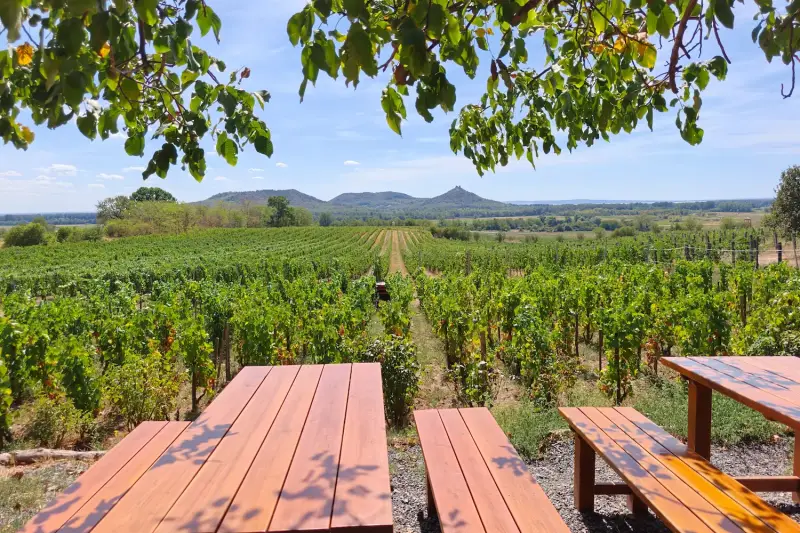
The vineyard view from my outdoor tasting table at Szászi Birtok
Szászi’s wines are expressive, aromatic, and quietly welcoming — shaped by volcanic soils but softened by the family’s gentle, organic approach to farming and winemaking. The range reflects both the diversity of Badacsony and the family’s commitment to preserving its rare local varieties: Muscat‑lifted Gyöngyözőbor, delicate orchard‑fruit Rózsakő, creamy hillside Olaszrizling, silky Kéknyelű, and the light, elegant Csókaszőlő red. Alongside these heritage grapes, the estate continues to rely on its core plantings of Olaszrizling and Pinot Gris, producing wines that balance familiarity with discovery. This breadth of expression shows a different facet of Badacsony — one defined not by tautness or angular precision but by ease, warmth, and a lived connection to the land. Szászi’s wines carry the hillside’s geology, yet they do so with softness and hospitality, reflecting a family that has tended these slopes for decades. In this way, Szászi Birtok helps articulate Badacsony not only as a terroir but as a cultural landscape, where volcanic soils, tradition, and human presence converge in wines that feel both grounded and inviting.
The Shape of Modern Badacsony
Together, Gilvesy and Szászi reveal the two complementary faces of modern Badacsony: one shaped by clean, disciplined, low‑intervention clarity, the other by organic warmth, varietal diversity, and a commitment to preserving the region’s rare heritage grapes. Gilvesy’s wines articulate the volcanic slopes with finesse and textural precision, while Szászi’s range — from Olaszrizling and Pinot Gris to revived local varieties such as Cserszegi Fűszeres, Zeusz, Zenit, Rózsakő, Kéknyelű, and Csókaszőlő — reflects a deep cultural rootedness and a sense of welcome. Together they demonstrate how Badacsony’s basalt hills and lake‑shaped climate can produce distinctive, characterful wines. What emerges is a region with its own identity and momentum: a volcanic landscape interpreted through two different but equally committed visions.
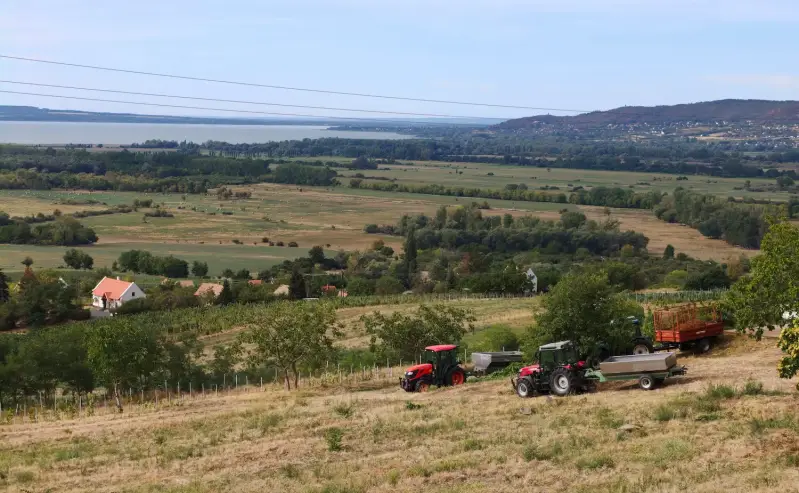
Harvest underway on the Szent György‑hegy vineyards during my visit
About the Author
John Penney is a wine experience guide based in Martinborough–Wellington, New Zealand. His lifelong passion for wine is shaped by extensive international wine travel, formal study (WSET Level 3), and a career in adult learning. He writes about wine from both technical and cultural perspectives, drawing on real‑world tasting, wine travel, and deep research. Through his wineinsights business he provides Martinborough wine tours, Wairarapa wine tours, private wine tasting experiences, and wine education for wine lovers and enthusiasts.
Add comment
Comments