A Volcano Shaped by Time: History, Geology & Living Vines
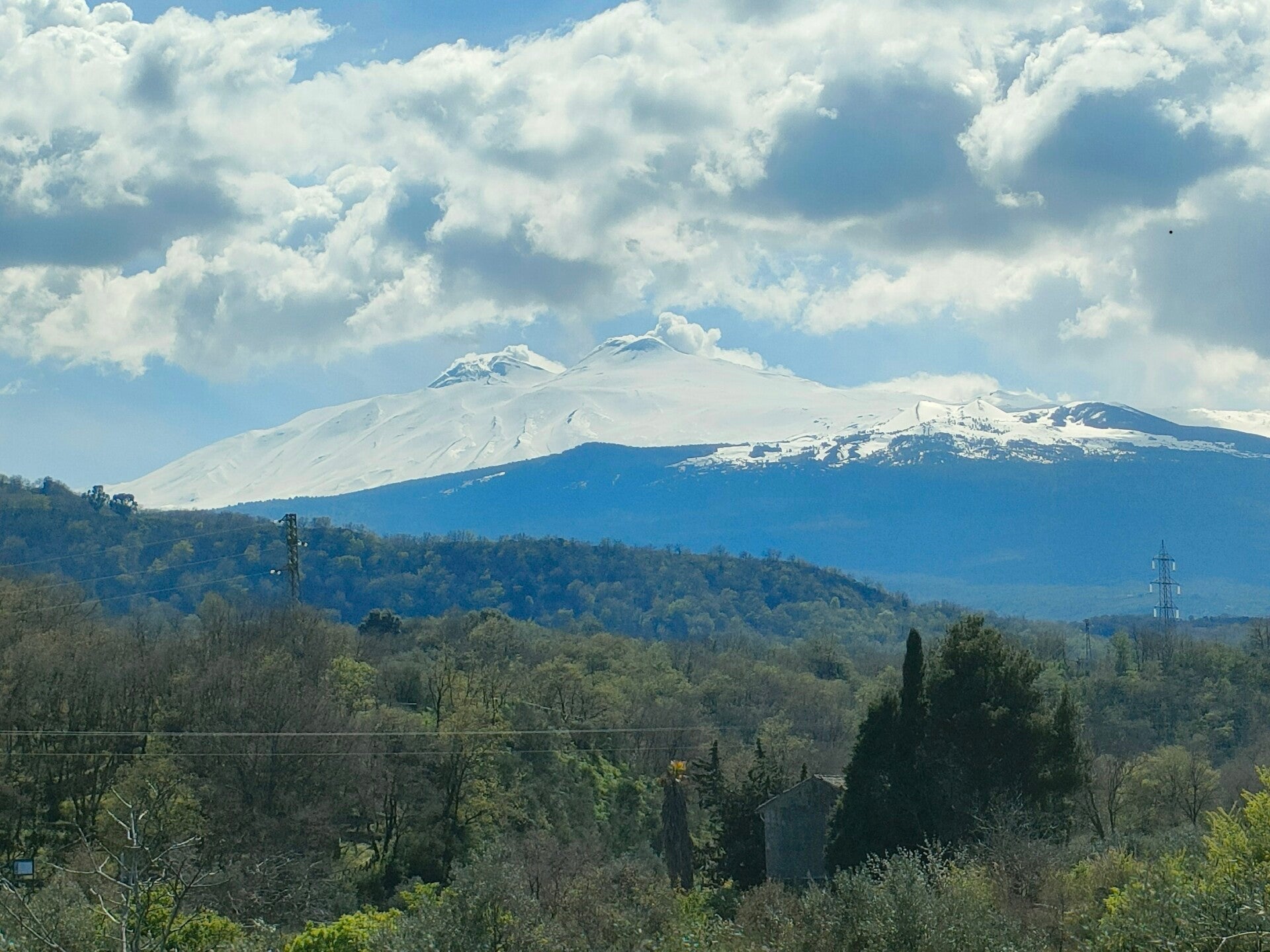
On the northern slopes of Mount Etna, wine is not just agriculture—it’s an ongoing dialogue between fire, ash, and human persistence. Viticulture here dates back to ancient times, with the Greeks first recognizing the potential of Etna’s fertile volcanic soils. Over centuries, successive cultures refined vineyard practices, but the essential character of Etna wines has always been dictated by the mountain itself—restless, unpredictable, and endlessly generative.
What makes Etna especially fascinating from a wine perspective is the way lava flows have shaped the landscape in layers rather than in uniform sheets. When the volcano erupts, molten rock advances in channels and tongues, sometimes engulfing entire vineyards while leaving neighboring parcels untouched. The result is a striking geological patchwork: soils formed from relatively recent lava flows sit directly beside vineyards rooted in far older, weathered deposits. In Etna Nord, this creates extraordinary diversity over very short distances. One plot may be dominated by loose, black volcanic sands from a more recent eruption, while the next rests on deeper, more evolved soils that have had centuries to break down and accumulate organic material. Each responds differently to water, heat, and root penetration—subtle variations that translate directly into the glass.
This fragmented geology has also played an unexpected role in preserving some of Europe’s oldest vines. In many parts of the world, vineyards were devastated in the late 19th century by the aphid responsible for Phylloxera. Yet on Etna, the sandy, volcanic soils proved inhospitable to the pest, allowing certain vineyards—particularly on the northern slopes—to survive on their original rootstocks. These pre-phylloxera vines, some well over a century old, are still cultivated today, their gnarled trunks offering a direct, living link to Etna’s viticultural past.
Traditionally, many of these vines are trained using the alberello system—a low, bush-trained form that shields the plant from wind and conserves moisture. Alongside them are newer plantings: grafted vines, sometimes still trained as alberello (increasingly with metal stakes rather than traditional chestnut), and sometimes on modern vertical shoot positioning (VSP) systems. The coexistence of these approaches—ancient and modern—captures Etna’s essence: a landscape where history is not replaced but layered.
Altitude, Winds & Microclimates: The Living Climate of Etna Nord
If the soils provide the foundation, the climate of Etna Nord brings the wines into focus. Vineyards here climb from roughly 500 to over 1,000 meters above sea level, and altitude is one of the defining factors of style. As you ascend, temperatures fall and diurnal shifts widen—warm, sunlit days followed by markedly cool nights. This slows ripening, preserves acidity, and builds aromatic precision, giving wines from Sicily an unexpected freshness and structure.
Wind is another defining force. Cool air currents descend from the upper slopes of Etna, particularly at night, ventilating the vineyards and reducing disease pressure. Meanwhile, the Ionian Sea exerts a moderating influence, softening extremes and contributing humidity, though less directly than on the eastern flank. Compared to the south side, Etna Nord is generally cooler and receives more consistent rainfall, supporting longer growing seasons and more gradual phenolic development.
The result is not a single climate, but a mosaic of microclimates. Variations in altitude, slope orientation, sun exposure, and the age of underlying lava flows combine to produce markedly different growing conditions within short distances. These differences underpin Etna’s contrade—named vineyard areas that function as distinct terroirs. Moving between them, even within Etna Nord, can feel like moving between entirely different expressions of the same grape.
Classifications, Contrade & Indigenous Varieties
Etna’s modern identity is anchored in the Etna DOC, established in 1968 and now one of the most dynamic appellations in Italy. At its foundation, the DOC defines wines by style:
· Etna Rosso DOC – predominantly red wines
· Etna Bianco DOC – white wines
· Etna Rosato DOC – rosé
· Etna Spumante DOC – sparkling wines, an increasingly important category
Yet the real complexity of Etna emerges beyond this basic framework. Increasingly, producers are emphasizing contrada wines—bottlings from specific named vineyard areas, each reflecting distinct combinations of soil, altitude, and exposure. These contrade function much like crus in Burgundy, offering a more precise expression of place.
At the highest level, some producers go further still, isolating individual parcels or even sections within a contrada—effectively Etna’s “grand cru” equivalents. These wines, often from old or pre-phylloxera vines, represent the most focused and site-specific expressions of the volcano, where micro-variations in soil age or elevation become clearly perceptible.
Underlying all of this are Etna’s indigenous grape varieties, uniquely adapted to the mountain:
- Nerello Mascalese– the defining red of Etna Nord, producing pale, aromatic, structured wines often compared to Pinot Noir or Nebbiolo.
- Nerello Cappuccio – typically blended for color and softness
- Carricante – the backbone of Etna Bianco, especially at altitude, producing mineral, saline, age-worthy wines
- Catarratto – often used to add texture and body
Together, these varieties act as interpreters of Etna’s fragmented terroir, translating subtle geological and climatic differences into distinct sensory profiles.
From Ancient Vines to Modern Estates: A Living Continuum
What becomes increasingly clear across Etna Nord is that progress has not meant abandoning tradition but refining it. Many producers continue to plant new vineyards using the alberello system, even when working with grafted vines, sometimes replacing traditional chestnut stakes with metal supports for durability. Alongside these, VSP-trained vineyards offer efficiency and precision. The result is not a uniform approach, but a thoughtful coexistence of systems, each chosen to suit site and intent.

Ancient albarello trained Nerello Mascalese vine
This same balance defines the evolution of winemaking. Historically, Etna’s wines were produced in small, family-run operations using palmenti—stone wineries built into the slopes, where grapes were processed through gravity-fed systems that required minimal mechanical intervention. These methods were born of necessity, but also of an intuitive understanding of gentle handling.
In recent decades, significant investment has transformed the region. Modern wineries now bring temperature control, cleaner fermentations, and a more precise articulation of terroir. The shift from purely local production to a mix of artisanal and larger, quality-focused estates has dramatically elevated consistency and global recognition.
Yet many producers have not abandoned the past. Instead, they reinterpret it—restoring old palmenti, incorporating gravity flow into new winery designs, and maintaining a philosophy that values minimal intervention where possible. The goal is not modernization for its own sake, but a clearer expression of Etna itself.
At estates like Firriato, this philosophy is especially tangible. Their vineyards include some of the oldest surviving vines on the volcano, studied and certified in collaboration with the University of Catania. Here, pre-phylloxera vines stand alongside younger plantings, forming a continuous thread between past and future.
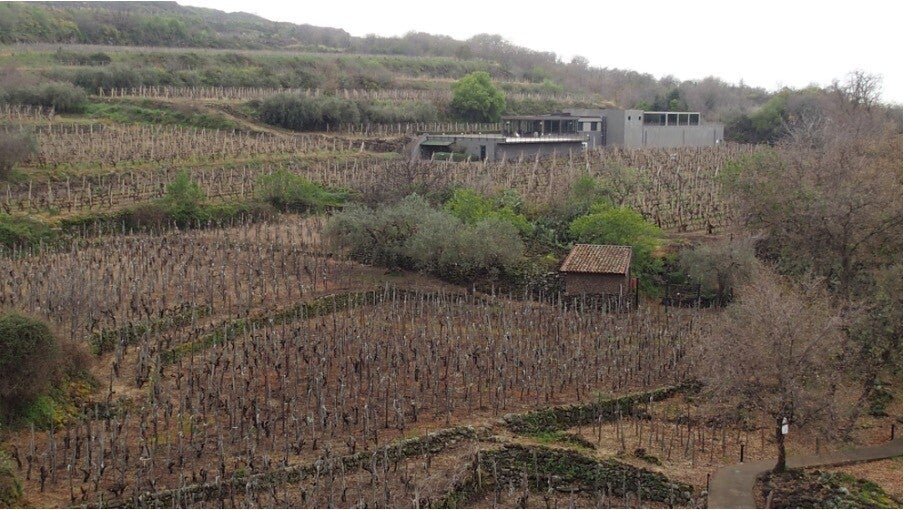
Firriato buildings carefully integrated into the surrounding Etna landscape.
At Firriato’s Verzella estate, this vision extends into a modern winery and hospitality complex carefully integrated into the landscape. The cellar combines contemporary precision with principles reminiscent of the old gravity-fed systems, while the surrounding terraces and vineyards—set against the dramatic northern slopes—anchor the experience firmly in place. It is here that Etna’s layered identity becomes fully tangible, offering not just wines, but a complete immersion into the mountain’s geography, history, and evolving culture—an ideal starting point for a deeper exploration of the estate and its wines.
Return to Verzella and the Cavanera Etnea Estate of Firriato
It felt entirely fitting that my first visit on this more formal exploration of Etna Nord would be to Firriato —a connection that, for me, dates back to 2015 and my very first trip to Sicily. My wife and I were hosted then by the family of the sister of one of my closest friends from my years living in Australia. Although I met him there, his roots are Sicilian, from the town of Francavilla on Etna’s northern slopes.
The day after we arrived, we were invited to join the extended family for lunch at the home of the family matriarch in Verzella—directly opposite what is now Firriato’s estate. It was one of those long, generous Sicilian lunches, full of warmth, conversation, and an easy sense of continuity between land and table. During the meal, I tasted a homemade Nerello Mascalese from the family’s own vineyards—land that has since been sold to Firriato. The wine was rustic, certainly, but even then the defining character of Nerello Mascalese was unmistakable. Afterwards, I remember walking through the old alberello-trained vines, unaware at the time that these very vineyards would one day become part of Firriato, and central to my own deeper understanding of Etna.
The Cavanera Etnea estate of Firriato is an extensive vineyard and hospitality complex nestled between the communes of Castiglione and Randazzo at about 600 metres above sea-level. The buildings are skilfully integrated into the surrounding landscape and the accommodation complex is based on the original palmenti. With vines up to 200 years old, Firriato has the oldest certified (by University of Catania) Nerello Mascalese vines on Etna.
In the photo below with my host Mr Agosta, the Accommodation and Restaurant Manager, you can see how the modern winery and restaurant is built into the surrounding hillside.

The Etna Wines of Firriato
Most of Firriato’s production comes from western Sicily (around Trapani), where the wines are grouped into “Premium,” “Classic,” and “Trendy.” These labels describe style and market level: richer, riper, more polished wines at the top, and simpler, fruit-forward ones below. But when you move to Etna, that logic changes completely. Here, Firriato isn’t organising wines by style—it’s organising them by terroir.
Their Etna wines sit under what they call the “Volcanic” range, all from the Cavanera Etnea estate on the slopes of Mount Etna. This is a fundamentally different environment: high altitude, black volcanic soils, big day–night temperature swings. As a result, the wines are leaner, more mineral, more structured—often compared to Burgundy in style rather than the broader, sun-driven wines of western Sicily.
Within this Etna range, there’s a clear internal progression that mirrors how seriously the winery is expressing the place. At the base are wines like Le Sabbie dell’Etna, which blend fruit from across different parts of the volcano. These are meant to give you a general picture of Etna—fresh, mineral, but relatively approachable.
Above that, you start to see wines labeled simply as Cavanera Etnea, which narrow the focus to the estate itself. These are more precise, but still not tied to a single site.
At the top level are the contrada wines—single-vineyard bottlings from specific named sites on the volcano. This is where Firriato is working in a Burgundian way, trying to show how tiny differences in lava flow, altitude, and exposure affect the wine. These are their most complex, age-worthy Etna wines, built on Nerello Mascalese for reds and Carricante for whites, with a strong sense of minerality and structure.
Alongside these, there’s also a small branch of Etna sparkling wines (like Gaudensius), which apply the traditional method to local grapes—another way of expressing the same volcanic terroir.

The extensive Firriato range displayed in their Cavanera Etnea store
Set against producers such as Tenuta delle Terre Nere, Graci, I Custodi delle Vigne dell’Etna and Pietradolce, Firriato’s Etna wines occupy a more visibly “crafted” stylistic middle ground. While all of these estates work with the same core varieties and volcanic terroir, the others tend to push further toward transparency and minimal intervention: Terre Nere with its Burgundian, parcel-by-parcel precision and restrained extraction; Graci with a cooler, almost austere expression shaped by large neutral oak and long élevage; I Custodi with a more artisanal, sometimes deliberately rustic approach rooted in traditional farming; and Pietradolce with a clean, high-altitude purity and relatively hands-off cellar work. Firriato, by contrast, shows a slightly more interventionist hand in the winery—through more consistent use of oak, controlled fermentations, and a polished, structured finish—resulting in wines that are still recognisably Etna in their minerality and lift, but with a rounder, more composed profile that reflects both terroir and technique.
The estate was closed for further development during our visit and the sommelier was not available, so we tasted just three wines as an introduction to the Firriato style and the signature grapes of the region.


Le Sabbie dell’Etna Bianco 2024
Mainly bush vine Carricante with a proportion of Catarratto from high altitude Etna vines. The winemaking is deliberately restrained: hand-harvested fruit is softly pressed and fermented in temperature-controlled stainless steel, with no use of oak. A short period of lees ageing adds texture without diminishing the wine’s freshness, followed by brief bottle ageing before release. Light lemon in the glass with aromas of yellow flowers, citrus, pear and fennel. On the palate citrus and orchard fruit notes sit alongside a saline, lightly smoky character, supported by bright acidity and a gently rounded but still linear palate with good persistence. In the context of Firriato’s range, it represents an accessible, regional expression of Etna Bianco, prioritising clarity and drinkability over site-specific complexity.
Cavanera Belza della Poiane Contrada Zotorinetto Etna Bianco 2022
Produced entirely from Carricante grown on the northeastern slopes of the volcano near Castiglione di Sicilia. Sourced from a single contrada, the focus shifts from regional character to micro-terroir, with volcanic soils and altitude shaping both structure and aromatic precision.
Light lemon in the glass, the wine shows a more concentrated and structured profile than Le Sabbie dell’Etna, with pronounced minerality and salinity underpinning almost pungent aromas of white flowers, citrus zest, peach and fennel with a balsamic edge. The more structured palate is fuller and more layered, combining intensity of flavour with elegance, and finishes with a persistent, savoury length marked by stony minerality.
Cavanera Sciaro del Figlio Contrada Zucconero Etna Rosso 2021
Firriato’s single-vineyard expression of Nerello Mascalese grown at around 800 metres on the northern slopes of Etna, where volcanic sands and significant diurnal shifts contribute to both aromatic complexity and structural tension. The winemaking follows a traditional but controlled approach: hand-harvested fruit undergoes classic red fermentation with maceration, followed by full malolactic conversion. The wine is then aged for an extended period—around 18 months in French oak tonneaux, with additional bottle ageing—introducing a measured oak influence that refines tannins and adds textural depth without overwhelming the site character.
Light ruby in the glass, with a nose of cherry, plum and blackberry interwoven with pot-pourri and a hint of peppery spice. The palate is full yet composed, with a lovely rich entry combining firm but silky tannins, a hint of licorice and a persistent, mineral-tinged finish.
In contrast with the approachable and easy style of the Le Sabbie, both Cavanera wines reflect a more deliberate expression of site, and a more precise, structured approach for wines that will age.
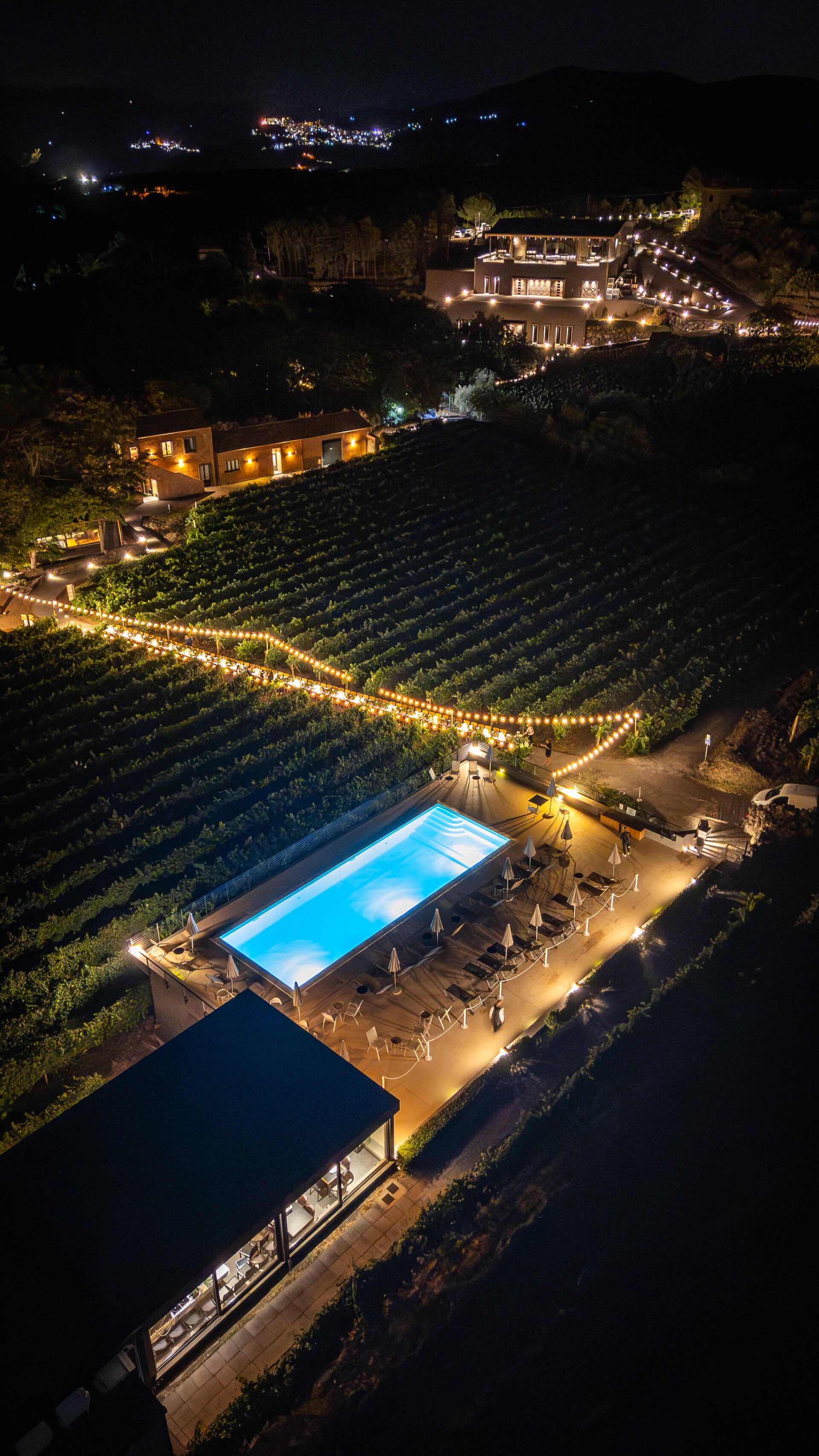
An expansive image of Firriato Cavanera Etnea (kindly provided by the Firriato team)
From First Impressions to Deeper Exploration.
With this compact yet thoughtfully curated introduction to the wines of Mount Etna, I left having only just begun to scratch the surface. Firriato offered a clear and structured lens through which to understand the mountain—its altitudes, its soils, and the interplay between winemaking and place—but it also sharpened my curiosity about how others interpret the same landscape.
Etna, after all, is not a singular story but a mosaic of sites, philosophies, and evolving traditions. From the old vines of Verzella to the emerging voices shaping Etna Nord today, there is a constant dialogue between past and future, restraint and expression. This first encounter set the stage, but it is only in contrast that the full picture begins to emerge.
In the next two instalments, I turn to a selection of producers whose approaches differ markedly in both vineyard and cellar, offering a deeper and more nuanced exploration of Etna’s identity. Together, they begin to reveal the true complexity of the volcano—one that cannot be captured in a single visit but only understood through a series of perspectives.
About the author
John Penney is a wine experience guide based in Martinborough, New Zealand. His lifelong passion for wine has been deepened through extensive international wine travel, formal wine study (WSET3) and a career in adult learning. Through his Martinborough-based business wineinsights, he provides exceptional wine tour, wine-tasting and wine education experiences for wine lovers and enthusiasts.
Add comment
Comments