If the first stage of this journey offered a framework through which to understand Etna—its elevations, exposures and the structural clarity of its wines—then the next step leads not forward, but back.

Ancient vats inside the old Palmento preserved at Graci
Across the slopes of the volcano, scattered among terraces of black basalt and dry-stone walls, lie the remnants of an older way of working: the palmenti. These stone-built fermentation houses, once central to rural life on Etna, speak to a time when wine was made not as a commercial product but as an agricultural necessity—deeply embedded in the rhythms of the land.
Though many now stand silent, their presence continues to shape the identity of the mountain. For some producers, they are artefacts of a past era; for others, they remain a living reference point—symbols of continuity rather than nostalgia.
It is within this context that two estates, encountered in succession but distinct in philosophy, offer particularly compelling perspectives. Both engage directly with Etna’s historical fabric yet interpret it in markedly different ways: one rooted in custodianship and revival, the other in preservation and refinement.
Together, they begin to illuminate what “tradition” means on Etna today—not as a fixed point in time, but as something continually redefined.
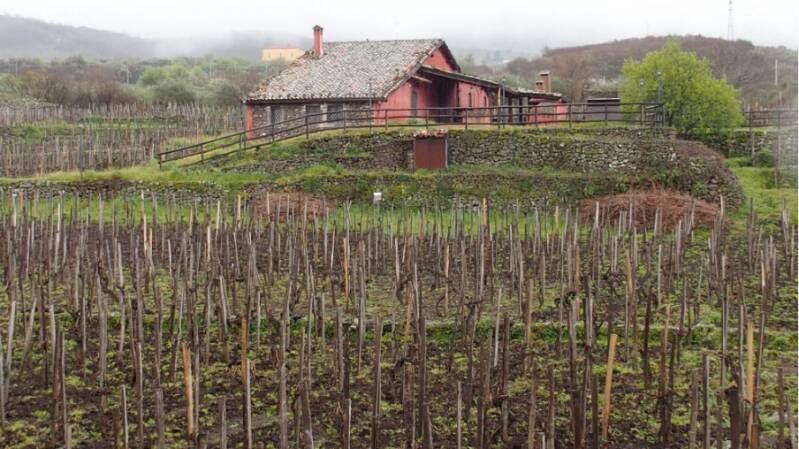
Commitment to tradition exemplified in I Custodi’s retention of the albarello vine training system
I Custodi delle Vigne dell’Etna: Preservation as Practice
Set on the southeastern slopes of Etna, I Custodi delle Vigne dell’Etna was founded with a clear and deliberate purpose: to safeguard the viticultural heritage of the mountain at a moment when much of it risked being lost.
The project was initiated by a group of individuals deeply connected to Sicilian wine, including oenologist Salvo Foti, alongside owner Mario Paoluzi and Marco Marinetti, his friend and partner, whose shared vision centres on the preservation and revival of Etna’s historic vineyards. It was Marco himself who guided my visit—an experience that brought an added immediacy to the estate’s philosophy, articulated not in abstract terms but through the vineyards and structures themselves.
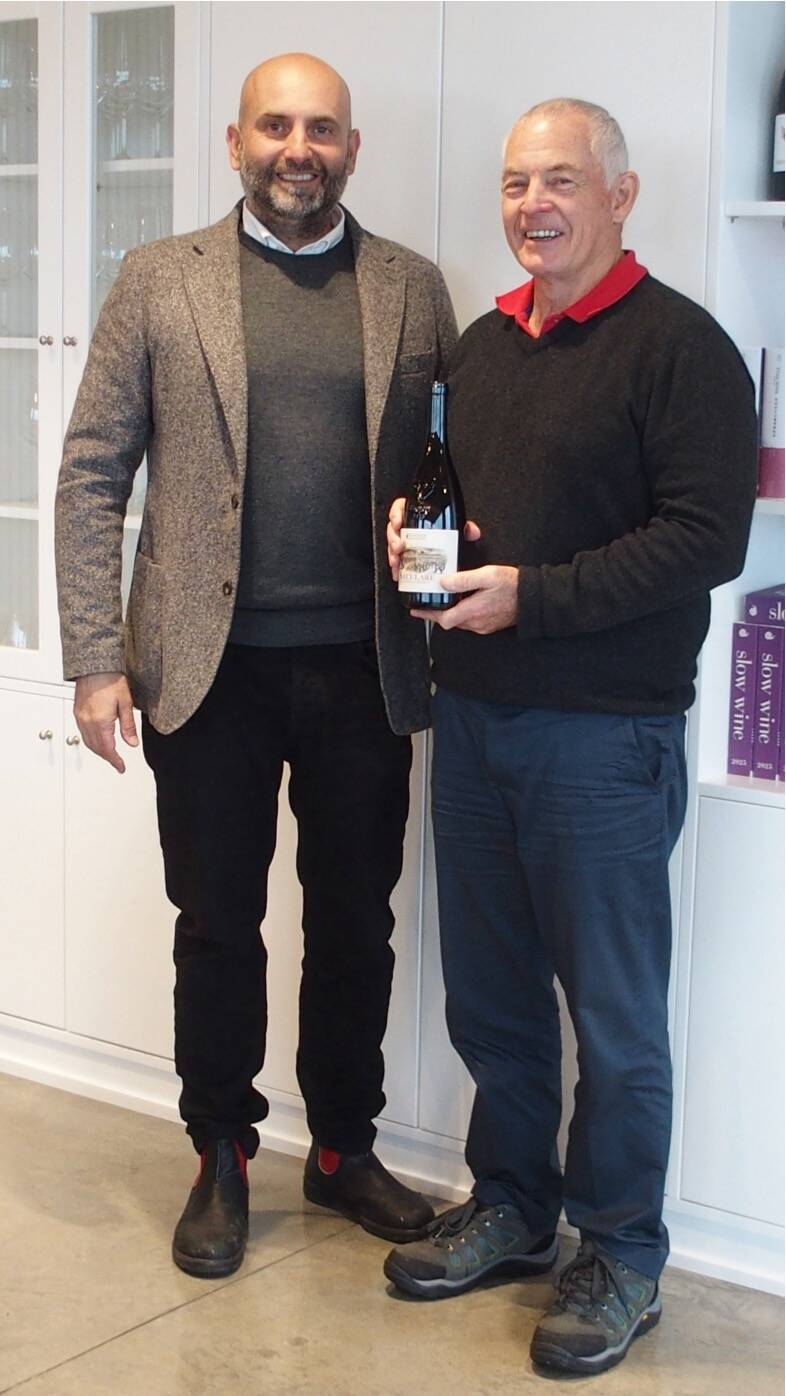
With Marco Marinetti, one of the I Custodi partners
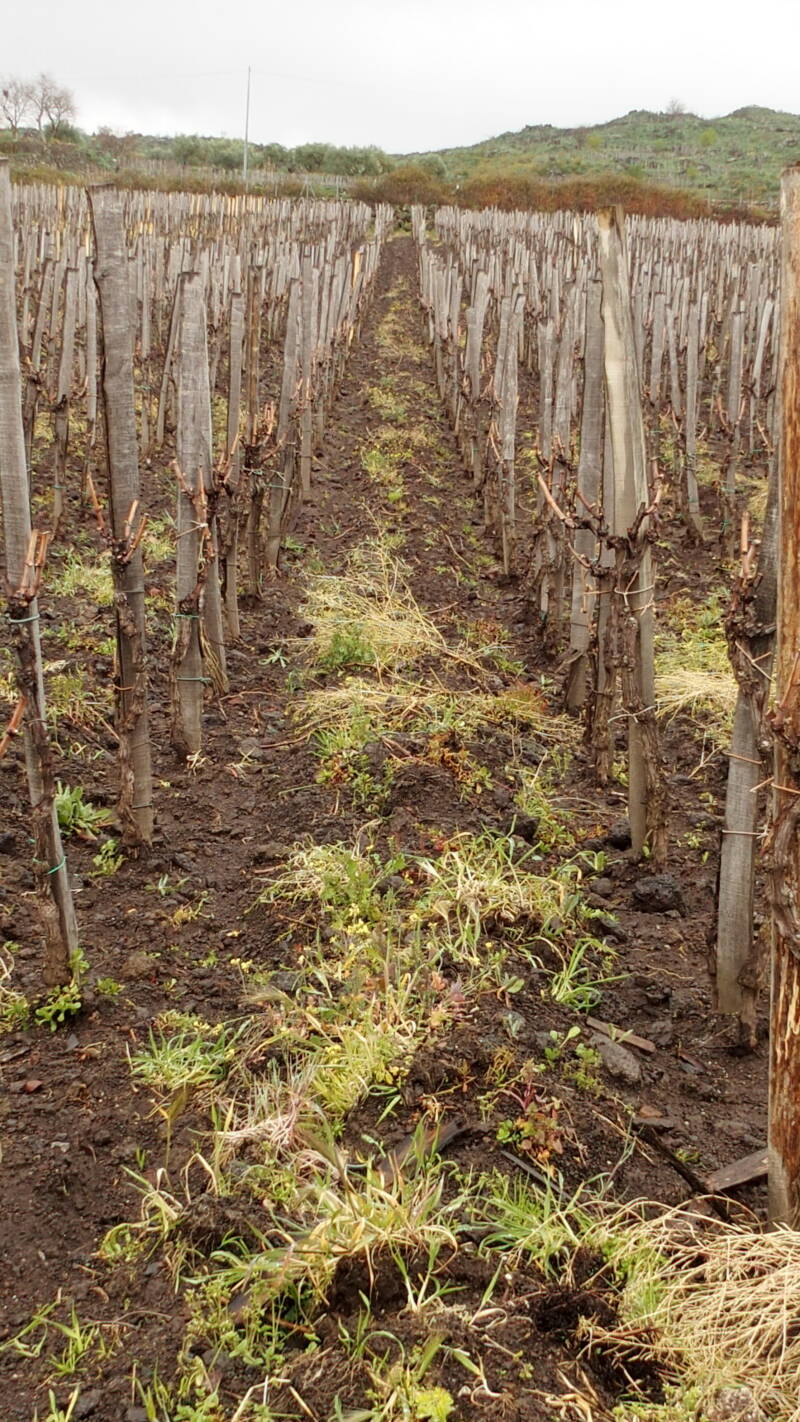
Albarello trained vines right on the edge of budburst
Rather than establishing new plantings in a conventional sense, I Custodi has focused on identifying and restoring old, often neglected plots—many of them planted with pre-phylloxera vines and cultivated according to methods that have remained largely unchanged for generations. Alongside these, newer plantings are often carried out at relatively high density, encouraging competition between vines and promoting naturally lower yields, concentration, and deeper root penetration into Etna’s complex volcanic soils. The traditional alberello training system remains central, particularly in older sites, reinforcing a continuity of form as well as practice.
Viticulture is conducted with a firmly low-intervention approach. Treatments are limited to elemental sulphur and copper-based sprays, applied in the form of Bordeaux mixture when conditions require, with the emphasis on maintaining ecological balance rather than imposing control. There is no use of systemic chemicals, and the majority of vineyard work—pruning, canopy management and harvesting—is carried out by hand, often on steep, terraced sites where mechanisation is neither practical nor desirable.
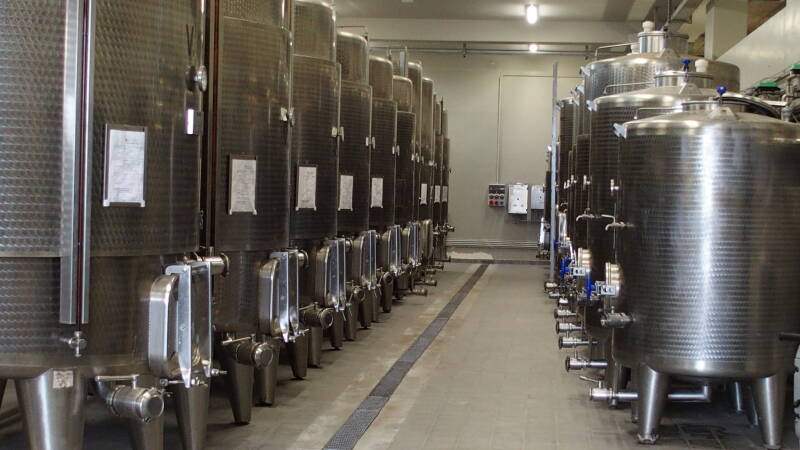
This philosophy extends into the cellar. Fermentations are spontaneous, relying on native yeasts, and carried out with minimal technological intervention, though within a winery that is itself clean, precise, and thoughtfully equipped. Stainless steel tanks and French oak barriques are used not to impose style, but to provide control and stability where needed. Extraction is gentle and measured, allowing tannin and structure to emerge gradually, while the use of sulphur is kept deliberately low, introduced only where necessary to preserve stability without masking the expression of site.
The presence of historic palmenti within their holdings reinforces this connection to Etna’s past. While no longer used for active vinification, they serve as physical reminders of a time when winemaking was inseparable from place—when each contrada functioned as a self-contained system, and where gravity, rather than technology, guided the process from grape to must.
The wines that emerge from this approach tend to reflect that ethos: less about precision or polish, and more about texture, nuance and a certain unforced authenticity. They do not seek to reinterpret Etna, but rather to allow its older voice to remain audible.
Tasting: I Custodi delle Vigne dell’Etna
After a tour of the winery and surrounding vineyards Marco then led me through a generous, illuminating tasting of the following wines, each one offering a distinct inflection of that philosophy in the glass.
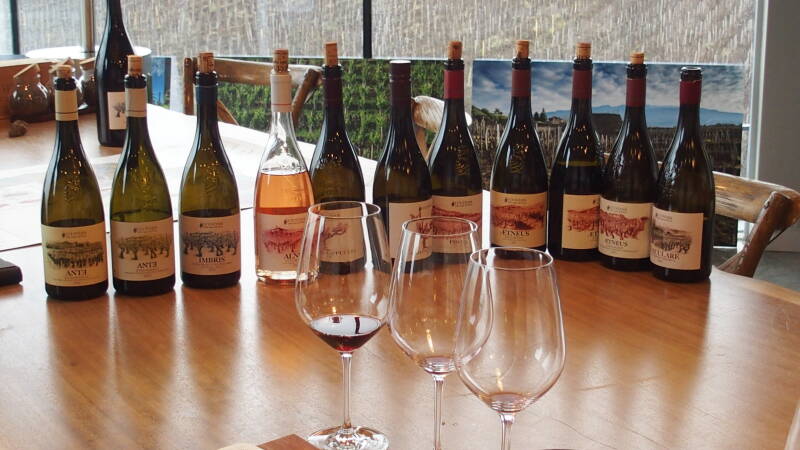
Ante Etna Bianco 2022. 100% Carricante from vineyards in Contrada Taverna on the East of Mt Etna, whole bunch pressed, fermented in stainless, matured in tank for 18 months then another 12 months in bottle before release. Lemon gold in the glass with shy nose of yellow flowers, citrus and fennel. In the mouth quite rich and mouthfilling with savoury citrus and mineral flavours and a satisfying mineral-edged finish that begs another mouthfill.
Ante Etna Bianco 2013. 100% Carricante and a masterclass in the sheer ageability of wins from this grape. Gold in the glass with aromas of marigolds, honey, citrus and wet stone. Utterly gorgeous on the palate with layers of flavour, intensely mineral, persistent and totally moreish!
Imbris Etna Bianco Superiore 2021. Grapes from Contrada Caselle in Milo. Bright lemon in the glass with notable aromas of honey, citrus flowers, citrus zest and a touch of smoke. Fresh and fruity on the palate but with a distinct minerality and excellent length. Already delicious but give it 5-8 more years!
Alnus Etna Rosato 2024. 80% Nerello Mascalese, 20% Nerello Cappuccio grapes from 10 year old vines on Contrada Muganazzi. Hand harvested, whole-bunch pressed with immediate separation of the must from the skins. Salmon in the glass with distinct strawberry, raspberry and red apple aromas. On the palate the fruit gives way to more herbal flavours with fresh acidity, persistent minerality and a touch of spice.
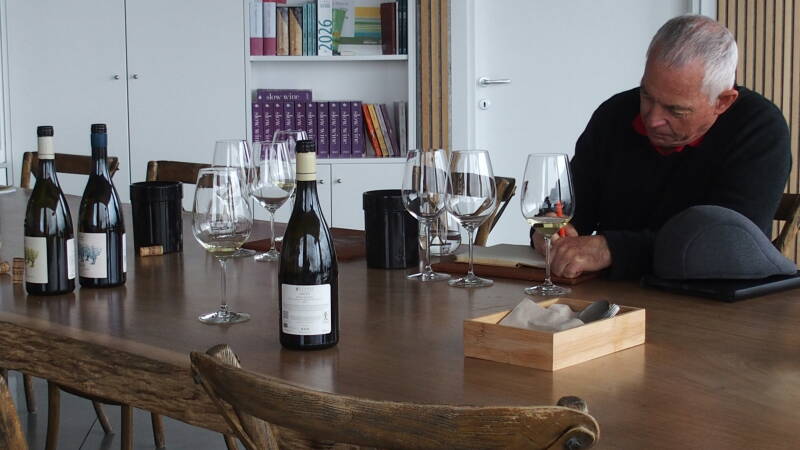
Pistus Etna Rosso 2024. 80% Nerello Mascalese, 20% Nerello Cappuccio from 10-year-old vines on Contrada Muganazzi, handpicked and sorted, destemmed and fermented in stainless to replicate the everyday Sicilian peasant wine. Fully ruby in the glass with aromas of violets and ripe berry fruits. On the palate medium-bodied with fresh berry and plum flavours, soft tannins, gentle freshness and medium length, an easy drinking red, perfect for a working lunch!
Aetneus Etna Rosso 2021. From albarello vines on Contrada Muganazzi mostly between 50 and 80 years old with a few more than 100 years old, 80% Mascalese, 20% Cappuccio, handpicked grapes, 80% destemmed, fermented in tank then racked to 500 litre oak barrels for 12 months aging, followed by another 3 years in bottle before release. Purple ruby in the glass with concentrated dark berry and dark cherry aromas and a tobacco lift. Rich and plush on the palate with soft tannins, adequate freshness and a cocoa edged fruity finish.
Aetneus Etna Rosso 2011. Purple ruby in the glass, bricking on the rim, with a slightly rustic edge on the dark berry fruit nose, edged with smoke and tobacco, dry on the palate with a tobacco and tar edge to the dark cherry and berry fruit, a long layered savoury finish with a slight hint of barnyard that some will love and others might not.
Taken as a whole, these wines form a deeply evocative portrait of Etna that privileges continuity over clarity, where time, vine age, and traditional handling shape wines of texture, evolution, and quiet complexity. From the layered, age-defying Carricante bottlings to the more rustic, immediately expressive reds, there is a consistent thread of savoury minerality, gentle oxidation, and an unpolished honesty that feels intimately tied to the rhythms of the land and its history. These are not wines chasing definition or precision, but rather embracing nuance, variability, and a kind of lived-in authenticity—wines that speak in a slightly older dialect of Etna.
Graci: Tradition Reframed
It is precisely this contrast in philosophy and expression that sets the stage for Graci, where the same landscape is interpreted through a lens of greater refinement, detail, and compositional focus.

The estate of Graci, located on the northern slopes near Passopisciaro, represents a different, though no less considered, engagement with Etna’s past. Established by Alberto Aiello Graci in the early 2000s, the estate reflects a deeply considered relationship with Etna’s terroir—one shaped as much by observation as by intent. Although Alberto had originally offered to host our visit, a lapse in coordination on my part meant he was away when we arrived. In his place, I was generously received by Vincenzo, a senior member of the team, whose insight and familiarity with the estate provided a clear and thoughtful introduction to its workings.
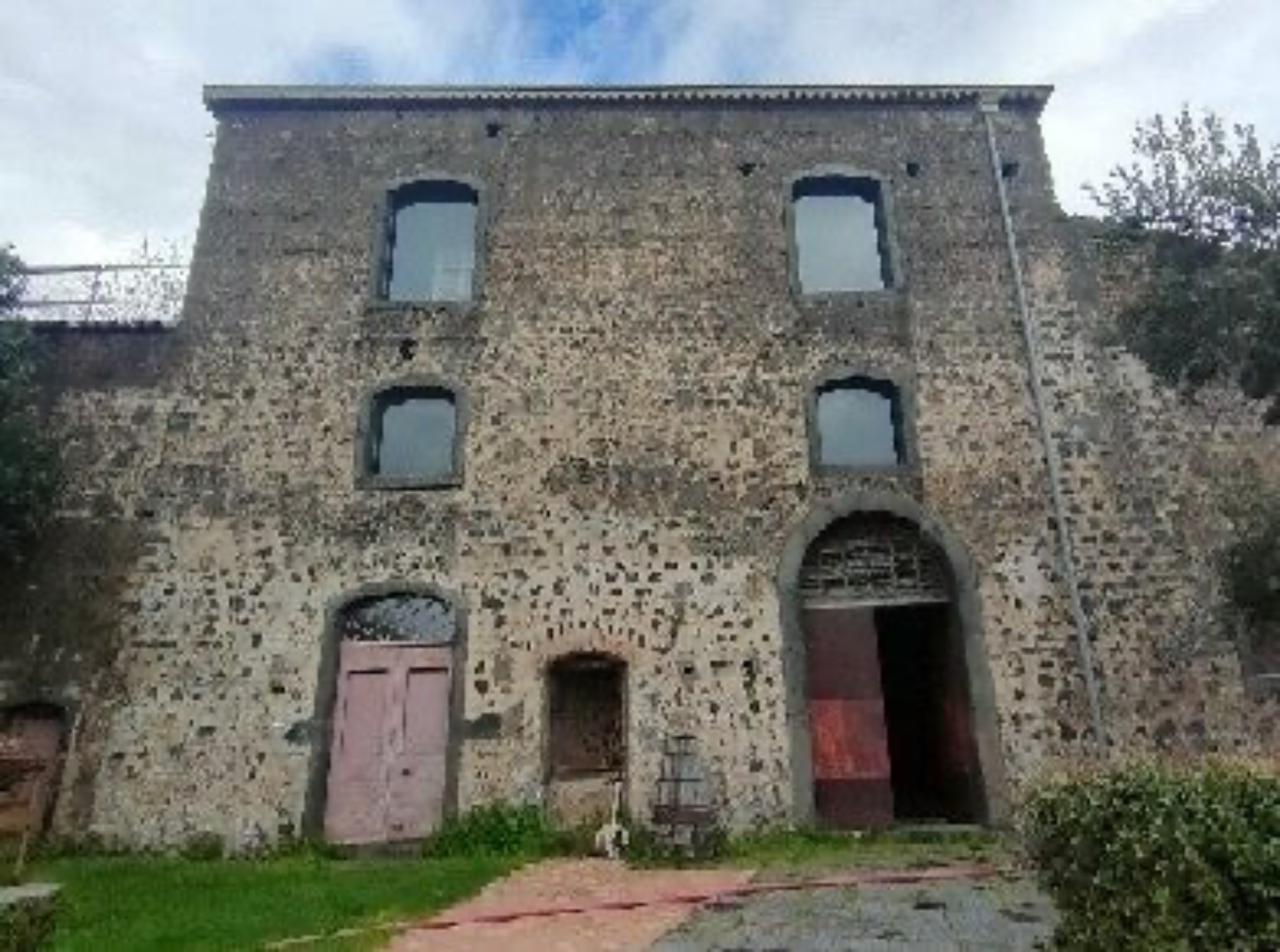
The ancient palmento preserved as a museum on the Graci estate.
The estate is notable for its remarkable collection of historic palmenti, preserved in situ and maintained almost as a working archive of Etna’s winemaking heritage. Walking through them offers a rare insight into the practical realities of traditional production: gravity-fed fermentation, separation of musts, and a system designed as much by necessity as by ingenuity. Set just above the current winery, one such palmento is preserved almost as a quiet museum overlooking the modern cellar—an architectural and symbolic bridge between past and present, where the memory of Etna’s older practices remains physically and visually present.
Yet, unlike at I Custodi, this legacy is not something Graci seeks to replicate directly. Instead, it informs a philosophy that is firmly rooted in the present. Vineyard work is meticulous, with a strong focus on individual contrade, and is carried out under certified organic principles that avoid herbicides and prioritise ecological balance. Low yields, careful selection, and a sensitivity to each site’s natural rhythm underpin an approach that seeks clarity rather than intervention. Sustainability here extends beyond the vine itself, encompassing a broader commitment to biodiversity and the preservation of the surrounding landscape, reinforcing the long-term resilience of the ecosystem.
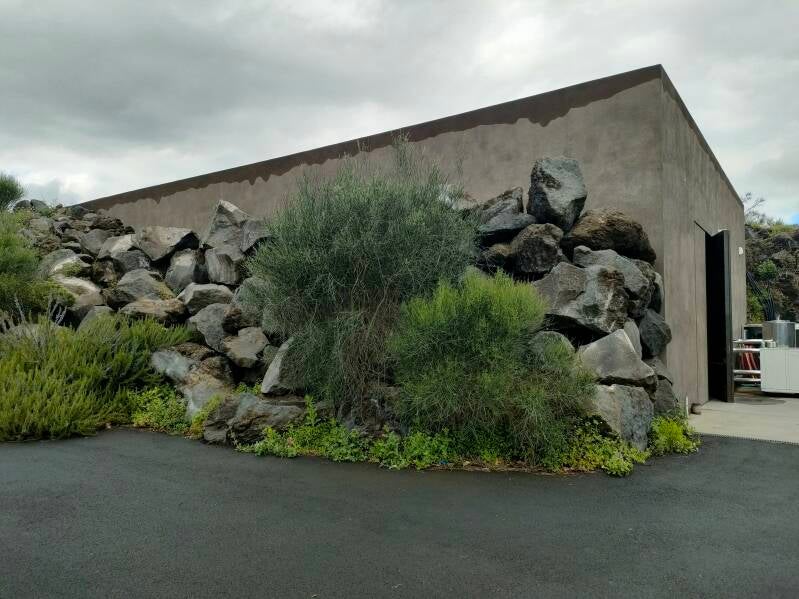
The perfectly landscaped and powerfully evocative Graci winery
In the cellar, practices favour restraint and transparency, allowing site expression to take precedence over technique. The resulting wines are often more linear and defined, shaped by a pursuit of balance and detail rather than overt rusticity. Where I Custodi leans into continuity through preservation, Graci channels it through interpretation—offering a vision of tradition that is distilled, rather than restored.
Tasting: Graci
What followed was a tasting of notable breadth and generosity, an experience that brought the estate’s philosophy into sharp and tangible focus. Moving through the wines, a quiet coherence emerged—each bottle a variation on a theme of clarity, restraint, and finely judged expression of place.
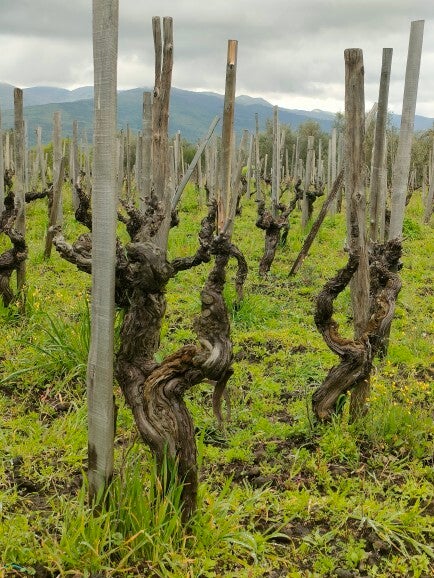
Old albarello trained Nerello Mascalese vines at Graci
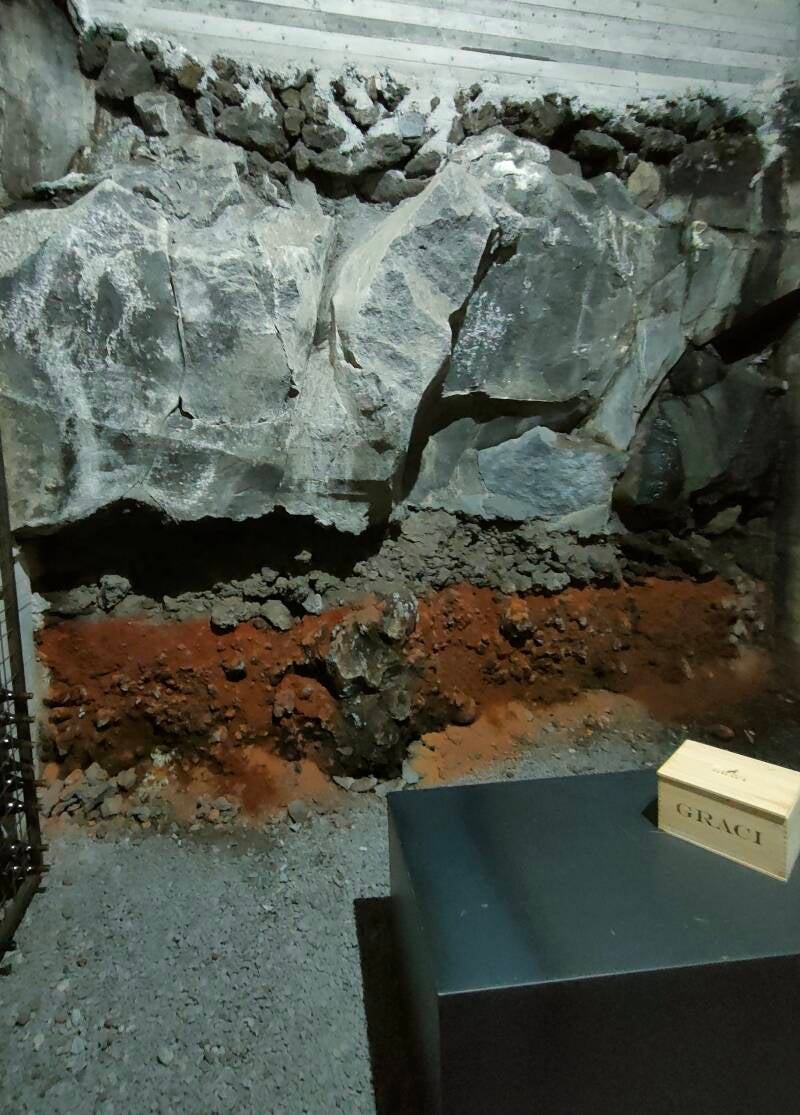
Successive volcanic layers over iron rich deposits
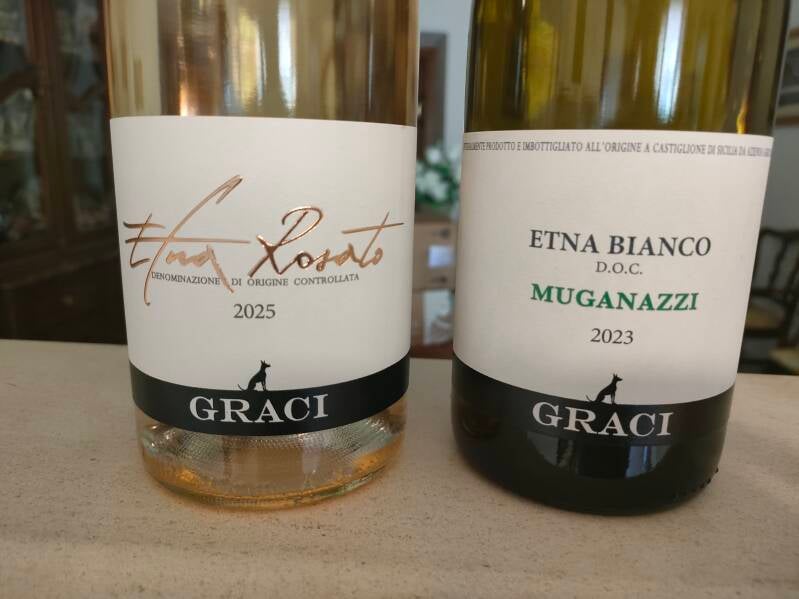
Etna Rosato 2024. From 100% Nerello Mascalese grapes grown on iron rich dark brown almost sandy volcanic soils from the NE slopes of Etna at Passopisciaro. Just a one-hour maceration then pressed to concrete tanks for fermentation and 8 months maturation on lees before bottling. Pale copper-pink with red apple, raspberry aromas with a floral lift and hint of spice. Bright, fresh and flinty on the medium-bodied palate with a long mineral finish.
Etna Bianco Arcuria 2023. 100% Carricante from Contrada Arcuria at 600 metres elevation on NE Etna slopes. Fully destemmed grapes are gently pressed 50% into concrete vats and 50% into 1000 litre oak vessels for fermentation followed by 12 months aging on lees and a further 12 months in bottle before release. Pale lemon-straw in the glass with aromas of citrus, white flowers and fennel. Crisp and dry on the medium-bodied palate with a distinct minerality and herbal edge over restrained peach, apple and lemon flavours with a lovely salty edge on the lingering finish.
Etna Bianco Muganazzi 2023. 100% Carricante from Contrada Muganazzi around Passopisciaro on Northern slopes of Mt Etna, slightly higher than Arcuria but more protected from wind and with more organic material in the deeper soil making for a warmer and more water retentive terroir. Pale lemon in the glass (darker than Arcuria) and more pronounced fruity aromas with a tropical overlay to the lemon wax, orange blossom and apricot key notes. The palate is more full-bodied and concentrated but retains tension and acidity with that characteristic saline minerality on the long finish.
Etna Rosso 2023. 100% Nerello Mascalese from multiple contrade on Nth Etna slopes between 600 and 700 metres. Mostly fermented and aged in concrete with a small portion in large format oak. Light ruby in the glass with violets, sweet cherry and dried herb aromas. The medium bodied palate features firm but fine-grained tannins, bright fresh strawberry and cherry fruit, with some gentle clove spice and a clean crunchy fruit finish.
Etna Rosso Arcuria 2022. 100% Nerello Mascalese grapes grown at Contrada Arcuria on Nth Etna, 3-4 bunches per vine, fermented and aged in large format oak with a long maceration. Light ruby in the glass with mineral and cherry aromas, a hint of baked plum and some cedary spice. On the medium-bodied palate the tannins are firm, the acidity is perfectly balanced and there is a distinct savoury minerality overlaying the red fruit flavours. Excellent length with intense minerality.
Etna Rosso Arcuria Sopra Il Pozzo 2015. From a single vineyard within Contrada Arcuria, only a few bottles made. Pale ruby with a garnet edge, complex aromas of pot pourri, maraschino cherry, star anise and woody herbs. The palate is medium-bodied with firm but fine tannins, ample freshness and a delicious melange of ripe red fruit, savoury herbs and spice. The finish is long, mineral edged and smoky. A compelling demonstration of the ageability of the grape.
Etna Bianco Arcuria 2012. What an absolute treat! Bright mid- lemon in the glass with distinct notes of honey, citrus pith and green olives on the nose. On the palate the wine is soft and round with sweet, honeyed olive flavours (yes I know that sounds strange but the taste was delicious!), the finish very long and satisfying.
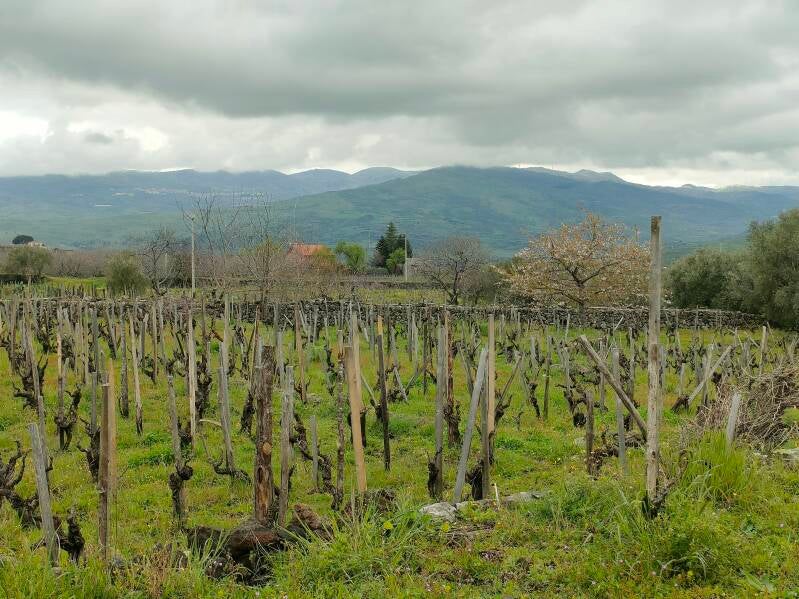
Taken together, these wines articulate a remarkably coherent vision of Etna that is both precise and expressive, where site transparency and thoughtful élevage converge to highlight nuance over power. Across both Carricante and Nerello Mascalese, Graci captures the tension between altitude, soil, and exposure: from the linear, saline-driven profile of Arcuria to the broader, more textural and exotically fruited character of Muganazzi, and from the vibrant, lifted freshness of the Rosato and entry-level Rosso to the layered depth and age-worthy structure of the single contrada and older bottlings. What emerges is a house style defined by clarity, restraint, and mineral fidelity—wines that speak fluently of their volcanic origins while demonstrating that elegance and longevity on Etna come not from extraction or weight, but from balance, precision, and an intuitive understanding of place.
Two Faithful Expressions of Place
Experiencing I Custodi and Graci in close succession reveals not contrast so much as dialogue: two distinct yet deeply connected readings of the same volcanic text. One speaks in the cadences of memory and continuity, the other in lines of clarity and refinement, yet both remain rooted in a profound respect for place. Together, they sketch the outlines of Etna’s identity—not as something fixed, but as something continually evolving, shaped by those who farm its slopes. This evolving narrative continues into the final visits of our journey, at Tenuta delle Terre Nere and Pietradolce, where these themes are explored from yet further perspectives.
About the author
John Penney is a wine experience guide based in Martinborough, New Zealand. His lifelong passion for wine has been deepened through extensive international wine travel, formal wine study (WSET3) and a career in adult learning. Through his Martinborough-based business wineinsights, he provides exceptional wine tour, wine-tasting and wine education experiences for wine lovers and enthusiasts.
Add comment
Comments