An exploration of Western Sicily centred on Planeta’s Ulmo estate — its landscape, history, biodiversity and cultural depth — culminating in a tasting that spans the island from Etna to Noto, Vittoria to Capo Milazzo. It offers a reflective introduction to Sicily’s complexity and lays the foundation for deeper study in the future.
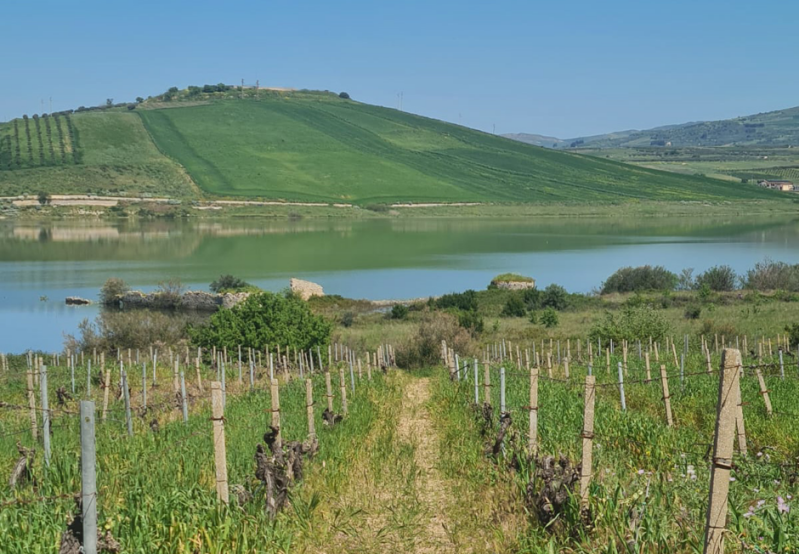
This visit follows my earlier introduction to Western Sicily, where I explored two contrasting wineries — one large, one boutique — and first began to understand the region’s character. That initial encounter created the framework for what Ulmo reveals in greater depth: a more expansive, layered perspective on the landscape and the people shaping it.
Planeta – History, Landscape and the Ulmo Estate
Planeta’s modern story begins in the mid-1990s, when cousins Alessio, Francesca and Santi Planeta set out to explore the potential of Sicily’s extraordinary diversity through a network of distinct estates. Although the family has been rooted in the island for seventeen generations, the contemporary project was built on a new idea: that Sicily’s major winegrowing regions — from the limestone hills and coastal plains of Menfi in the west to the volcanic terraces of Etna in the east, from the calcareous soils of Vittoria to the baroque landscapes of Noto and the maritime headlands of Capo Milazzo — could each express a different facet of the island’s identity. Today, Planeta’s vineyards form a near complete cross section of Sicily’s viticultural geography, spanning almost every significant terroir on the island. This breadth also shapes the rhythm of the vintage: harvest unfolds across nearly 90 days, beginning in early August in the western estates and concluding in late October on the high-altitude slopes of Etna. It was against this backdrop of island‑wide diversity that my visit to Ulmo began, offering a ground‑level view of how these ideas take shape in practice.
The next generation of the family — including Chiara Planeta, niece of the founding cousins Alessio, Francesca and Santi — is now involved in carrying the project forward. As a member of the younger generation Chiara represents the continuity of the family’s work. During my visit, it was she, together with the estate winemaker Calogero Riportella, who guided me and my friend through an exceptionally comprehensive tour of the estate: the vineyards, the Iter Vitis museum spaces, the historical palmento, and finally the tasting. Their partnership — her perspective shaped by family heritage and deep familiarity with the land, his by technical precision and an intimate understanding of the cellar — offered a vivid sense of how the estate is evolving. The experience was not simply a walk-through but a layered introduction to Ulmo’s agricultural, historical and cultural identity, shaped directly by two people most closely connected to its present-day expression. Their perspectives also framed the estate’s evolving approach in the cellar, where stylistic refinement has become increasingly central
The winemaking philosophy at Planeta has shifted subtly but meaningfully over the years. The current winemaker works with a focus on clarity, restraint and site expression: cleaner ferments, gentler extractions, and a more attentive approach to élevage. The wines from recent vintages show this clearly — recognisable continuity with the past, but with greater definition and transparency. It is a refinement rather than a reinvention, shaped by both experience and the changing conditions of Sicilian viticulture.
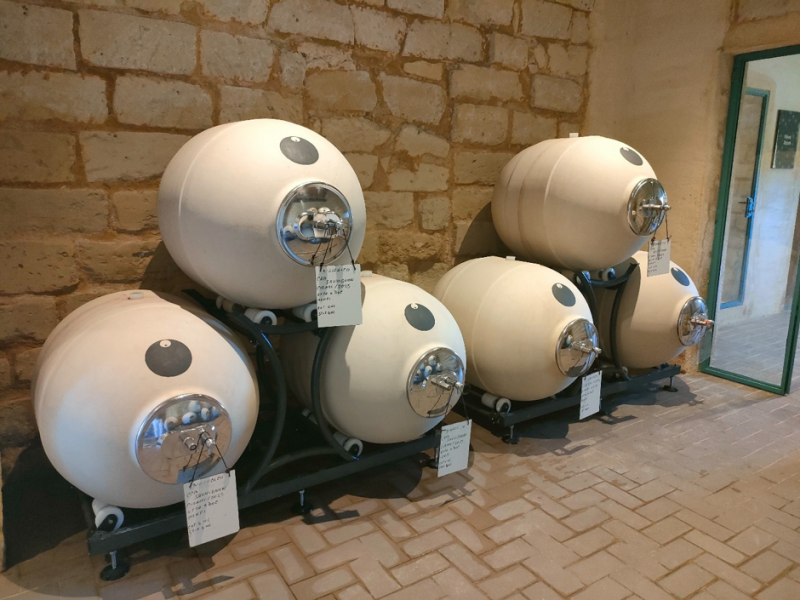
These small ceramic “eggs” with Cabernet Sauvignon in Planet’s Ulmo winery speak to the precision focus of their winemaking.
Ulmo: Landscape, History and Renewal
Nowhere is the interplay of history, landscape and renewal more visible than at Ulmo, the estate where the modern Planeta project began. Located near Sambuca di Sicilia, Ulmo is both the geographic and symbolic origin point of the family’s contemporary winemaking. The 16th century farmhouse anchors the property, surrounded by rolling vineyards, pockets of native vegetation, and the shimmering expanse of Lake Arancio. Even before tasting a wine, the estate communicates a sense of layered time: agricultural, architectural and cultural.
Walking through the vineyards with Chiara and Calogero Riportella, the scale of renewal becomes immediately apparent. Many parcels have been replanted in recent years, with young vines establishing themselves alongside older blocks that date back to the early years of the project. The replanting is strategic rather than cosmetic — a response to evolving climatic conditions, improved clonal material, and a desire to refine the match between variety and site. Their explanations — Chiara’s grounded in family memory and long-term vision, Riportella’s in the practical realities of vine age, soil structure and fermentation outcomes — made the landscape legible in a way that would have been impossible to grasp alone.
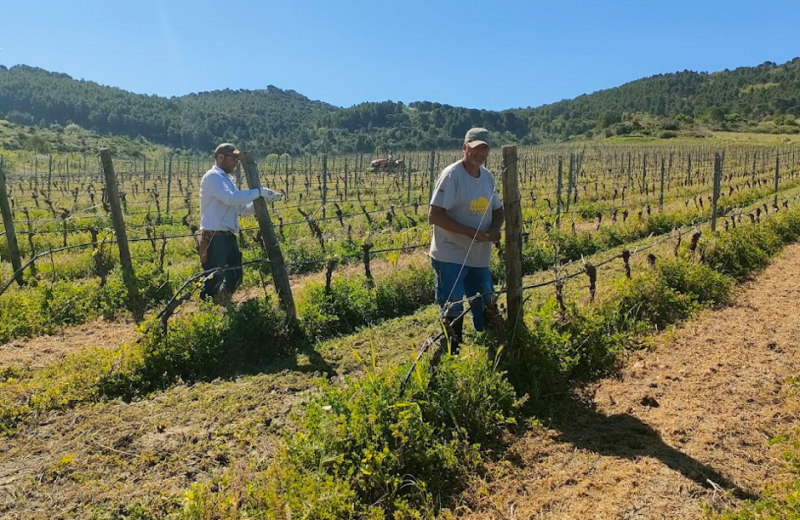
Workers adjust trellis wires at Ulmo
One of the defining features of Ulmo is its biodiversity. Much of the estate is bordered by woodland, and the transition from forest to vineyard is gradual rather than abrupt. Native trees, shrubs and wild plants form ecological corridors that support insects, birds and beneficial predators. In several vineyard blocks, the inter row vegetation is left intact, with grasses and native species growing between the vines. This is part of the estate’s broader move toward low intervention farming: reduced herbicide use, increased reliance on cover crops, and a focus on soil structure rather than bare earth. While not all parcels at Ulmo are certified organic, the visual cues — living ground cover, flowering plants, minimal soil disturbance — align with the sustainable approach the estate has documented across its Menfi holdings. The proximity of forest, lake and vineyard creates a mosaic of habitats that contributes to the resilience of the site. Yet Ulmo’s identity is shaped not only by its living landscape but also by the deep historical layers embedded in the hills above it.
One of the most striking features of the Ulmo landscape lies just above the estate in the Risinata Forest: the Palmento di Contrada Risinata, a rock cut winemaking complex carved directly into the grey pink Miocene limestone at around 445 metres above sea level. Far from being a rustic pre modern farm installation, this palmento belongs to a much deeper historical layer. Archaeological evidence — including the form of the basins and fragments of amphorae matching material from the Punic settlement at Monte Adranone — places its construction in the Hellenistic period (4th–3rd century BC), when the hinterland of Selinunte was an active agricultural zone. The structure covers roughly 30 square metres and consists of three interconnected vats: larger rectangular basins for crushing, with straight profile channels cut into the floor, and lower semicircular or elliptical vats for collecting and settling the must. Their differing capacities suggest the processing of grapes at varying stages of ripeness or desiccation, consistent with the production of early raisin wines prized in the period. What is most striking is how recognisable the system remains: despite the two millennia that separate it from later rural Sicilian palmenti, the logic is identical — a gravity fed sequence of crushing and collecting vats carved directly into the rock.
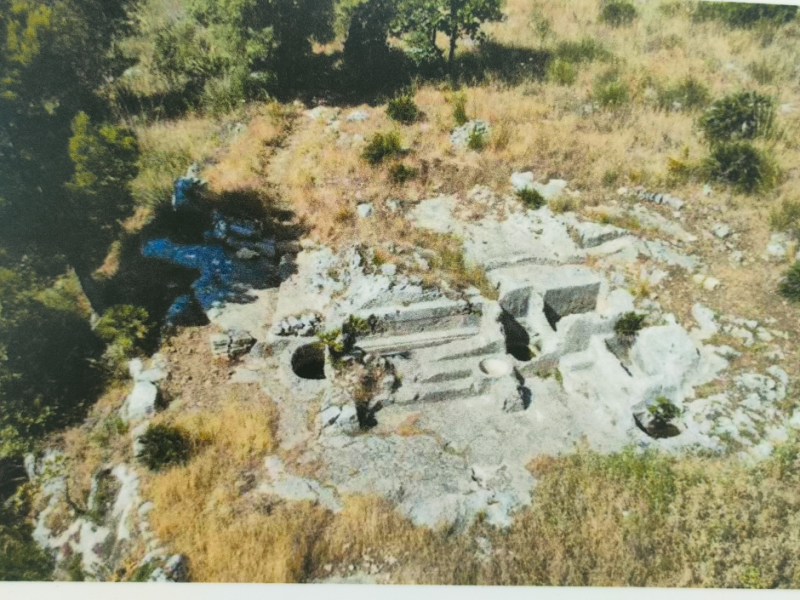
The Palmento di Contrada Risinata
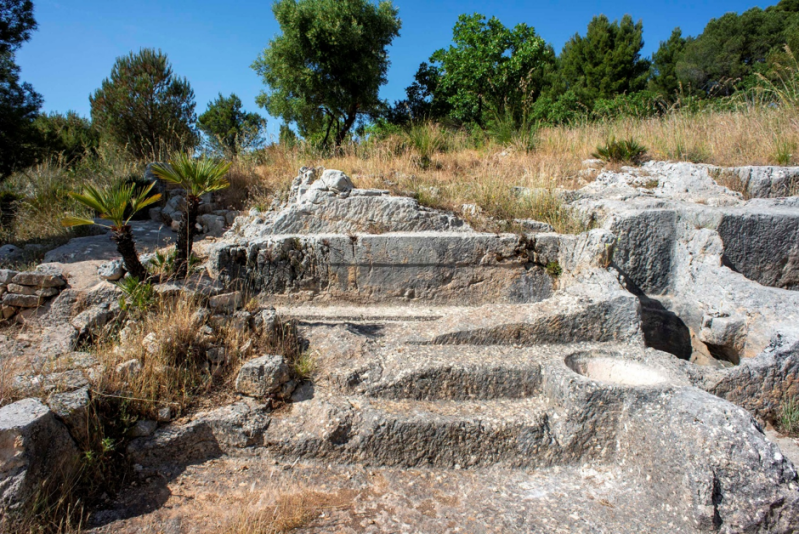
Today the site forms part of the Iter Vitis cultural route, a reminder that the slopes above Lake Arancio have been shaped by viticulture for more than two thousand years. Its presence adds an unexpected archaeological depth to Ulmo, linking the estate’s contemporary renewal to a landscape where wine has been made since antiquity. Back near the heart of the estate, that sense of continuity takes a more intimate form.
Close to the main buildings is the Studiolo di Ulisse, a small, contemplative space created as part of the family’s cultural initiatives and incorporated into the Iter Vitis open air museum. The room is simple — stone walls, wooden beams, a long low library of books — yet its atmosphere is unmistakably deliberate. At the far end, a flame shaped light glows against the wall, its warm, amber colour echoing the tones of the glass block window beside it. The effect is subtle but powerful: a symbolic hearth that evokes the Renaissance idea of the studiolo as a place of inner illumination, and a reminder that the journey of the vine is also a journey of knowledge. In a landscape shaped by millennia of agricultural practice, the studiolo acts as a cultural counterpoint — a quiet room where the intellectual and imaginative threads of the estate are gathered, linking the modern project at Ulmo to the long continuity of memory, story and place.
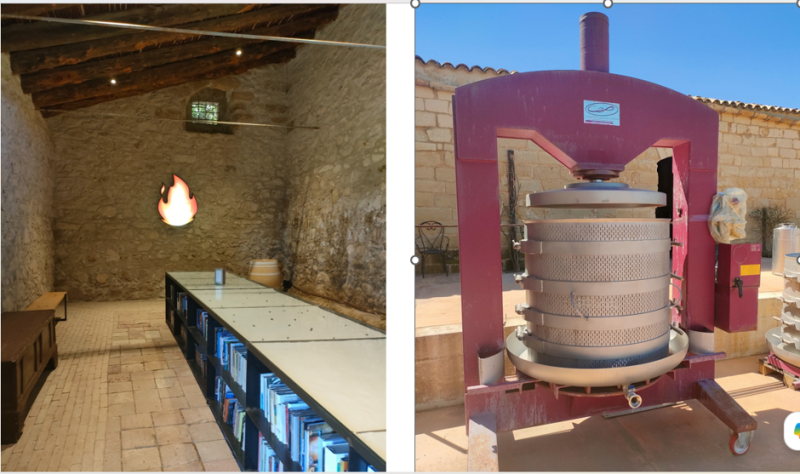
The rough stone of the 16th‑century Studiolo, still housing Vito Planeta’s library, contrasts with the vertical hydraulic press outside the modern winery — a pairing that captures Ulmo’s blend of tradition and renewal.
Stepping outside, the same themes unfold in a more public register. Outside the Studiolo, the Iter Vitis route continues along the rough dry‑stone wall that forms the back of the 16th‑century baglio, where Planeta has installed a permanent open‑air exhibition on Sicilian viticulture. A series of large, weatherproof panels turns the courtyard into an outdoor museum, presenting themes such as the island’s native grape varieties, the geology of the Menfi hills, and the deep cultural heritage of the surrounding landscape. Rather than a linear display, it functions as a visual anthology — a set of interpretive posters that visitors encounter as they move through the estate, extending the studiolo’s quiet intellectualism into the open air and anchoring Ulmo within the wider story of Sicilian wine.
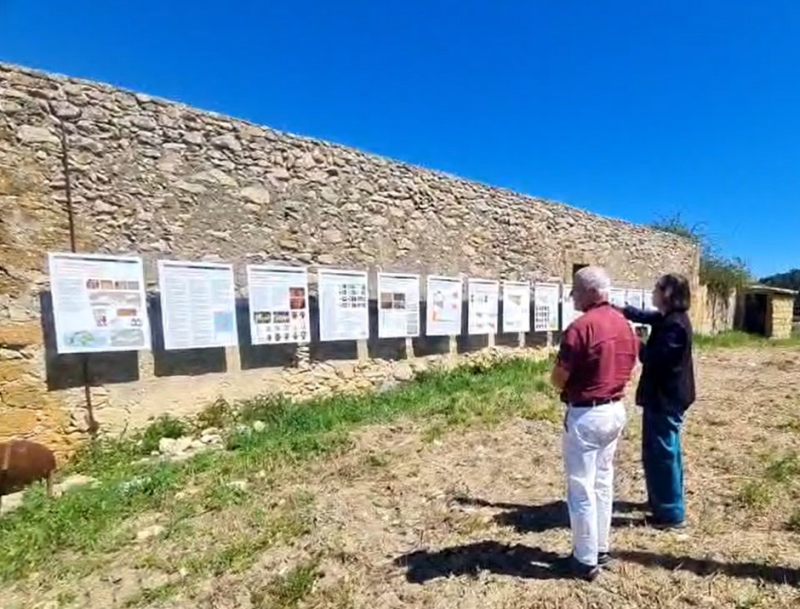
Chiara explains some of the highlights of this pictorial depiction of the history of Sicilian viticulture
The Importance of Lake Arancio and the surrounding landscape
Below the vineyards lies Lake Arancio, the mid twentieth century reservoir created by damming the Carboj River as part of a regional agricultural development programme. Formed in the 1950s to provide irrigation and stabilise farming in the Belice Valley, the lake reshaped the local topography and introduced a new climatic influence into the landscape. Its thermal mass moderates temperature extremes, softens heat spikes, slows nighttime cooling, and increases evening humidity, all of which subtly affect ripening patterns and disease pressure in the parcels closest to the water. What began as an infrastructural intervention has become an integral part of the ecological and agricultural identity of Ulmo.
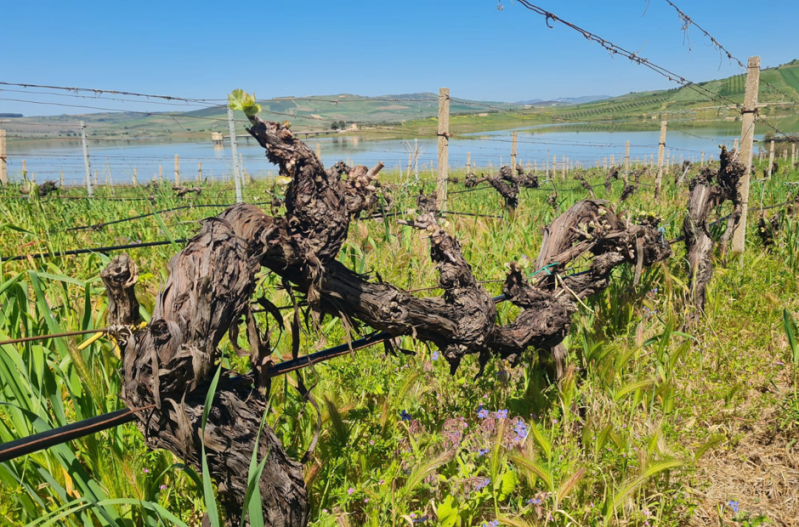
Lake Arancio with an ancient vine in the foreground right at budburst
Taken together — the renewed vineyards, the surrounding forest and biodiversity, the historical palmento, the contemplative studiolo, the moderating influence of the lake, and the architectural presence of the old farmhouse — Ulmo presents a landscape where past and present coexist. It is both the origin point of Planeta’s modern winemaking and a living, evolving estate shaped by ongoing agricultural and cultural stewardship.
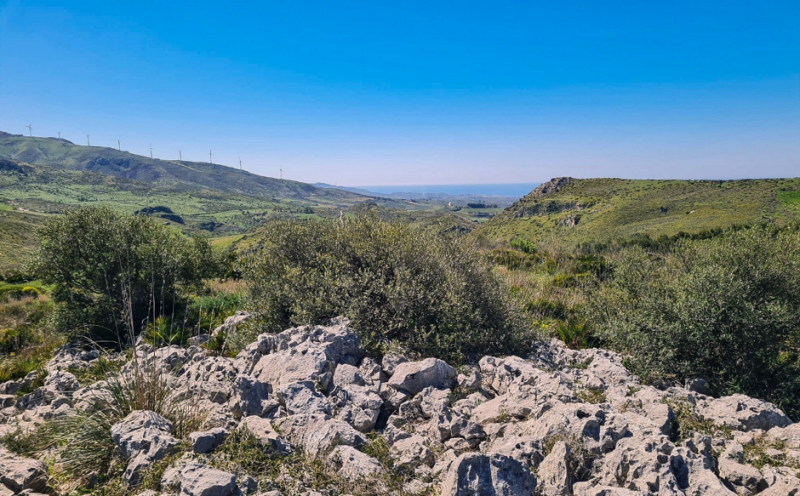
A glimpse of the Mediterranean from the crest of Maroccoli Hill
From the water’s edge, the landscape rises toward a very different vantage point. The views unfold from the crest of Maroccoli Hill, a 414 metre rise that forms one of the natural balconies above Lake Arancio. From here, the land drops away in long, soft folds toward the southwest, the Mediterranean faintly visible on clear days. The elevation gives a full sense of the region’s structure: rocky calcareous outcrops in the foreground, a patchwork of vineyards and cereals on the mid slopes, and the darker inland ridges lined with wind turbines in the distance.
Part of the viewpoint sits within the La Segreta nature trail, where the rocky garden showcases the native vegetation that thrives in these limestone soils. The spiky shrubs, hardy grasses and scattered dwarf palms are not decorative plantings but the natural flora of the hills — a reminder that this landscape is shaped as much by geology and water scarcity as by agriculture.
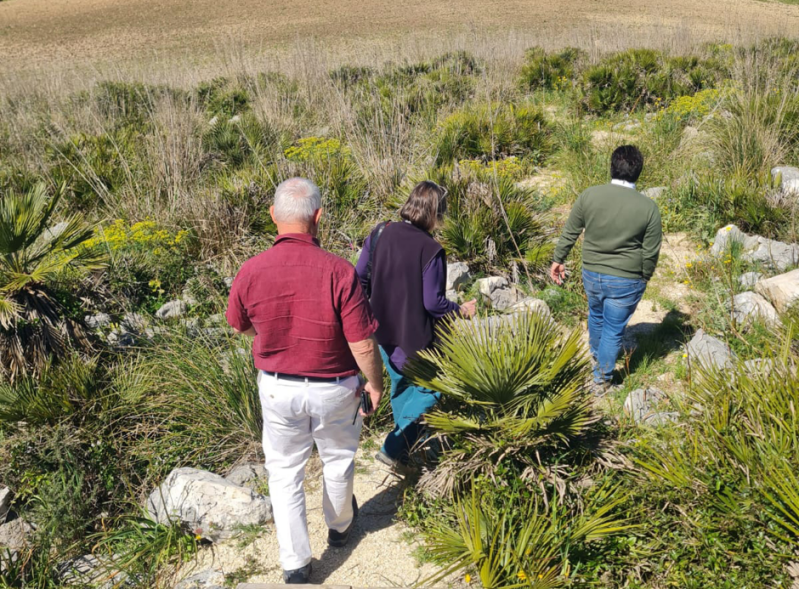
Descending the La Segreta nature trail with Chiara and Calogero
Beyond the mid slopes, the valley floor spreads into a mosaic of agriculture: cereals, olives, and vineyards arranged in long, straight rows across the rolling marine sedimentary hills. It’s a landscape that looks wild at first glance, but it’s actually a layered interplay of natural ecology, reforested slopes, and centuries of cultivation — the quiet architecture of western Sicilian viticulture.
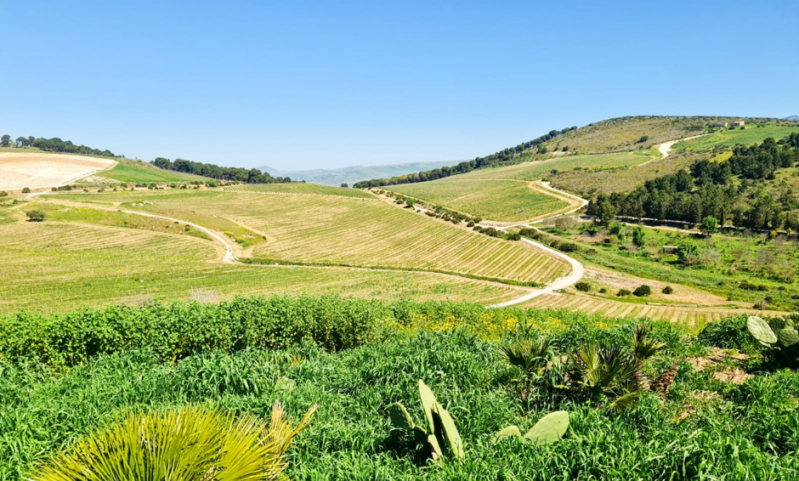
A mid slope vineyard block on calcareous soils above Lake Arancio.
The vineyards above Lake Arancio sit on limestone derived clays and marls, soils that give whites their tension and reds their savoury edge. The lake moderates temperature, slowing ripening and preserving aromatics, while the reforested slopes soften the wind that sweeps across the valley. The natural macchia — rosemary, wild fennel, and hardy shrubs — hints at the dryness and mineral structure that often echo in the wines themselves. Set within this wider geography, the Ulmo farmhouse emerges as the estate’s architectural anchor.
The Estate at Ulmo and the Planeta Wines
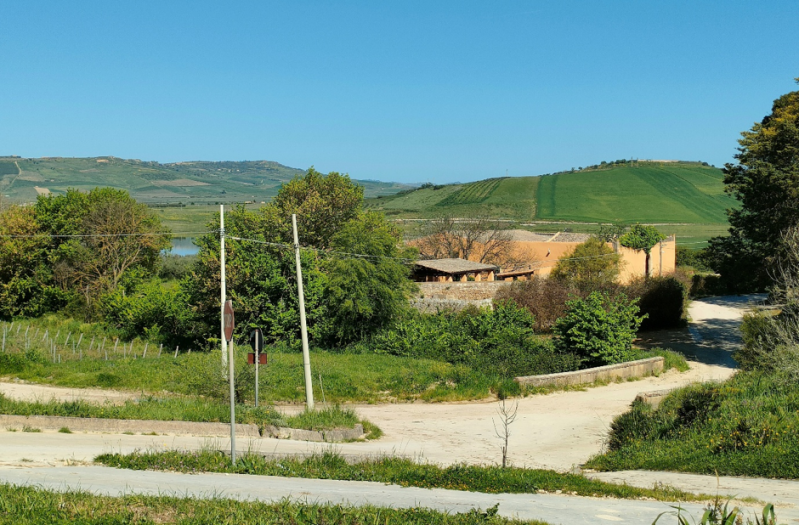
The Ulmo farmhouse and cellar door, the architectural heart of the estate.
From the ridge, the estate sits quietly in the middle distance — a low, sandy stone building with tiled roofs, surrounded by olive trees, shrubs and the soft geometry of vineyard blocks. It occupies the mid slope, where drainage is ideal and the calcareous soils begin to thin, giving the vines just enough stress to produce concentration without losing freshness.
This is the heart of the Ulmo property: a working agricultural estate rather than a showpiece, shaped by the rhythms of pruning, harvest, and the lake’s moderating influence. The dirt roads that wind through the property connect vineyard parcels, olive groves, and the lake itself, tying the human and natural elements into a single, coherent landscape.
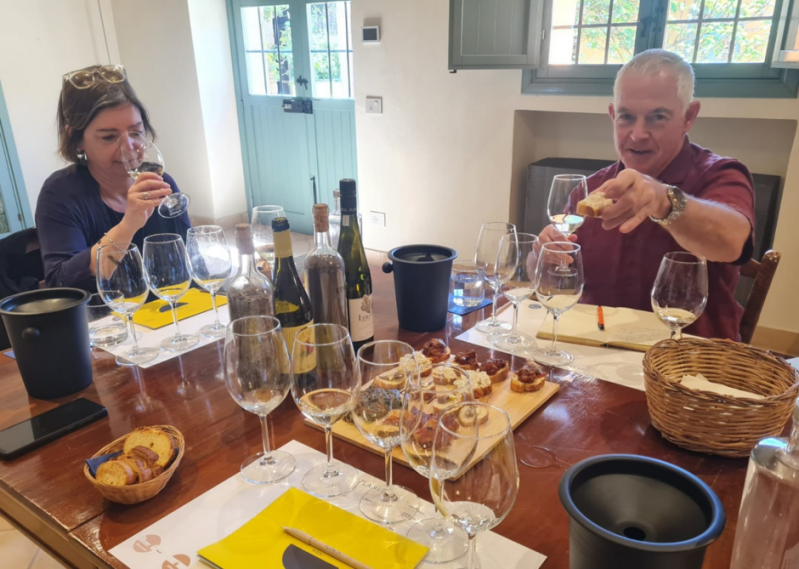
It was from here that we turned to the wines themselves, a tasting designed to trace the breadth of Planeta’s work across Sicily. I was privileged to be treated to a signature tasting of representative wines across the entire Sicilian range with Chiara and Calogero.
Planeta Eruzione 1614 DOC Sicilia 2022 Carricante. Stelvin closure. From vines on Etna 900m above sea level unable to be labelled Etna DOC, but nonetheless an Etna benchmark. Hand-picked grapes cooled overnight before careful selection, crushing and pressing. Only the free run juice used, fermented in stainless.
Light lemon gold in the glass with aromas of citrus and fennel. On the palate citrus pith predominates with a little white peach and distinct herbal notes, fresh and dry with a long saline finish.
Planeta Terebinto 2025, Menfi DOC Grillo. From vines grown organically on relatively unstructured chalky fine gravel soils an average of 200m high. For those unfamiliar, Grillo is a cross between Cataratto and Zibbibo (Muscat of Alexandria). Some whole bunch pressing to emphasise thiols. 6 months on fine lees in stainless tanks.
Pale lemon gold in the glass with aromas of lemon wax, orange zest, and broom flowers. On the palate, it’s fresh and bright with a tropical fruit edge to the citrus pith and herbs mainstay and a nice linear persistence.
Serra Ferdinandea 2023 Menfi (50% Grillo and 50% Sauvignon Blanc). Serra Ferdinandea is a JV between Planeta and the French Oddo family at Menfi, dry farmed and bio-dynamic. The Grillo is fermented spontaneously in stainless and the Sauvignon Blanc in large format oak.
Light lemon gold in the glass with still recognisably Sauvignon Blanc aromas of citrus, gooseberry, herbs and some spice. The palate edges more to stone fruits with a nutty edge and again that so-Sicilian magical balance of fresh acidity, and textural salinity.
Planeta Frappato 2025 Vittoria DOC (100% Frappato). An exclusive and rare grape from the Vittoria region organically grown on loose sandy red soils overlaying tufa at 90cm. Hand picked grapes, cool semi-carbonic ferment in stainless, followed by a further 10-13 days on skins in tank before racking. Maturation and malo also in stainless.
Light ruby with a magenta tinge, and pale rim. Strawberry, blood orange and tutti-frutti aromas. On the palate light, fresh and dry but still quite richly red-fruited, almost Gamay like, with a smoky edge on the finish.
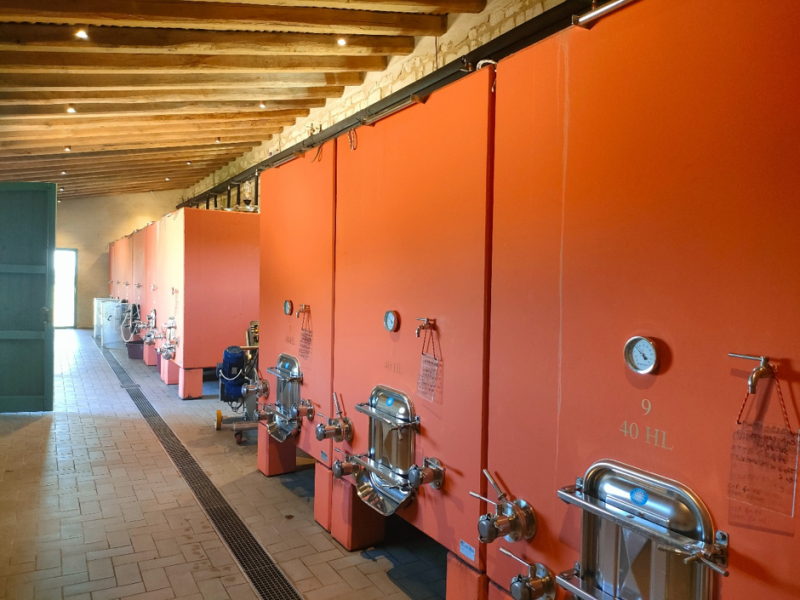
A sleek row of concrete vats in the modern Ulmo winery situated in the historic building complex
Planeta Nocera 2023 Sicilia DOC. Planeta has led the resurrection of this ancient grape variety organically grown at Capo Milazzo La Baronia near Messina on alluvial soils with silt, granite and a layer of volcanic ash blown from Etna. Hand-picked destemmed grapes are fermented in stainless with ten days on skins until they reach 25C, with manual pressing and pump-overs followed by racking and pressing. The wine is returned to tank for malo and further maturation.
Purple ruby in the glass with a nose of black fruits, bitter chocolate, seaweed and some pepper spice. The palate is rich with dark sweet berry and tart cherry fruit, a hint of chocolate, forest floor and ironstone. The tannins are soft and silky, the acid balance is impeccable and the finish long and fresh.
Planeta Santa Cecilia Nero d’Avola, Noto. Nero d’Avola is often considered Sicily’s most important grape but has a reputation for being difficult to fully ripen. From organically grown grapes at Noto, a site selected by Planeta after extensive research, on stark white limestone and chalk marl soils. Hand-picked grapes are destemmed, crushed and fermented in tank. Maturation for 14 months in oak barriques, mostly 2nd, 3rd and 4th use.
Ruby purple in the glass with distinct violet and boysenberry aromas, coconut and vanilla, blood orange and olive tapenade. The palate is full-bodied and rich, firm tannins and balanced acidity framing the ripe berry fruits, with a touch of liquorice and dried herbs, and a long slightly chewy finish.
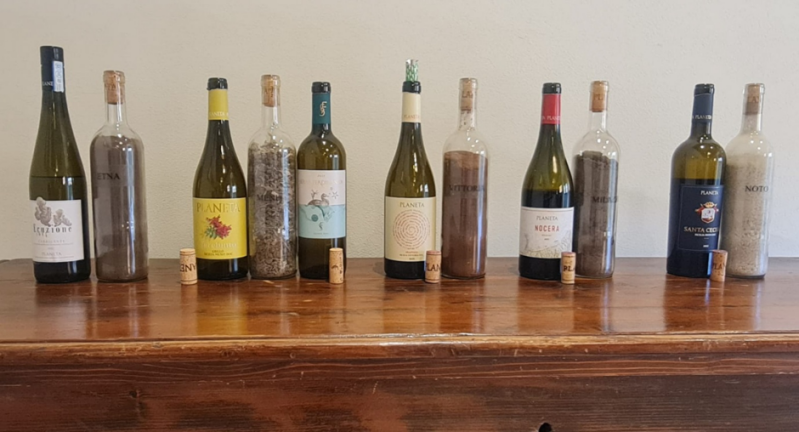
The full lineup of wines tasted and the various soils that produced them
Final reflections
The wines brought the whole journey into focus. Tasted together — Etna’s Carricante, Menfi’s Grillo, Vittoria’s Frappato, Milazzo’s Nocera, Noto’s Nero d’Avola — they formed a quiet atlas of the island, each shaped by the landscapes I had been moving through all week. What struck me most was how clearly the stylistic development at Planeta shows in the glass: cleaner lines, finer detail, a more transparent sense of place. It echoed everything Chiara and Calogero had shown me at Ulmo — the renewed vineyards, the biodiversity corridors, the archaeological depth, the lake’s moderating presence — a reminder that the estate’s evolution is both philosophical and physical, rooted in land, memory and long-term stewardship.
As a first encounter with Western Sicily, this visit felt like a beginning rather than a conclusion. From the wind-scoured ridges above Lake Arancio to the volcanic terraces of Etna, the week revealed a region far more intricate, more historically layered, and more agriculturally alive than I had imagined. These notes are only a toe in the water — a provisional map drawn from a handful of estates and a few days on the ground. What they have given me, though, is a clear sense of direction. Sicily rewards depth, patience and return, and I look forward to coming back with the time and focus this remarkable island deserves.
About the author
John Penney is a wine experience guide based in Martinborough, New Zealand. His lifelong passion for wine has been deepened through extensive international wine travel, formal wine study (WSET3) and a career in adult learning. Through his Martinborough-based business wineinsights, he provides exceptional wine tour, wine-tasting and wine education experiences for wine lovers and enthusiasts.
Add comment
Comments