From tropical monsoon vineyards to frozen northern plateaus, wine is now being grown in places once thought impossible. This article explores how climate, ambition and adaptation are reshaping the edges of the wine world — and what that means for the regions caught between expansion and retreat.
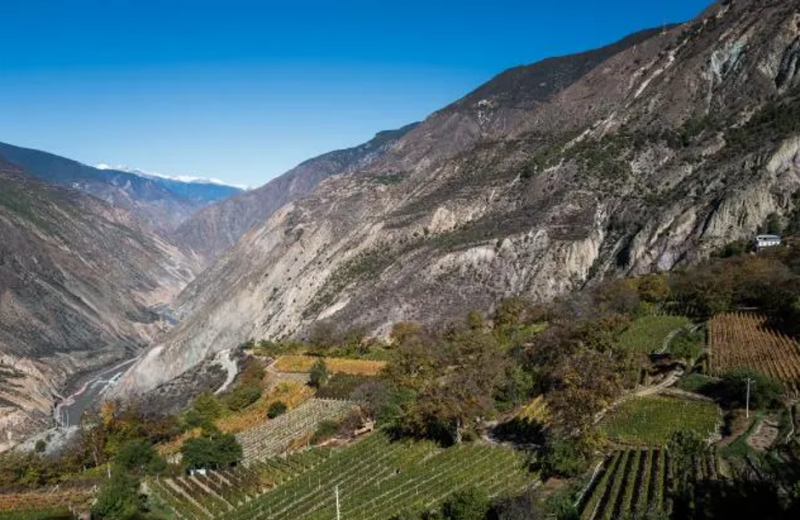
Vines in Yunnan below the Himalayas
Introduction
My first encounters with wine production in unlikely places was while living in Thailand. I had been living permanently in the northeastern province of Khon Kaen since 2008 and was vaguely aware that a small amount of wine was produced not far north in the mountainous region of Loei near the Laos border, and also down south in the hills of Hua Hin at the strangely named Monsoon Valley. But I never regarded these as anything other than fanciful curiosities. A French friend once brought a bottle of Monsoon Valley to my home; we both concluded it was unpalatable and poured it down the sink.
In late 2010 I moved to Bangkok to take up a role with ChildFund International as their Asia Regional HR Manager. In 2012, our Office Manager organised a weekend teambuilding retreat for the whole office, and we drove up to Khao Yai (“Big Mountain”) National Park — a retreat just three hours northeast of Bangkok, popular for its cooler climate due to elevation. After the mandatory burger stop at the much‑loved Chokchai Ranch, our afternoon activity was a tour of PB Valley Estate, the earliest and still largest winery in a region now dubbed the “Tuscany of Thailand.”
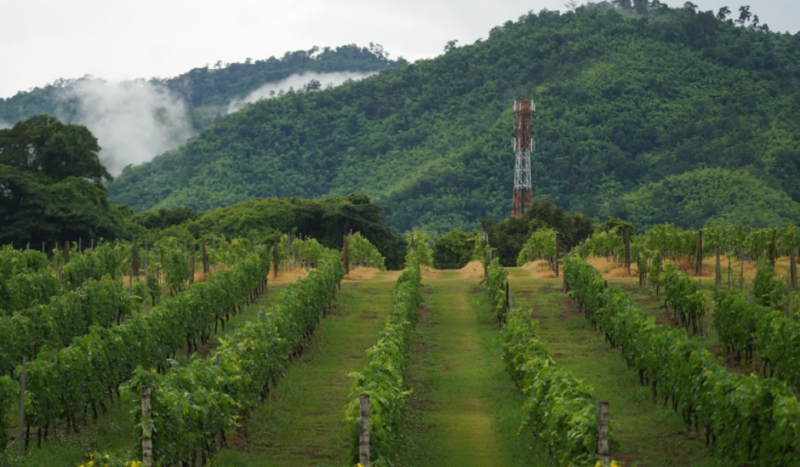
Vines at PB Valley Estate, Khao Yai, Thailand
It was an eye‑opening, if not utterly convincing, experience. At 14°N, the region sits well outside the traditional 30–50° latitude band for wine. Yet there were neatly laid rows of VSP‑trained Chenin Blanc, Colombard, Syrah and Cabernet Sauvignon; a modern winery with an impressive barrel room of French oak; and a guide whose passion and knowledge demanded to be taken seriously. My recollection of the tasting was that all of the wines were acceptable and the Syrah (called Shiraz) was actually quite good. After enjoying a glass at their restaurant that evening, I bought a bottle — but it was expensive and hardly good value. I lived in Thailand for eight years, but that was the only bottle of Thai wine I was ever tempted to buy.
My next unlikely encounter was also in those ChildFund days, on a trip in 2013 to our India office in Bengaluru. Hoping to find an affordable and palatable red wine to ease a night’s work in the hotel room, I was persuaded to try a Grover Cabernet Sauvignon from the nearby Nandi Hills. It wasn’t great — recognisably Cabernet, but with a strange taste and mouthfeel that at the time I described as “curry‑like,” though with the benefit of greater knowledge and experience it was probably Brettanomyces. Again, I considered this just another interesting curiosity.
The third encounter was different — and far more convincing. In 2017 my wife and I visited the Cité du Vin in Bordeaux, and I was intrigued to find a Chinese red wine on the restaurant’s list: Château Nine Peaks 2013 Shandong Cabernet Sauvignon. I ordered a bottle for lunch. Unmistakably Cabernet, adequately ripe, medium‑bodied — I might have mistaken it for an entry‑level Margaret River. By then, through my formal wine studies, I was already aware of the huge investment, planting and growing quality of wine production in a country with wine regions extending from the tropical south to the frigid north.
These experiences planted a seed. If wine could be made — sometimes convincingly — in Thailand, India and China, what did that say about the old certainties of the 30–50° rule? And what does it mean for the future of wine as climate, technology and ambition push viticulture into ever more unlikely places?
China: A Case Study in Climatic Extremes
China is the perfect place to begin because it contains both ends of the viticultural spectrum: some of the coldest, harshest winegrowing conditions on earth, and some of the warmest, highest, most dramatic high‑altitude vineyards anywhere. It is a country where viticulture is not simply adapting to climate — it is wrestling with it.
I’ve written previously about China’s rapid rise as a wine producer in China Wine: Three Surprising Facts, and the scale and ambition of its industry continue to surprise me. But nothing captures China’s extremes better than the contrast between Ningxia in the north and Yunnan in the south — two regions that have become benchmarks for cold‑desert and high‑altitude viticulture respectively.
Ningxia: The Cold Desert Frontier
In Ningxia, winter temperatures routinely plunge to –20°C or lower. Vines cannot survive these conditions unprotected, so growers practise one of the most labour‑intensive viticultural techniques in the world: burying the vines every winter. Entire vineyards are laid down, covered with soil, and then dug up again in spring. This annual ritual shapes everything — vine spacing, trunk height, labour costs, and even the varieties chosen.
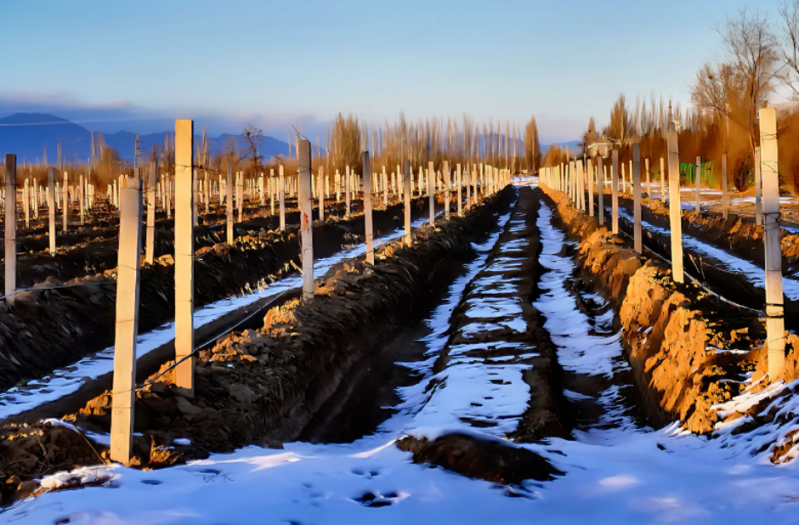
Buried vines in Ningxia, China
Summers, by contrast, are hot, dry and intensely sunny. Irrigation is essential in this desert climate, and canopy management becomes a delicate balancing act between protecting grapes from sunburn and ensuring enough exposure for ripening.
The result is a style of Cabernet‑based wine that is structured, ripe and increasingly polished. In the last decade, Ningxia wines have begun receiving high international scores, sometimes into the mid‑90s, and often at prices that reflect both the ambition and the cost of production. Many of the top wines are expensive by global standards — a combination of low yields, high labour input, and a domestic market willing to pay for prestige.
Marselan: China’s Signature Red
Alongside Cabernet Sauvignon, one grape has quietly become China’s most distinctive red: Marselan, a Grenache × Cabernet Sauvignon cross. It was originally bred in France, and the first decent example I tried was a Gros Tollet from the Languedoc. Marselan has found a natural home in China’s diverse climates. It ripens reliably, handles heat well, and produces fragrant, supple wines with fewer green notes than Cabernet. Many producers now see Marselan as the variety that could give China a truly original red wine identity.
A Shift Toward White Wines
For years, China’s wine industry was overwhelmingly focused on red wine — partly because red is associated with luck, prosperity and prestige. But this is changing. As Chinese consumers become more familiar with wine as a culinary companion rather than a ceremonial object, producers are increasingly planting white varieties that better suit Chinese cuisine.
Chardonnay, Riesling, Italian Riesling, Rkatsiteli and even Albariño are gaining ground. In coastal regions like Shandong, aromatic whites pair naturally with seafood; in the north, crisp, mineral styles are emerging from high‑altitude sites. The shift is still in its early stages, but it signals a broader cultural evolution: wine is becoming part of the dining table, not just the banquet hall.
Yunnan: The High‑Altitude Tropics
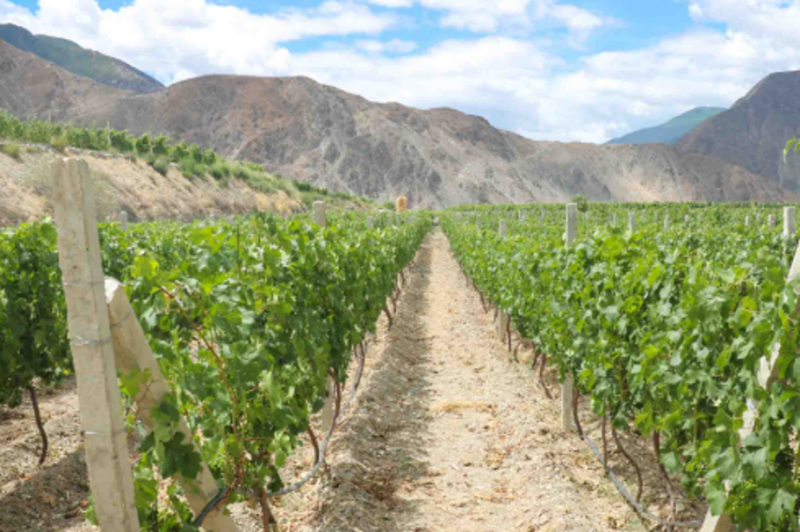
Terraced vineyards at 2500 metres altitude 28 degrees N latitude in Yunnan, China
Travel south to Yunnan and the contrast with Ningxia is astonishing. Here, vineyards sit at 2,200–2,600 metres in the Himalayan foothills. The latitude is tropical, but altitude transforms the climate: cool nights, dramatic diurnal shifts, and a growing season shaped by monsoon rhythms. Terraced vineyards cling to steep slopes, and the challenges are as much about rainfall and erosion as they are about ripening.
Producers use altitude as their cooling mechanism, relying on the mountains’ rain shadow and careful canopy shading to protect grapes from intense UV exposure. The wines — often Cabernet blends — are aromatic, fresh and elegant, a world away from the desert‑grown Cabernets of the north.
Other Key Regions: A Patchwork of Extremes
Although Ningxia and Yunnan dominate the conversation, China’s wine map is far broader and more varied:
- Shandong (Penglai Peninsula) — maritime, humid, Bordeaux‑like; home to Château Nine Peaks and major international investment.
- Hebei (Huailai / Changli) — continental climate near Beijing; early centre of Chinese wine production.
- Xinjiang — vast, sunny, continental; capable of high yields and increasingly high quality.
- Gansu (Wuwei) — desert‑influenced, similar challenges to Ningxia; emerging as a serious region.
- Shanxi (Qingxu) — high‑altitude continental climate; home to Grace Vineyard, one of China’s most respected producers.
Each region faces its own climatic extremes — humidity in Shandong, frost in Hebei, desert dryness in Xinjiang — and each has developed its own viticultural adaptations.
China as the Thesis in Microcosm
China, in short, demonstrates the central argument of this article: modern viticulture is defined not by latitude, but by adaptation. From vine burial in the frozen deserts of Ningxia to monsoon‑shaped viticulture in Yunnan, from the rise of Marselan to the shift toward whites that suit Chinese cuisine, China is not just participating in the global expansion of wine — it is leading it.
Hot and Tropical Viticulture: Wine Beyond the Heat Ceiling
My first encounters with tropical viticulture were in Thailand and India, and they taught me that the challenges of heat and humidity require a completely different viticultural mindset. In these regions, the problem is not ripening grapes — it is slowing them down, managing disease pressure, and working around monsoon cycles.
Thailand: Forced Dormancy and Monsoon Timing
Thailand sits between 14° and 18°N, well outside the traditional winegrowing band. Yet regions like Khao Yai and Hua Hin have developed a distinctive approach known as “tropical viticulture.” Vines are pruned to force dormancy, not because winter demands it, but because the monsoon does. Growers time pruning and harvest to avoid the heaviest rains, often harvesting in January or February and working almost entirely at night to preserve acidity.
My visit to PB Valley in Khao Yai showed me how seriously this is taken: Chenin Blanc and Syrah thrive here, and while the wines may not always be profound, they are increasingly competent and sometimes genuinely good. Thailand’s wine culture is also deeply tied to tourism, with wineries functioning as destinations as much as producers.
India: Monsoon‑Driven Viticulture
India’s wine regions, particularly Nashik and the Nandi Hills, face similar challenges. When I first tasted a Grover Cabernet Sauvignon in Bengaluru, I didn’t yet understand the viticultural gymnastics required to produce it. India’s vineyards must navigate monsoon timing, humidity, and rapid vegetative growth. Harvest often takes place before the monsoon arrives, and altitude becomes a crucial tool for moderating heat.
India is now producing increasingly refined wines, and the domestic market is growing rapidly. The country’s viticulture is a frontier not because it is new, but because it is difficult. But India’s story doesn’t end in the tropics — it also stretches north into the mountains.
India’s Himalayan Foothills: A Quiet Cool‑Climate Frontier
While India’s established wine regions lie in the tropical south, there is a small but intriguing movement of vineyards emerging in the Himalayan foothills of Himachal Pradesh and Uttarakhand. At elevations of 1,000–1,800 metres, these sites enjoy cooler nights, lower disease pressure and a more recognisably “classic” growing season than the monsoon‑shaped viticulture of Nashik or Nandi Hills. Plantings remain experimental — Chardonnay, Sauvignon Blanc and even Pinot Noir have been trialled — but the region hints at a future where India may develop both tropical and cool‑climate wine identities.
Brazil: Equatorial Viticulture and Surprisingly Good Wines
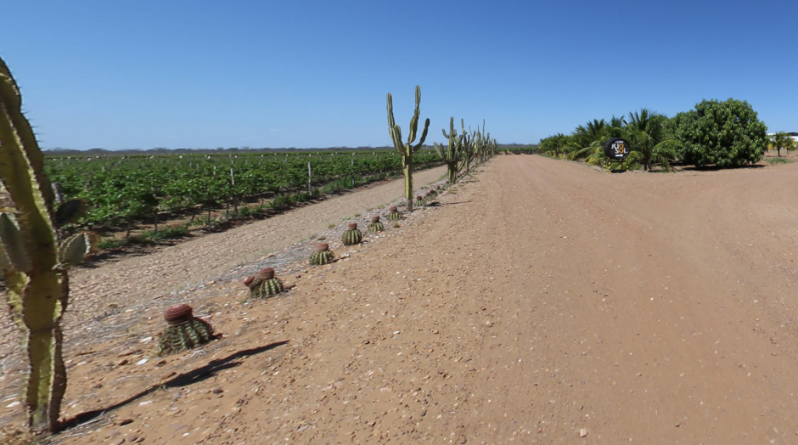
Vines at 9 degrees South of the Equator in Brazil
Brazil is one of the most fascinating tropical wine stories because it contains two completely different viticultural worlds. In the far south, in Serra Gaúcha, the climate is humid and temperate, producing bright, fruit‑driven wines and increasingly impressive traditional‑method sparkling. But the real frontier lies in the São Francisco Valley, just 8–9° south of the equator — a region that defies every classical assumption about winegrowing.
Here, irrigation from the São Francisco River allows vines to grow in a semi‑arid landscape, and producers can harvest twice a year. The wines are far better than their latitude suggests: ripe but not flabby, with Syrah, Tempranillo and even Chenin Blanc showing real promise. The best examples have a generosity of fruit and a surprising freshness, thanks to careful canopy management and night harvesting. Brazil’s tropical wines are no longer curiosities — they are increasingly serious, technically sophisticated, and internationally competitive.
Mexico: Heat, Altitude and a New Wave of Quality
Mexico’s wine story is shaped by two forces: heat and altitude. In Baja California, the country’s most important region, the climate is hot, dry and desert‑influenced, moderated only by Pacific breezes. Water scarcity is the defining challenge, and irrigation is essential. Yet the wines — particularly from Valle de Guadalupe — can be excellent: bold, savoury reds with Mediterranean character, and whites with surprising tension.
Further inland, high‑altitude regions such as Querétaro and Guanajuato produce fresher styles, including some of Latin America’s most exciting sparkling wines. Mexico’s best wines are vibrant, characterful and increasingly refined, reflecting a new generation of winemakers who are embracing both local conditions and international technique.
Vietnam: High‑Altitude Hybrids and Humidity Management
Vietnam’s Da Lat region sits at altitude, giving it a cooler climate than its tropical latitude suggests. Here, hybrids such as Cardinal and Chambourcin are essential, as is constant canopy management to combat humidity. The wines are modest but improving, and the region is a fascinating example of how altitude can create pockets of viability even in tropical environments.
Across all these tropical regions — Thailand, India, Brazil, Mexico and Vietnam — the solutions are similar: forced dormancy, monsoon‑timed pruning, night harvesting, heat‑tolerant varieties, and in some cases, high altitude as a cooling mechanism.
Cold and High‑Latitude Viticulture: Wine at the Edge of Ripeness
If tropical viticulture is about managing excess — excess heat, excess vigour, excess humidity — cold‑climate viticulture is about managing scarcity: scarce warmth, scarce sunlight, scarce ripening time. The regions pushing into this space are redefining what cool‑climate wine can be, and England has led that charge.
England: Chalk, Climate Change and a Sparkling Revolution
No discussion of cold‑climate viticulture is complete without England, which has undergone one of the most dramatic quality transformations in the wine world. Southern England shares the same chalk and limestone soils as Champagne, but until recently lacked the warmth to ripen grapes reliably. Climate change has altered that balance. Warmer summers and longer growing seasons now allow Chardonnay, Pinot Noir and Meunier to ripen consistently — and the results have been extraordinary.
English traditional‑method sparkling wines are now among the best in the world, with razor‑sharp acidity, fine mousse and a precision that rivals Champagne. Producers such as Nyetimber, Gusbourne, Ridgeview and Wiston have demonstrated that England is not a novelty but a genuine cool‑climate powerhouse.
Even more striking is the emergence of still wines — particularly Chardonnay and Pinot Noir — in warmer years. These wines are delicate, bright and increasingly sophisticated, signalling that England’s future may include a broader stylistic range than anyone imagined two decades ago.
Netherlands: The Rise of PIWIs
In 2023 I visited the Netherlands and tasted a range of PIWI wines — disease‑resistant hybrids bred specifically for cool, wet climates. I wrote about the experience in Dipping into PIWI Wines, and it was clear that these varieties are not just a curiosity; they are the future for many northern regions. Solaris, Souvignier Gris and Johanniter thrive where traditional vinifera would struggle, offering clean, aromatic wines with surprising character.
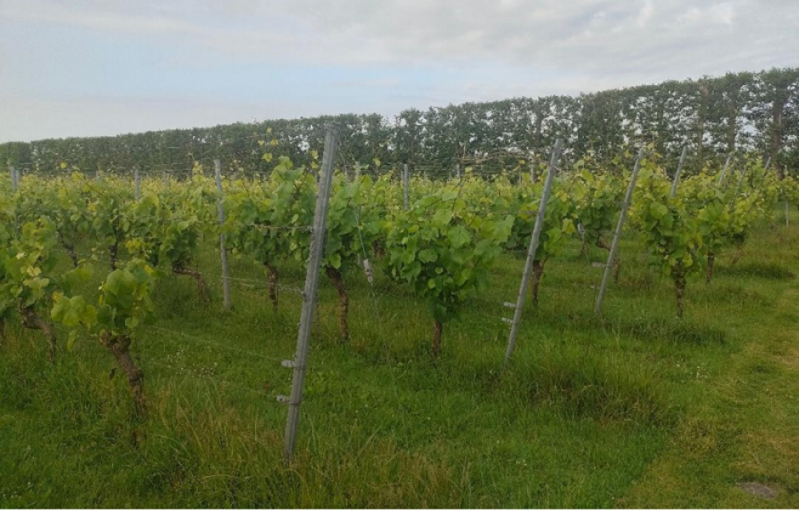
Johanniter vines in Wognum, Netherlands
Vancouver Island: Maritime Moderation
Later that year I visited Vancouver Island’s Cowichan Valley, a region I wrote about in Wines of the Cowichan Valley. Here, maritime influence softens the climate, allowing Pinot Noir, Ortega and hybrids to ripen reliably. The wines are delicate, bright and expressive of place — proof that cool‑climate viticulture is expanding into new coastal zones.
Scandinavia: Cool‑Climate Pioneers in a Temperance Landscape
Scandinavia has quietly become one of the most intriguing cold‑climate wine frontiers. Denmark now has more than 100 commercial producers, many working with Solaris, Rondo, Regent and other PIWI varieties that thrive in cool, wet conditions. Sweden’s Skåne region is emerging as a genuine quality zone, producing crisp whites and increasingly confident sparkling wines. Even Norway, where vineyards cling to fjord‑side pockets of marginal warmth, is seeing a small but determined wave of growers experimenting with hybrids and early‑ripening vinifera.
What makes this especially remarkable is the cultural backdrop. These are countries with strong temperance traditions, where alcohol sales are tightly regulated through state monopolies such as Systembolaget in Sweden and Vinmonopolet in Norway. Wine consumption is relatively recent, and domestic production was once unthinkable. Yet climate change, long summer daylight hours, and the rise of disease‑resistant hybrids have created a new viticultural frontier in places where winegrowing was historically impossible. Scandinavian producers are not just making wine — they are making wines of clarity, freshness and identity, and doing so in a cultural context that makes their success all the more striking.
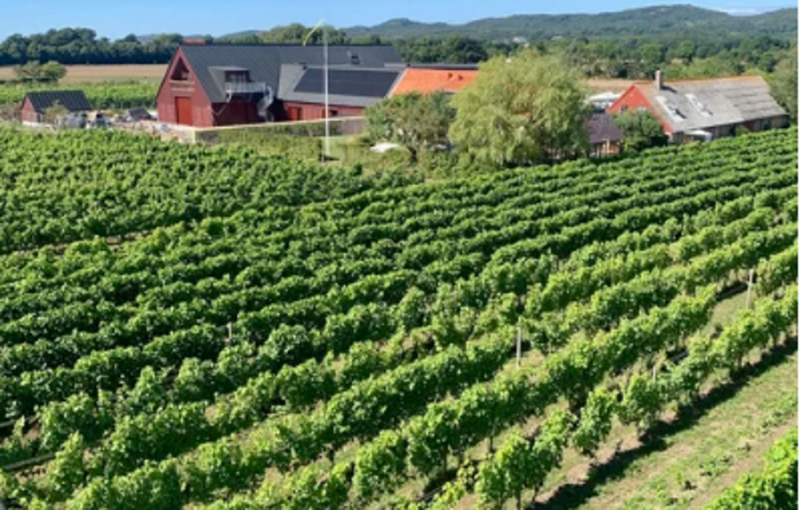
Solaris, Rondo and Regent thrive in the oldest vineyard of Kullabergs in Skåne, Sweden
The Broader Cold‑Climate Frontier
Across northern Europe, Scandinavia, Nova Scotia and parts of the northern United States, growers face short seasons, frost risk and limited heat accumulation. Their solutions include hybrids, frost protection, careful site selection and, increasingly, a focus on sparkling wine, where high acidity becomes an asset rather than a flaw.
And then there is Ningxia — perhaps the most extreme cold‑climate wine region of all — where vine burial remains the ultimate expression of viticulture pushed to its limits.
Sustainability, Paradox, and Open Questions
From tropical monsoon belts to frozen desert plateaus, wine is now being grown in places once dismissed as impossible. The old 30–50° rule has not disappeared, but it has been decisively challenged. Climate change, technology and human ambition are pushing viticulture into new latitudes, new altitudes and new cultural landscapes.
Yet this expansion sits uneasily alongside another reality: the global wine glut. Even as vineyards are being planted in Thailand, India, Yunnan, Denmark and Vancouver Island, vines are being pulled out in Bordeaux, Rioja, the Languedoc, South Australia and California. Consumption is falling, oversupply is rising, and governments are paying growers to grub up vineyards that no longer have a viable economic future.
Some of this contraction is driven by climate change — regions that once relied on irrigation now face water scarcity; areas built on bulk production can no longer produce the cheap wines consumers have abandoned; and heat spikes, drought and disease pressure are making traditional viticulture increasingly fragile. But the new frontier regions raise their own sustainability questions. Vine burial in Ningxia shortens vine life and demands enormous labour. Tropical viticulture requires constant canopy management, forced dormancy and sometimes irrigation. High‑latitude viticulture depends on hybrids that are still finding their place in the market. Even England’s sparkling revolution is built on the knife‑edge of a warming climate that could just as easily tip too far.
So we are left with a paradox. Wine is expanding at the edges while contracting at the centre. New regions are flourishing just as old ones are struggling. Innovation is happening in places where wine was never meant to be grown, while tradition is being uprooted where it once seemed unshakeable.
What does this mean for the future of wine? Are these boundary‑pushing practices sustainable in the long term, or are they temporary adaptations to a rapidly shifting climate? Will the economic model of high‑cost, high‑labour extreme viticulture hold if global demand continues to soften? And how should the wine world balance the excitement of new frontiers with the responsibility to steward existing landscapes more sustainably?
There are no easy answers. But perhaps that is the point. The future of wine will not be defined by a single region, climate or philosophy. It will be shaped by a world in flux — by the tension between expansion and retreat, innovation and tradition, possibility and constraint. And in that tension lies both the uncertainty and the fascination of wine’s next chapter.
About the author
John Penney is a wine experience guide based in Martinborough, New Zealand. His lifelong passion for wine has been deepened through extensive international wine travel, formal wine study (WSET3) and a career in adult learning. Through his Martinborough-based business wineinsights, he provides exceptional wine tour, wine-tasting and wine education experiences for wine lovers and enthusiasts.
Add comment
Comments