
Last month I paused my Martinborough wine tours and exclusive Wairarapa wine experiences to explore Hungary, moving from Tokaj to Eger as my second stop. To understand Eger properly, you have to begin with its long historical arc. Eger’s wine culture is inseparable from its history. Viticulture here began to take shape in the 11th century, when King St. Stephen founded one of Hungary’s earliest bishoprics and endowed it with extensive vineyards. Monastic communities arriving from Western Europe brought their own grapes and cellar practices, embedding a European winemaking sensibility into the region long before Hungary’s other major wine districts emerged. After the devastation of the Tatar invasion in the 13th century, King Béla IV repopulated the area with Walloon settlers, whose influence was profound: they introduced barrel ageing and more structured cultivation methods, nudging Eger toward a red‑wine identity centuries before it became codified.
The Ottoman period transformed that identity further. Kadarka, a grape that thrives with skin contact, became widespread, and fermentation on the skins became a hallmark of local practice. This era also produced the legend that still shapes Eger’s global image: during the 1552 Siege of Eger, defenders were said to be strengthened by the deep red wine that stained their beards, inspiring the name Egri Bikavér—“Bull’s Blood.” Whether myth or metaphor, it captured the region’s shift toward darker, more structured reds and gave Eger a story that travelled far beyond Hungary’s borders.
By the 18th and 19th centuries, Eger was firmly a red‑wine region. But phylloxera forced a complete rethinking of its vineyards. When replanting began around 1880, growers combined traditional grapes—Kékfrankos and Kadarka—with newly fashionable French varieties such as Cabernet Franc, Cabernet Sauvignon, Merlot, Pinot Noir and Syrah. This mix of heritage and modernity became the foundation of the Bikavér style that Jenő Grőber later formalised: a structured, barrel‑aged blend built on Kékfrankos, supported by both indigenous and international grapes.
The region’s whites have a similarly layered history. Leányka and Hárslevelű were long associated with Eger, while Olaszrizling found a particular home in Egerszalók. More recently, Furmint, Kabar, Juhfark and Királyleányka have become central to Egri Csillag—the white counterpart to Bikavér introduced in 2010 to express Eger’s cool‑climate minerality through blending rather than varietal purity. Aromatic grapes such as Irsai Olivér and Sárga Muskotály add lift and perfume, giving Csillag a stylistic range that mirrors the diversity of the region itself.
What makes Eger distinctive is not only its grapes but its geology. The southern foothills of the Bükk Mountains are built on volcanic rhyolite tuff, a soft rock that can be carved into cellars. Over centuries, growers created an underground labyrinth—some cellars more than 400 years old—where constant cool temperatures shaped the oxidative, barrel‑driven style that defined Eger’s reds. Even today, the Valley of the Beautiful Women is lined with these tuff‑cut cellars, a physical reminder of how geology and culture intertwine, while the region’s most celebrated hill, Nagy‑Eged, rises above the town with limestone‑based soils that give a very different structure and tension to its wines.
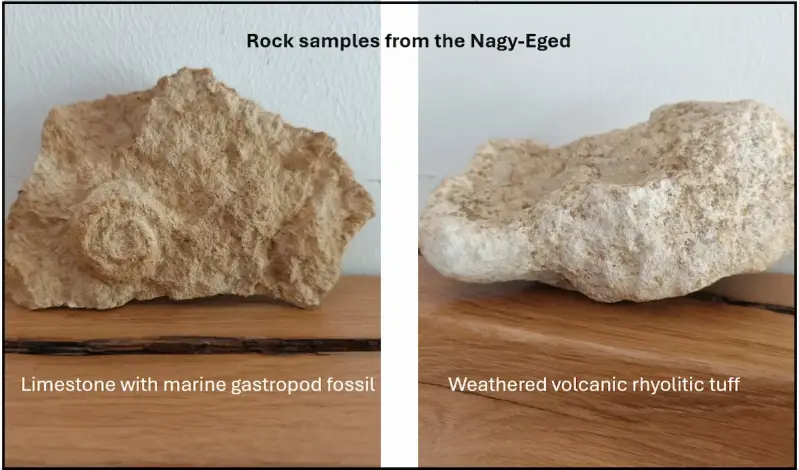
Modern Eger is the product of a dramatic renaissance. After the political changes of the 1990s, the region experienced a surge of investment, replanting and experimentation. Growers returned to top sites such as Nagy‑Eged and Pajdos, re‑evaluating their potential through a cooler‑climate lens. The DHC origin‑protection system brought stricter rules for Bikavér and Csillag, emphasising structure, terroir and ageing. A new generation of winemakers—often working at small, quality‑focused estates—shifted the region toward precision: cleaner ferments, selective oak, and a renewed respect for acidity and minerality. At the same time, heritage grapes such as Kadarka, Turán and Bíbor Kadarka have been revived, not as nostalgic curiosities but as tools for expressing Eger’s identity with greater nuance.
Today, Eger stands at the intersection of tradition and modernity. It remains a region defined by blending—no single grape dominates its narrative—and by the interplay of volcanic tuff, limestone pockets and hillside exposures. But its wines are fresher, more transparent and more site‑driven than ever before. The best producers articulate Eger’s cool‑climate soul with a clarity that would have been unimaginable a generation ago. This tension between history and innovation is what makes Eger one of Hungary’s most compelling wine regions, and what gives each of its leading estates a distinct voice within a shared landscape.
During my time in Eger I visited three singularly excellent and representative wineries, each offering a warm welcome and a generous tasting despite the pressures of a harvest in full swing. For reasons of space and equity I have focused on just four wines from each estate, but readers can be assured that every wine I tasted was worthy of attention. What follows are impressions shaped not only by the wines themselves but by the people and places behind them.
Marcell Bukolyi – Precision, Patience and the Quiet Power of Nagy‑Eged
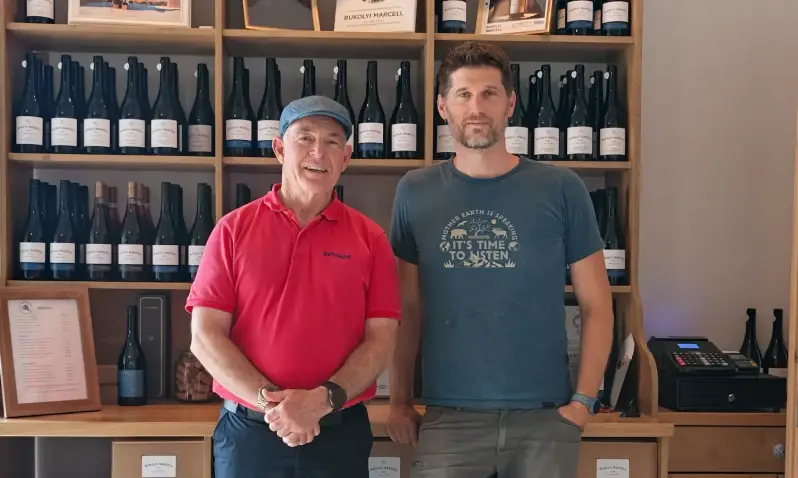
The author with Marcell Bukolyi
Marcell Bukolyi represents the most artisanal edge of Eger’s modern renaissance: a winemaker who works with the deliberateness of someone who knows that the region’s greatest sites reveal themselves slowly. His entire 14‑hectare estate sits at the foot of the southern slopes of Nagy‑Eged, and it is the only 100% organic estate in the Eger region—a distinction that underscores both his philosophy and his commitment to site expression.
The estate is divided into three distinct vineyards, each with its own geological fingerprint. Köves, the 6‑hectare parcel climbing from 310 to 410 metres, is defined by limestone and calcareous marl, giving the wines their taut, mineral spine. Directly in front of the winery lies the 4‑hectare Farm Vineyard (280–295m) [pictured in the opening photo], where rich calcareous marl overlays volcanic subsoil, producing fruit with greater depth and mid‑palate weight. The 4‑hectare Birsalmas Vineyard (275–301m), on the Steinhauser hill, is markedly different again: moist black volcanic soil with tuff‑sandy washes, contributing darker fruit tones and a more textural profile. Across these sites, Bukolyi cultivates Kékfrankos, Furmint, Hárslevelű, Syrah, Cabernet Franc and Pinot Noir, each variety chosen for how it responds to altitude, soil tension and the region’s cool structure.
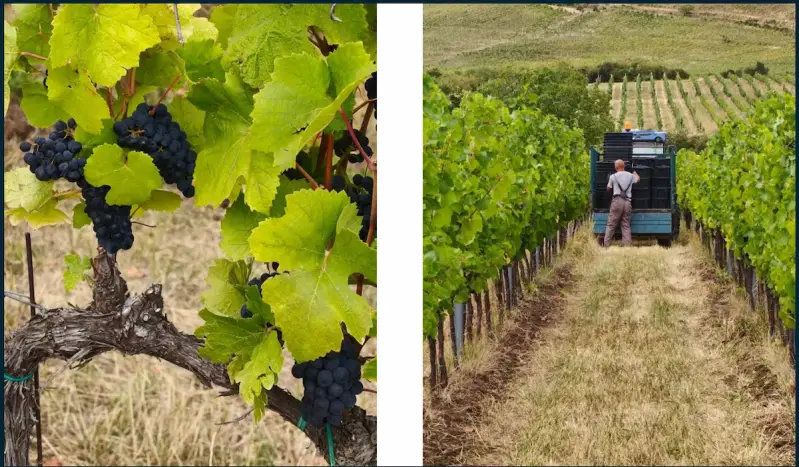
Pinot Noir grapes are harvested from the Farm vineyard on Nagy-Eged
These vineyards on Nagy‑Eged—among the highest and most demanding in Hungary—are places where nothing comes easily. The soils are thin, the exposures dramatic, and the growing season stretched by altitude and wind. Bukolyi’s wines reflect that tension: lean, mineral, tightly coiled, and built on the idea that elegance is earned rather than engineered.
What sets Bukolyi apart is his refusal to chase volume or fashion. His approach is almost monastic: small parcels, meticulous handwork, and a belief that Nagy‑Eged’s character is best expressed through restraint rather than embellishment. In a region historically defined by blends, his wines often feel like studies in purity—an exploration of how Kékfrankos, Furmint or Hárslevelű behave when grown in extreme conditions and handled with minimal intervention. The family lives beside the winery, and they carry out every part of the work themselves, reinforcing the sense that this is not a commercial project but a long, quiet conversation with the mountain.
We arrived at the estate late in the afternoon, right in the middle of a harvest that can only be described as difficult due to the drought conditions. Picking was in full swing right in front of us, crates of freshly picked grapes stacked in the winery entrance, and yet Marcell made time to personally welcome us, show us the winemaking facilities and lead us through an enlightening and enjoyable tasting.
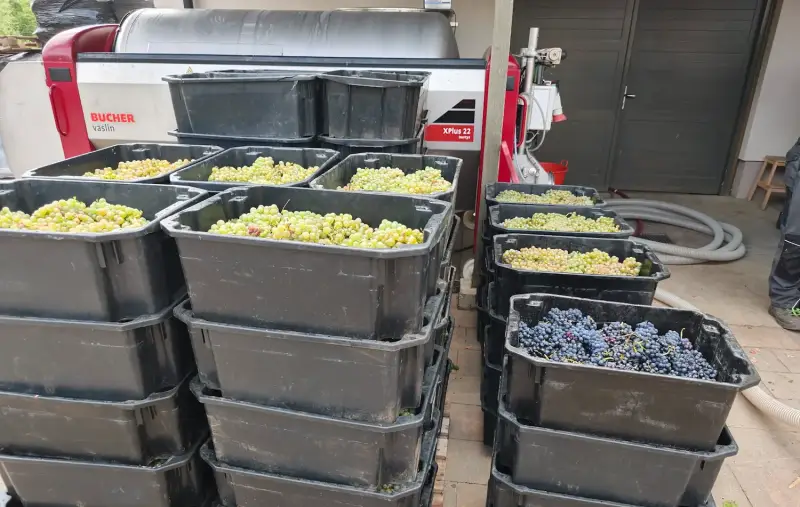
Freshly picked Furmint and Pinot Noir grapes from the Marcell Bukolyi Farm vineyard
Wines Tasted:
Bukolyi Marcell Eger Organic Wines Spring Riesling 2025
Hand-harvested grapes from the edge of the Nagy-Eged hill, whole bunch pressed, tank fermented. Green-tinged lemon in the glass with chamomile and lime aromas. Beautifully balanced on the palate with a touch of spritz, green apple and citrus flavours and good persistence.
Bukolyi Marcell Koves Egri Csillag Grand Superior Nagy-Eged
A blend of Hárslevelű (50%), Riesling (30%), and Furmint (20%) from Nagy-Eged, spontaneous fermentation, and aged 65% in stainless and 35% in Hungarian oak for six months. Pale lemon gold in the glass with aromas of pear, yellow flowers and apricot. The palate has a distinctly chalky and saline spine with some peach, citrus and nutty elements giving a long, layered finish.
Bukolyi Marcell Egri Bikaver Nagy-Eged Grand Superior 2023
A blend of Kekfrankos, Syrah, Pinot Noir and Cabernet Franc from organically grown grapes on Nagy-Eged. 12 months barrel aging – no new oak. Deep ruby in the glass with a cherry and bramble nose and notes of thyme and crushed stone. The palate is impeccably balanced and elegant with fine grained tannins, freshness and red and blue fruit flavours tinged with spice and excellent length.
Bukolyi Marcell Kekfrankos Nagy-Eged Grand Superior Reserve 2021
100% Kekfrankos from the Nagy-Eged in a hot, dry vintage producing grapes with high sugar levels yet retaining vibrant acidity. Fremented in open vats without temperature control and aged in Hungarian oak for 12 months. Bottled unfiltered and unfined. Dark ruby in the glass with aromas of plum and berry compote, clove spice, and wet stone. On the palate there is quietly powerful red and blue fruit and some still firm tannins balanced with nice freshness and underlying minerality, excellent length, already delicious I’d like to try this in another 3-5 years.
Gál Tibor – The Architect of Modern Eger, and the Evolution of a Legacy
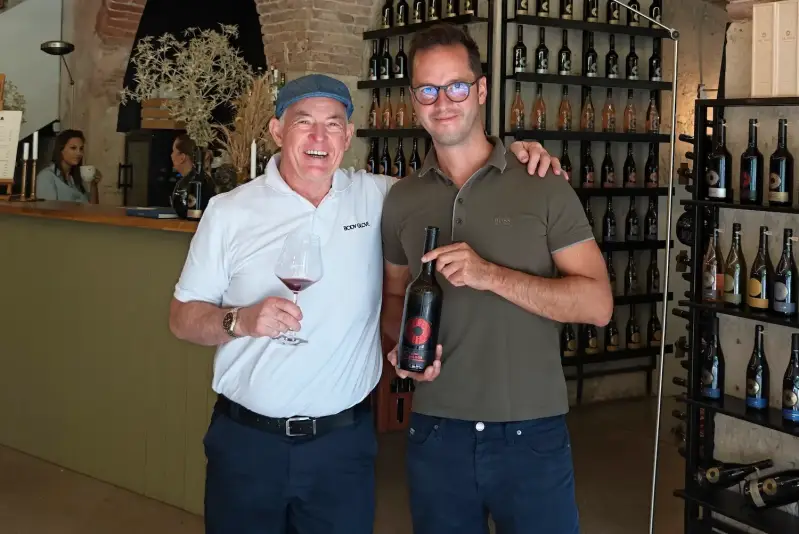
The author with Gai Tibor Jnr
To understand contemporary Eger, you have to understand the legacy of Gál Tibor. Few winemakers have shaped the region’s identity as profoundly. Tibor Gál (senior) returned to Eger after an international career—most famously at Ornellaia—and brought with him a conviction that Eger’s cool‑climate structure and volcanic minerality could stand shoulder to shoulder with Europe’s great wine regions. He championed indigenous grapes, reintroduced Kadarka with seriousness, and reframed Bikavér not as a rustic curiosity but as a disciplined, terroir‑driven blend capable of finesse.
Today, that legacy is carried forward by Gál Tibor Jr, who honours his father’s achievements while walking his own path with clarity and independence. He speaks of wine as “the mirror of the soul,” a philosophy that shapes both his winemaking and his connection to place. In 2025 he was awarded Winemaker of Winemakers, the most prestigious recognition in Hungarian wine—an acknowledgement not only of technical mastery but of cultural leadership within the region.
The estate itself reflects this evolution. It is urban, located in downtown Eger, and known as Fúzió—a name chosen deliberately to signal the fusion of past and present, of cellar and city, of tradition and contemporary cultural life. For Tibor Jr, the location is not incidental but central to the identity of the estate. As he puts it, “For me it’s essential that we are woven into the cultural fabric of the city—that we become part of its rhythm.” By situating the winery in the heart of Eger rather than on its outskirts, he positions wine as something lived, shared and visible, not removed from the daily life of the community.
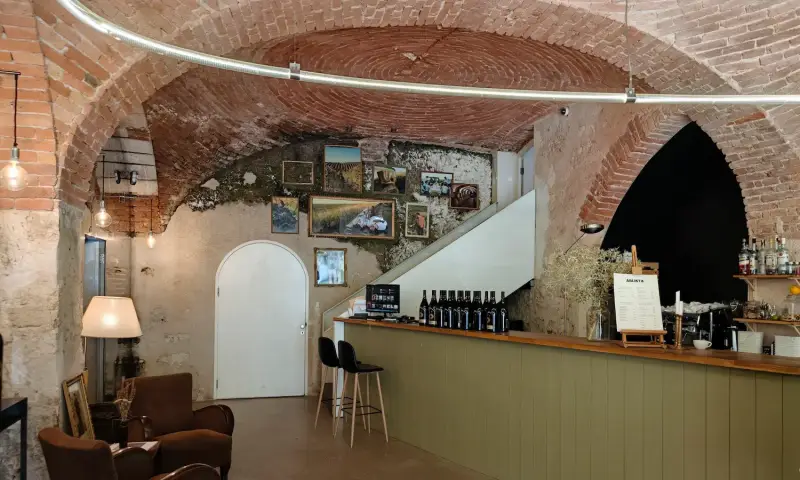
The cellar door at Fúzió, the urban winery of Gai Tibor
The cellar itself reinforces this connection. Carved into ancient rhyolite tuff, it is both a physical and philosophical anchor: a reminder that Eger’s volcanic geology is not only beneath the vineyards but beneath the city’s foundations. Working in this space ties the estate’s modern winemaking directly to the region’s deep geological story. Tibor Jr’s guiding principle, “Keep and Rise,” expresses the balance he seeks—honouring the traditions established by his father while building upon them, preserving what matters while pushing the estate toward a more expressive, contemporary identity. In this way, Fúzió becomes more than a location: it is the embodiment of how the estate sees itself within Eger’s evolving narrative.
This philosophy extends to the vineyards. Since 2014, the estate has embraced a single‑vineyard approach, treating sites such as Síkhegy and select parcels on Nagy‑Eged as individual voices within Eger’s volcanic landscape. These vineyards—defined by rhyolite tuff, pockets of limestone and marl, altitude and diurnal shift—provide the raw material for wines that are lifted, spicy and unmistakably Eger. Whether working with Kékfrankos, Kadarka or the components of Egri Csillag, the estate’s focus is on clarity of site expression rather than stylistic ornamentation.
The wines mirror this duality. They are modern without being glossy, expressive without being loud. The cellar’s energy is youthful, but the philosophy remains anchored in the belief that authenticity comes from understanding where you stand. In many ways, Gál Tibor is the bridge between Eger’s past and its future: a producer who helped the region shed its insecurities and speak with a confident, contemporary voice—and whose next generation is ensuring that voice continues to rise.
Wines Tasted:
Gai Tibor Egri Csillag 2025
A blend of Harslevelu, Leankya, Kiralyleankya, Pinot Gris and Viognier co-fermented in and aged in stainless steel. Lemon straw in the glass with fragrant aromas of jasmine, pear, white peach and lemongrass. On the palate crisp and dry with a slight oiliness and flavours edging to citrus, with an attractive minerality on the finish.
Gai Tibor Kadarka 2025.
100% Kadarka made as a chillable summer wine, cool fermented in stainless and bottled early. Pale almost clear ruby in the glass with bright red fruit tinged with spice. Light and lively on the palate with sour cherry, raspberry and rhubarb flavours, barely-there tannins and bright acidity finishing with a fresh sour cherry note.
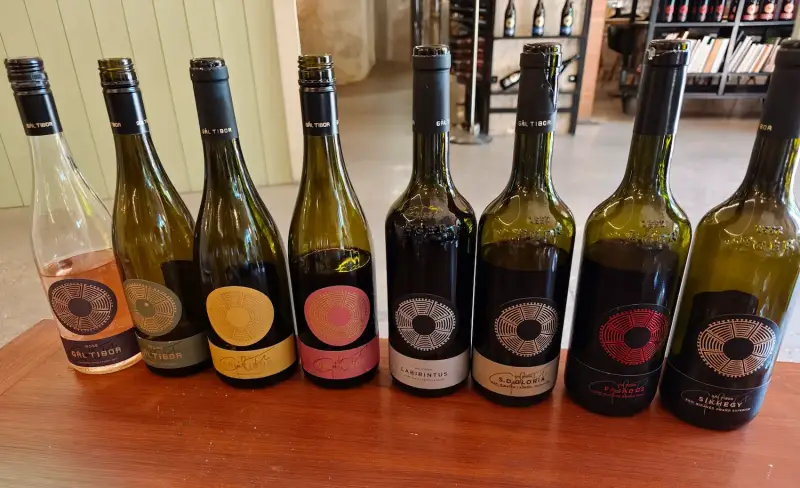
The lineup of Gai Tibor wines tasted during my visit.
Gai Tibor Labirintus Egri Bikaver Superior 2023
The signature wine of the Estate, based on 43% Kekfrankos with Syrah, Cabernet Franc, Kadarka, Cabernet Sauvignon and Pinot Noir all from Pajados and Sighegy vineyards. Spontaneous fermentation of each variety separately in a mix of open wooden vats and stainless, aged in 500 litre Hungarian oak barrels (just 15% new) for 12 months. Medium ruby in the glass with bright bramble fruit aromas edged with dried herbs, violets and a hint of forest floor. The medium bodied palate has fine tannins, bright acidity and slightly sour-edged cherry and blueberry fruits, impeccably balanced and decent length.
Gai Tibor Síkhegy Egri Bikavér Grand Superior 2018
I tasted three compelling SV Egri Bikavers but had to choose one and this was pretty special. A blend of Kekfrankos, Kadarka, Cabernet Franc, Syrah and Pinot Noir, handpicked, macerated for 20-30 days and aged in 500 litre oak barrels for 18 months. Ruby purple in the glass with aromas of forest berries, plum and sour cherry edged with black pepper, clove, dried herbs and coffee. On the structured palate the tannins are firm but fine, with good freshness, flavours of juicy dark berries and black cherries, and a salty minerality on the long finish.
St. Andrea – Elegance as a Regional Benchmark
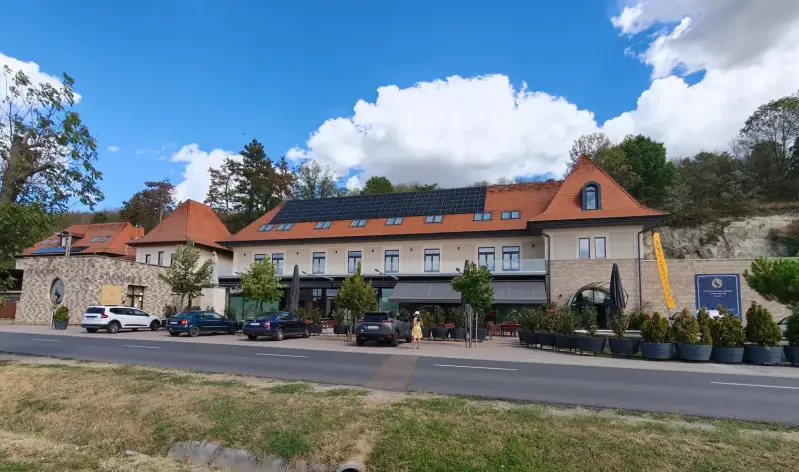
The impressive St Andrea Estate Complex
If Bukolyi is the craftsman and Gál Tibor the modernist, St. Andrea is the estate that gives Eger its sense of classical refinement. Under Dr. György Lőrincz (Senior), St. Andrea has become synonymous with balance, polish and an almost architectural sense of proportion. His winemaking philosophy is shaped not only by deep regional knowledge but by formative international experience — working vintages at Sepp Moser in Austria, where he absorbed a disciplined, vineyard‑first approach, and at St Clair in New Zealand, where clarity and precision are central. These influences underpin the estate’s belief that structure and elegance are not opposites but partners. Nothing is exaggerated; everything feels deliberate.
Yet St. Andrea’s identity is not solely technical or stylistic — it is also spiritual. The estate’s name refers to Saint Andrew (Szent András), reflecting the Lőrincz family’s Hungarian Catholic heritage. For Lőrincz Senior, faith is not a marketing motif but a worldview: winemaking as stewardship, humility, gratitude and responsibility. This religious grounding shapes the tone of the estate — a quiet seriousness, a sense of purpose, and an insistence that beauty in wine comes from harmony, proportion and respect for the land. It is an ethos rather than an aesthetic, and it permeates the way the family works.
St. Andrea’s strength lies in its ability to articulate terroir with clarity across a broad and diverse vineyard base. The estate works multiple sites in and around Egerszalók, Eger and the southern foothills of Nagy‑Eged, each with its own geological fingerprint. Volcanic tuff, limestone, marl, clay‑loess pockets and varied exposures shape the character of their Egri Bikavér, Egri Csillag and single‑vineyard bottlings. Their most important sites — Hangács, Merengő, Nagy‑Eged, Örökké, Boldogságos and Nimród — are treated as individual voices within a coherent stylistic language. Across these vineyards, St. Andrea cultivates Kékfrankos, Kadarka, Merlot, Cabernet Franc, Pinot Noir, Hárslevelű, Olaszrizling, Leányka and other Csillag components, each chosen for how it contributes to the estate’s composed, harmonious style.
Under Lőrincz Senior, the wines are not driven by extraction or power; they are built through proportion, patience and a deep respect for the raw material. Long ageing, careful blending and a refusal to chase trends define the house approach. Even their most ambitious reds — Merengő, Hangács, Nagy‑Eged — retain a sense of lift and restraint, showing how Eger’s volcanic tension can be channelled into finesse rather than force. In a region where experimentation is increasingly common, St. Andrea provides a counterpoint: demonstrating that modernity does not require abandoning classical roots, and that elegance can be as expressive as innovation.

Dr. György Lőrincz (Senior) and György Lőrincz Jr. Father & Son, a common theme in many of the Hungarian estates I visited, succession assured.
In recent years, the estate has entered a new phase under György Lőrincz Jr, who works alongside his father and is increasingly shaping the future direction of the winery. Where Senior brings architectural balance and classical proportion, Junior brings a more site‑transparent, contemporary sensibility — a focus on purity, precision and the fine‑grained details of terroir. His influence is visible in the tightening of stylistic lines across the portfolio and in the subtle evolution of Egri Csillag and Bikavér toward even greater clarity. The father‑and‑son dynamic gives St. Andrea a rare combination of experience and renewal: tradition actively reinterpreted rather than preserved in amber.
Beyond the wines themselves, St. Andrea has become a cultural anchor in Eger. Their work has helped define what the region’s classical voice sounds like: lifted aromatics, volcanic spice, disciplined structure, and an elegance that feels inseparable from place. More than any other producer, St. Andrea has become a reference point for what “great Eger” tastes like. Their wines are not just benchmarks for quality; they are benchmarks for coherence. They demonstrate how the region’s volcanic tuff, limestone pockets, altitude and cool climate can be woven into wines that feel both grounded and aspirational. In the broader narrative of Eger, St. Andrea is the estate that proves elegance is not an accident but a philosophy — one shaped by discipline, by faith, and by a generational commitment to making wines that speak with quiet authority.
Wines Tasted
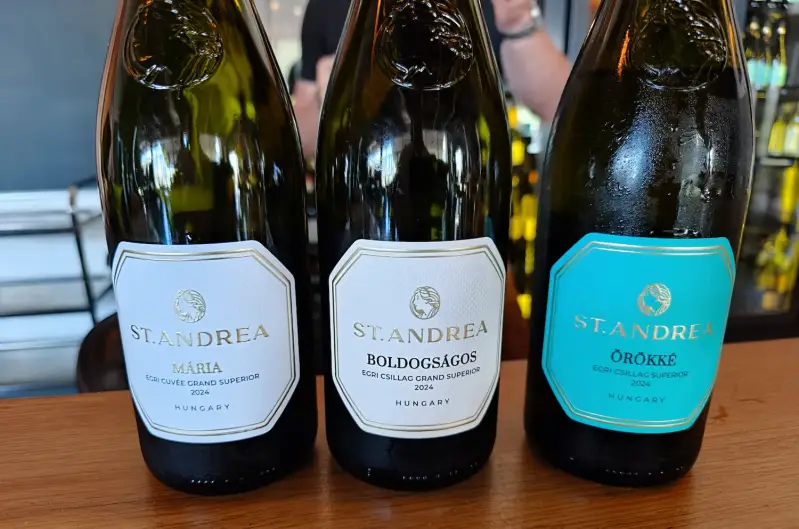
The St Andrea whites tasted
St. Andrea Örökké Egri Csillag Superior 2024
Handpicked Hárslevelű, Furmint, Pinot Gris, Sauvignon Blanc grapes from across Eger. Destemmed and gently pressed (except Furmint & Pinot Gris whole bunch pressed) fermented in a mix of stainless and oak barrels, aged 5 months in Hungarian oak. Clear straw in the glass with pear, chamomile and yellow flower aromas. The palate is quite round, rich and textured with citrus, pineapple and honey notes, crisp and fresh with a stony minerality on the long finish.
St. Andrea Boldogságos dűlő Egri Csillag Grand Superior 2024
Handpicked Hárslevelű, Furmint, Olaszrizling, Sauvignon Blanc, Szürkebarát from the Boldogságos vineyard, winemaking as for Örökké, aged 5 months in 500 litre Hungarian oak barrels. Lemon straw in the glass with aromas of peach and citrus edged with nettle and yellow flowers. The palate is rich and juicy with peach and grapefruit flavours and oak not yet quite in balance, with herbs and a salty minerality on the long finish.
St Andrea Merengő Egri Bikavér Superior 2022
Handpicked Kekfrankos (38%) Cabernet Franc (26%) Merlot (18%) Pinot Noir (11%) Syrah (7%) from vineyards across Eger. Destemmed and fermented in stainless and oak vats for 18-21 days, aged 15 months in 500l Hungarian oak barrels. Ruby purple in the glass with aromas of black cherry, plum, cinnamon and Chinese five spice. The medium – full bodied palate has blackberry, plum and blackcurrant fruits with firm but fine tannins, nicely balanced acidity and a long mineral-edged finish.
St Andrea Agape Nagy-Eged Egri Bikavér Grand Superior 2019
Handpicked Kekrankos (40%) Merlot, Pinot Noir, Syrah and Kadarka from the Nagy-Eged vineyard. Destemmed and fermented 18-21 days in open vats then aged 18 months in 500l Hungarian oak barrels. Deep purple in the glass with black and blue fruit aromas rich baking spices and pot-pourri. The rich and full-bodied palate has fine tannins, dark berries, crushed stone minerality and pronounced spice with a depth and freshness driving to a long, complex, layered finish.
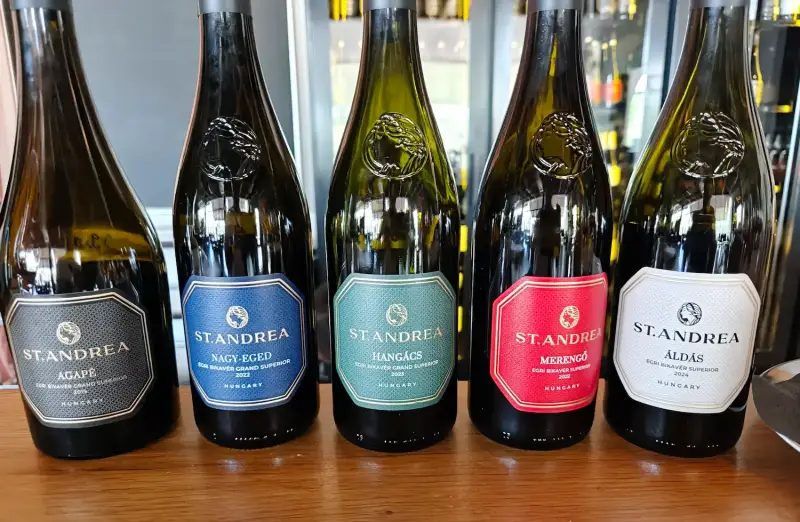
The St Andrea Reds tasting Lineup
Conclusion – Three Voices in a Region Learning to Adapt
Eger has long been described as a cool‑climate region, and structurally it still is: altitude, volcanic tuff, limestone pockets and sharp diurnal shifts shape its wines in ways that distinguish it from Hungary’s warmer plains. But walking the vineyards this year — in a hot, dry, drought‑stressed vintage — it is clear that Eger is now negotiating a new reality. The region’s identity is no longer defined solely by what the climate once was, but by how its best growers respond to what the climate is becoming.
That is what makes Bukolyi, Gál Tibor and St. Andrea so compelling. Each estate expresses Eger’s landscape through a different philosophy, yet all three are engaged in the same essential work: adapting without losing themselves. Bukolyi’s mountain‑driven austerity shows how altitude and thin soils can preserve freshness even in heat. Gál Tibor’s urban energy demonstrates how modern winemaking can sharpen clarity and lift. St. Andrea’s classical, faith‑infused elegance proves that proportion and restraint still have a place in a warming world.
Together, they reveal a region not defined by nostalgia but by resilience. Eger’s wines are fresher, more transparent and more site‑driven than ever before, not because the climate is stable, but because its growers are learning how to work with instability. They are rethinking canopy management, harvest timing, oak use, and the role of heritage grapes. They are rediscovering altitude, reconsidering blends, and treating terroir not as a fixed inheritance but as a living conversation.
Leaving Eger, I felt the sense of a region in motion — one that honours its volcanic past while confronting its climatic future. The three estates I visited do not offer a single answer to what Eger should be; they offer three coherent, confident interpretations of what Eger can be. And that is the real story: a region whose identity is being shaped not not only by history and geology, but also by the people who refuse to let either define its limits.
Eger is rising — not because conditions are easy, but because its best voices are learning how to rise with them.
About the Author
John Penney is a wine experience guide based in Martinborough–Wellington, New Zealand. His lifelong passion for wine is shaped by extensive international wine travel, formal study (WSET Level 3), and a career in adult learning. He writes about wine from both technical and cultural perspectives, drawing on real‑world tasting, wine travel, and deep research. Through his wineinsights business he provides Martinborough wine tours, Wairarapa wine tours, private wine tasting experiences, and wine education for wine lovers and enthusiasts.
Add comment
Comments