
Tokaj is no longer defined solely by Aszú. The region has evolved into a multidimensional landscape where dry wines, terroir transparency, and individual vineyard identity now stand alongside its historic sweet wines.
My four winery visits last month illustrate this evolution perfectly:
- Barta → the new Tokaj: dry Furmint with volcanic tension and revived historic sites.
- Royal Tokaji → the classical Tokaj: benchmark Aszú and Essencia; the estates that rebuilt Tokaj’s reputation after socialism.
- Szepsy → the intellectual Tokaj: single‑parcel wines and terroir mapping.
- Holdvölgy → the experiential Tokaj: architecture, storytelling, and immersive cellar design.
Together, they show Tokaj as a region honouring its past while redefining its future.
Tokaj’s History, Geography, and Evolution
Tokaj is one of Europe’s oldest formally demarcated wine regions. Its boundaries were set by the Royal Charter of 1737, establishing official control over where Tokaji wine could be produced. This demarcation is often mistaken for a classification, but Tokaj’s vineyard hierarchy actually predates the Charter: the earliest known classification is Halápi’s list from the 1670s, followed by the better‑known system recorded by Mátyás Bél in the 1730s. Unlike Bordeaux, where estates were classified, Tokaj’s tradition—much closer to Burgundy—has always centred on the ranking of individual dűlő (vineyard sites), many of which still define the region’s identity today. Its fame rested on Tokaji Aszú, the world’s first botrytised wine, celebrated from Versailles to St Petersburg. The region’s terroir is singular: volcanic subsoils, loess, clay and the autumn mists created by the Bodrog and Tisza rivers, which encourage noble rot. These conditions made Tokaj the “wine of kings, king of wines,” a phrase associated with Louis XIV.
The 20th century brought disruption, especially under socialism, when quality and identity suffered. The 1990s marked a renaissance: renewed investment, international expertise, and a new generation of Hungarian winemakers determined to reclaim Tokaj’s prestige. Dry Furmint emerged as a serious category, terroir studies intensified, and producers began exploring single‑vineyard and even single‑parcel expressions.
Today Tokaj is a UNESCO World Heritage Site and a region in full creative momentum: still the guardian of Aszú, but increasingly defined by precision, site transparency, and stylistic diversity.
The Grapes: Furmint and Hárslevelű
Tokaj’s identity rests mainly on two indigenous varieties. Furmint is the backbone, accounting for around two‑thirds of plantings. It is late‑ripening, naturally high in acidity, and capable of producing both taut, mineral dry wines and intensely sweet botrytised styles. In the glass, Furmint shows orchard fruit, citrus, and quince, often layered with volcanic flint and honeyed depth as it ages. It’s thick skins, tight bunches and a long season make it particularly suited to noble rot, the thick skins resisting infection until late in the season when shrivelling is advanced. This is the foundation of Aszú. Hárslevelű, whose name means “linden leaf,” is Furmint’s daughter and aromatic counterpart. It contributes linden blossom, acacia honey, pear, and gentle spice, with a rounder texture and slightly softer acidity. In blends it lifts perfume and mid‑palate flesh, while as a varietal it delivers floral, honeyed wines that complement Tokaj’s structural backbone. Together, these grapes define Tokaj’s stylistic range, from bone‑dry Furmint to perfumed blends and botrytised sweet wines.

The Wines: Aszú, Szamorodni, and Essencia.
Tokaj’s historic reputation rests on its botrytised wines. Aszú is made from individually hand‑picked shrivelled berries affected by noble rot, macerated in base wine, must or fermenting must before slow fermentation and long barrel aging. Sweetness was traditionally measured in “puttonyos,” baskets of aszú berries added to a cask, though today residual sugar levels define the style. Szamorodni (“as it comes”) is made from whole clusters containing both healthy and botrytised grapes, yielding either dry or sweet wines depending on sugar levels. Essencia is the rarest: the free‑run juice that drips naturally from aszú berries under its own weight, fermenting only to 2–4% alcohol but with extraordinary sugar concentration. Historically regarded as medicine, Essencia remains one of the world’s most unique wine treasures.
With Furmint and Hárslevelű as the region’s defining voices, and Aszú, Szamorodni, and Essencia as its historic signatures, Tokaj today speaks in multiple dialects. The following four estates illustrate how this grammar is being re‑written: each winery offers a distinct lens on Tokaj’s past, present, and future.
I was afforded generous tastings at each of these estates, covering a wide range of styles. Space, however, only permits me to present a selection — hopefully representative — of the wines I encountered.
Barta Pince — Reviving the Old King: Heritage, Hillsides, and the Rise of Dry Tokaj
Barta’s identity is inseparable from Öreg Király (Old King), one of Tokaj’s most historically significant vineyards. Records show the site was already prized in the 17th century, and by the time Tokaj was formally classified in 1737, Öreg Király was recognised as one of the region’s top crus. Its steep, south‑facing slopes above Mád were long considered capable of producing Tokaj’s most concentrated Aszú.
Under communism, the vineyard was abandoned — too steep for mechanisation, too labour‑intensive for the collectivised system. When Karoly Barta acquired it in 2003, it was essentially a ruin: terraces collapsed, vines gone, and the hillside overgrown.
The Revival: A Monumental Restoration
The restoration of Öreg Király is one of the great modern vineyard revival stories in Hungary. Barta rebuilt the terraces stone by stone, re‑planted with Furmint and Hárslevelű, and returned the site to its historical form. The project was guided by archival maps and soil studies, ensuring the vineyard’s original structure was respected.
This revival is not just agricultural — it is cultural. Barta’s work restored one of Tokaj’s most important historical vineyards to active life, reconnecting modern Tokaj with its pre‑communist heritage.
As you walk the terraces, the physical structure of the vineyard reveals the geology that shaped its reputation. The steep slopes of Öreg Király are cut directly into volcanic rhyolite tuff, streaked with zeolite veins and red clay. These fractured rocks, visible between the vines, are the foundation of the site’s mineral‑driven character and provide a striking reminder of Tokaj’s volcanic origins.
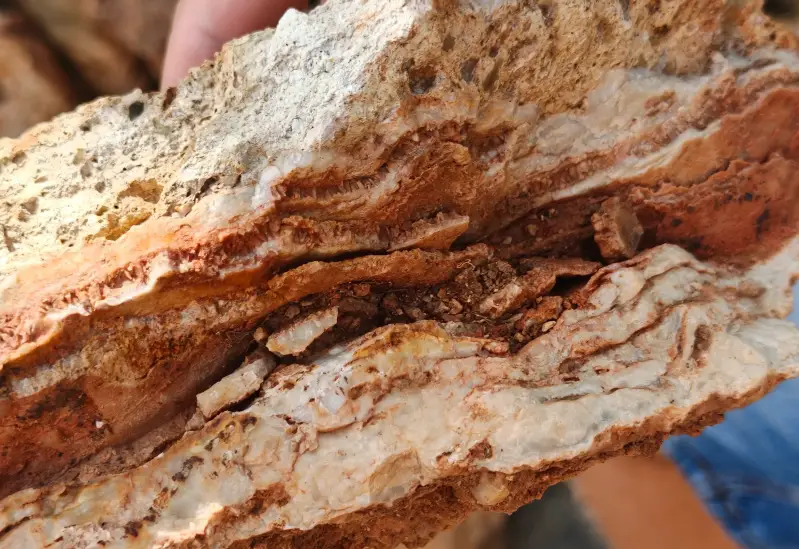
Volcanic rhyolite tuff from the Öreg Király Vineyard
The Wines: Volcanic Precision and Dry‑Wine Leadership
Barta is one of the estates leading Tokaj’s shift toward high‑quality dry wines. Their dry Furmints from Öreg Király are defined by volcanic minerality, vivid acidity, and a taut energy that conveys the hillside’s geology with remarkable purity. Volcanic
My vineyard walk and tasting impressions align perfectly with the estate’s philosophy: the wines are shaped by the hillside itself, not simply by cellar technique.
Sweet Wines: A Return to Tradition
Although Barta is best known for dry wines, their late‑harvest and Aszú bottlings from Öreg Király have gained international recognition. These wines echo the site’s historical reputation for producing concentrated botrytised fruit.
Tasting Highlights
Barta Mad Furmint - Hárslevelű 2024
From a hailstorm challenged vintage, this blend of 53% Furmint and 47% Hárslevelű was cool-fermented in stainless and then 30% aged in French oak for 6 months. Gently expressive nose of white flowers, honey, lemongrass and smoky kaffir lime. On the palate citrus and green apple flavours are touched with a smoky mineral edge, the crisp acidity is perfectly balanced with some residual sweetness, that seems to finish relatively dry.
Barta Öreg Király Dülő Furmint 2023
Grapes from an ideal vintage were gently pressed, gravity settled and cool-fermented in a mix of stainless and oak with 58% further aged for five months in used oak barrels. Aromas of lemongrass, chamomile, beeswax and a distinct minerality. The palate has a lipsmacking acidity and salinity framing citrus, herbs and salt flavours with impeccable balance and real persistence.
Barta Öreg Király Dülő Furmint 2013
From an outstanding vintage this wine presents with aromas of honey, yellow flowers, lemon wax and smoke. The palate has that characteristic smoky, salty minerality supporting flavours of yellow plum, lemon zest and apple, there’s a distinct grip to this mouthfilling wine and real persistence. Heaps of life ahead!
Barta Öreg Király Dülő Aszú 6 Puttonyos 2019
Botrytised shrivelled Furmint berries were individually handpicked and macerated in fermenting Furmint base must for 18 hours before gentle pressing and fermentation in oak barrels followed by 24 months aging in a mix of Hungarian and French oak. Lemon gold in the glass with aromas of honey, apricots and mango. The palate is incredibly rich, concentrated and unctuous yet shows bright acidity and minerality that gives lift and energy to the long, persistent finish.
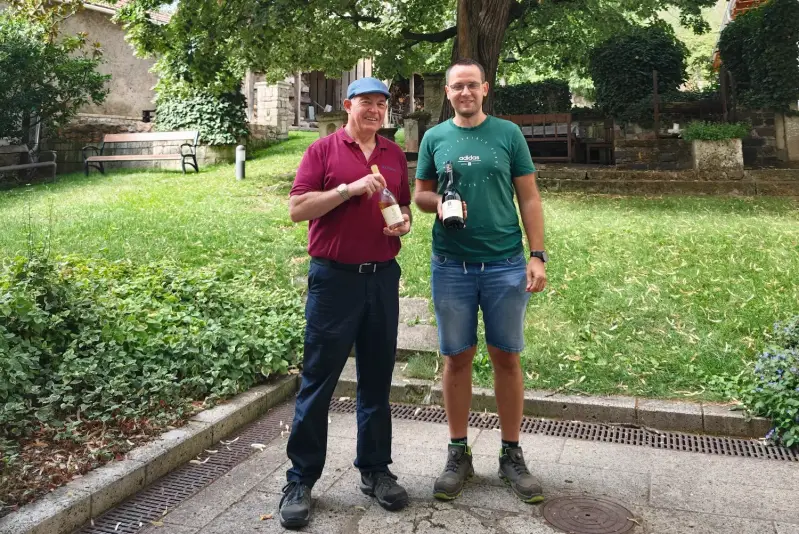
The author with Adam Toth, winemaker and my host at Barta Pince
Why Barta Matters
Barta represents Tokaj’s rebirth: the recovery of great sites, the rise of dry Furmint, and the return of terroir‑first thinking.
Royal Tokaji — The Post‑Communist Rebuilder: Tradition, Investment, and the Return of Aszú
Royal Tokaji was founded in 1990, immediately after the fall of communism, by a group of international investors including Hugh Johnson, one of the world’s most influential wine writers. At that moment Tokaj’s reputation was in tatters — decades of collectivised production had damaged quality, vineyards were neglected, and the region’s identity was fading.
The estate’s mission was clear — to restore Tokaj’s prestige and re‑establish its wines on the world stage.
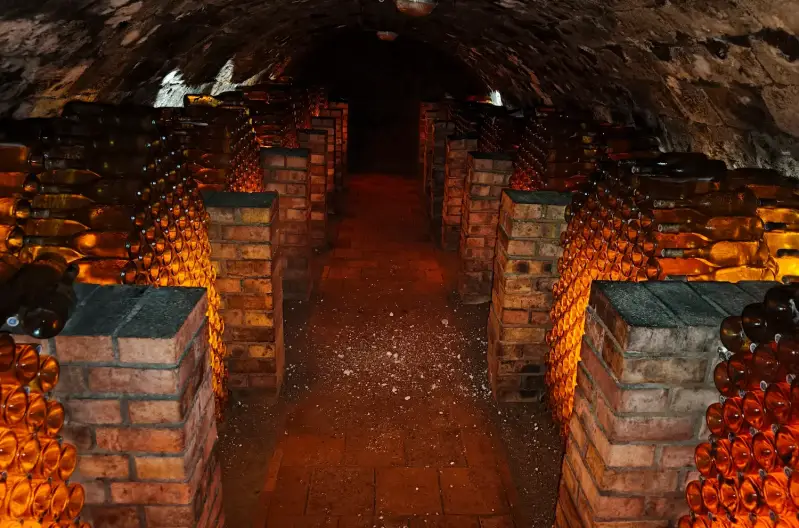
Liquid gold: backlit bottles of Aszú aging in the Royal Tokaji underground cellars
Single‑Vineyard Aszú: A New Standard
From the beginning, Royal Tokaji focused on high‑quality Aszú, single‑vineyard bottlings, and the rare Essencia, setting new standards for excellence. Their early releases were instrumental in reintroducing Tokaji Aszú to collectors, critics, and the global fine wine market. By pioneering the modern concept of single‑vineyard Aszú, with sites such as Mézes Mály, Nyulászó, Szent Tamás, and Betsek, they mirrored Burgundy’s cru system and reframed Tokaj as a terroir‑driven region rather than a monolithic sweet wine producer.
Their early releases were instrumental in reintroducing Tokaji Aszú to collectors, critics, and the global fine‑wine market.
Essencia: The Pinnacle
Royal Tokaji’s Essencia is one of the world’s rarest wines — often under 3% alcohol, made entirely from free‑run juice of botrytised berries. It is produced only in exceptional years and is released in tiny quantities. It is not merely a wine (indeed in Hungarian history it was medicine!) rather, it is a cultural artefact of unique significance.
Dry Wines: A Modern Expansion
Although founded on sweet wines, Royal Tokaji now produces refined dry Furmints that reflect Tokaj’s evolution. These wines are precise, mineral, and increasingly important to the estate’s identity.
Tasting Highlights
Royal Tokaji Furmint 2022
From a warm dry growing season, the wine presents with aromas of citrus, green pear and a smoky minerality. The palate is crisp and dry, the acidity quite intense underpinning herb, citrus and apricot flavours with a salty lemon finish.
Royal Tokaji Late Harvest 2023
A blend of Furmint, Hárslevelű and Yellow Muscat from an excellent vintage with a fragrant nose of orange blossom, Turkish Delight and apricot. The palate has a lovely honey flavoured but not cloying sweetness perfectly balanced with fresh acidity, flavours of ripe apricots and candied lemon peel and a clean, long finish.
Royal Tokaji Blue Label Aszú 5 Puttonyos 2019
A blend of Furmint and Hárslevelű fully botrytised grapes, aged 24 months in used oak after fermentation then further bottle aging. Aromas of dried mango, baked pineapple apricots and caramel. The palate is lusciously sweet with honeyed dried apricot, mango and candied citrus peel with a vibrant acidity that keeps the long finish clean and moreish.
Royal Tokaji Essencia 2017
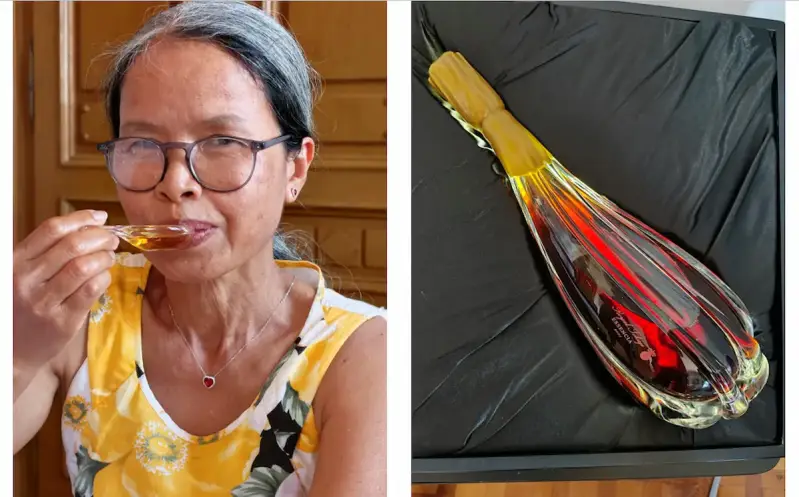
Suchitta (my wife) tasting the stunning 2017 Essencia
If I have one elixir on my lips before I die this must be it. Just 2% alcohol, a whopping 557 gm/l residual sugar and an incredible 10.4 gm/l acidity, the wine was aged 2/3 in traditional glass demijohns and one third in 500 litre Hungarian oak barrels. The powerful nose exhibits candied citrus peel, Catalan cream and dried apricots. The viscous palate is dense and unctuous yet beautifully lifted by laser acidity, with an incredible depth of flavour featuring tart marmalade, fresh and cooked yellow peaches and a slight bitterness that adds tension.
Why Royal Tokaji Matters
Royal Tokaji represents Tokaj’s restoration: the rebuilding of reputation, the return of Aszú to global prominence, and the bridge between tradition and modernity.
István Szepsy — The Architect of Modern Tokaj Terroir
István Szepsy is not just a leading Tokaj producer — he is one of the central figures in the entire history of the region. His family’s documented involvement in Tokaj dates back nearly 400 years to 1631 when Szepsy Laczkó Máté, chaplain to the Rákóczi noble family, documented the winemaking process for Tokaji Aszú. This record preserved the method that defines Tokaj’s legendary sweet wine to this day.
Tokaj’s Golden Age and Global Prestige
During the 17th–18th centuries, Tokaji Aszú became a diplomatic currency across Europe. It was traded by Polish and German Jewish merchant dynasties, stored in royal cellars, and famously valued “more than gold.” Catherine the Great even stationed a Cossack regiment to escort annual shipments from Tokaj to St Petersburg. Many of Tokaj’s great sites were classified as first‑growth vineyards in 1737, when Tokaj became the world’s first officially delimited wine region.
Surviving Communism and Protecting Tokaj’s Terroir
Communist collectivisation devastated Tokaj’s vineyard structure, replacing noble clones with high‑yielding vines and stripping families of their land. The Szepsys were dispossessed like many others.
Yet István Szepsy Senior refused to abandon independent winemaking. He secretly maintained a small four‑hectare vineyard throughout the socialist era, delivering grapes to the state until 1990.
After the fall of communism, he began the painstaking process of rebuilding the estate. Today, 83% of the family’s vineyards lie within Tokaj’s historic first‑growth crus, an extraordinary recovery given that only 52 vineyards were ever classified at that level.
The Modern Renaissance: Terroir Mapping and Precision
Szepsy’s modern reputation rests on István’s obsessive pursuit of terroir expression. He has:
- Conducted groundbreaking research on Furmint, mapping over 300 genetic variations of the grape.
- Mapped Tokaj’s volcanic soils to understand their affinity with Furmint and Hárslevelű.
- Pioneered single‑vineyard and single‑parcel wines, pushing Tokaj toward a Burgundian model of terroir interpretation.
- Implemented extreme crop‑thinning and bunch‑wing removal to intensify site expression.
Awards and Recognition
Szepsy’s influence has been recognised both nationally and internationally. In 1999 István was awarded the Officer’s Cross of the Order of Merit of the Hungarian Republic, a distinction that acknowledged his role in safeguarding Tokaj’s heritage during a period of profound change. Two years later, in 2001, he was named Hungary’s Winemaker of the Year, cementing his reputation as the leading voice of modern Tokaj. His standing was further elevated when he received Les Seigneurs du Vin, often described as the “Academy Award of winemaking,” a rare honour that placed him among the world’s most respected producers. These accolades reflect not only his technical mastery but also his lifelong commitment to preserving Tokaj’s cultural identity while redefining its future.
Szepsy Today: Father and Son
The estate now spans 52 hectares, producing fewer than 50,000 bottles — a deliberate choice to maintain quality. István Szepsy Jr., an enologist, is increasingly focused on dry, single‑varietal Furmint, continuing the family’s terroir‑driven evolution while preserving the legacy of benchmark sweet wines.
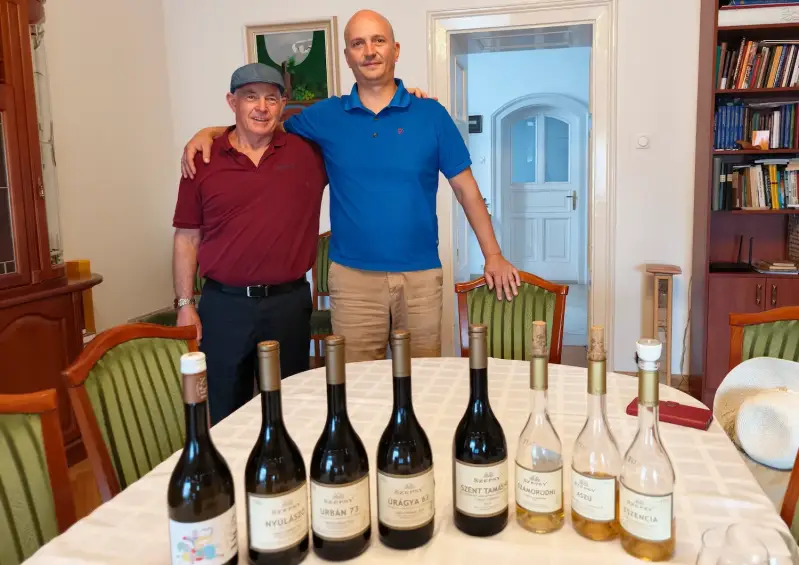
The author with István Szepsy Jnr and the wines tasted
Tasting Highlights
Szepsy Nyulászó Tokaji Furmint 2022
From a single vineyard with rhyolite soil on the outskirts of Mad. Lemon, herbs, flint, and sweet white flower aromas. On the palate, dry and tense with a definite stone and salt minerality over the grapefruit and green apple fruit and a long mineral edged almost peppery finish.
Szepsy Urban 73 Tokaji Furmint 2022
The number refers to the actual plot within the urban vineyard which has the rockiest soils on a steep East slope. The green apple, quince and citrus nose is overlaid with flint and smoke. The palate is also dominated by textural mineral elements but there is a greater concentration and roundness to the pear and quince fruit in the mid palate than in the Nyulászó. The finish is nicely balanced with vibrant acidity and some residual sugar adding drive and depth.
Szepsy Úrágya 63 Tokaji Furmint 2022
From the numbered plot in a vineyard next-door to Urban, the fruit were whole-bunch pressed and spontaneously fermented in Hungarian oak barrels with a full malolactic conversion. Aromas of chamomile, green apples, lemon and quince supported by vanilla and wet stone. Medium bodied on the plate with a creaminess and richer, sweeter fruit than Urban with flavours of yellow plum, pear, apricot and wet earth, underpinned by fresh salty acidity, and a long pepper edged finish.
Szepsy Szent Tamás 46 Tokaji Furmint 2024
Old low yielding vines on steep volcanic soils from a historic single vineyard plot. Hand harvested in small batches whole bunch pressed and fermented in 300 litre Hungarian oak barrels with ambient yeasts. The nose is restrained with chamomile, apple and beeswax aromas. The palate is bone dry with a broad texture and flavours of honey, herbs, underpinned with salty minerality and noticeable oak influence not yet fully integrated but on its way.
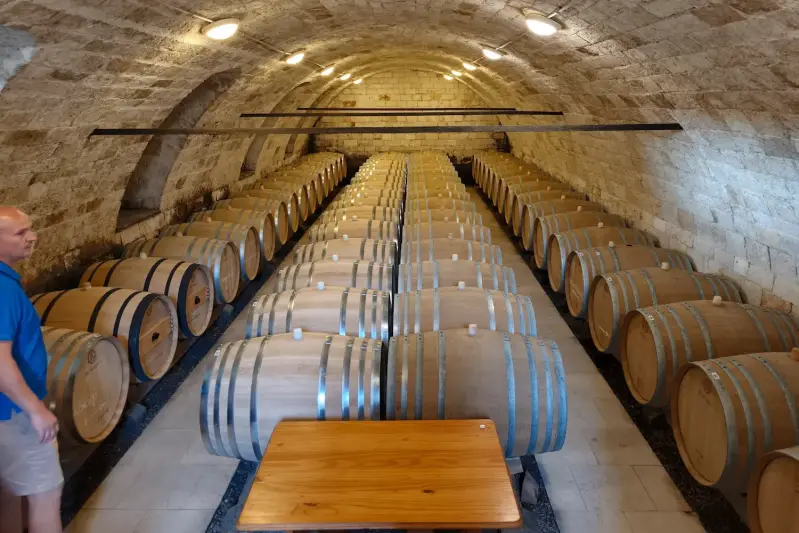
The pristine Szepsy barrel room
Why Szepsy Matters
Szepsy redefined Tokaj through single‑parcel precision, proving Furmint’s power as a true terroir transmitter.
Holdvölgy — The Immersive Tokaj: Architecture, Storytelling, and Immersive Cellar Design.
Holdvölgy was founded in the early 2000s by Pascal Demkó, who purchased parcels across multiple first‑growth vineyards exclusively in Mád basin with a long‑term vision: create a Tokaj estate that blends heritage, architecture, and modern winemaking into a unified experience.
The name “Holdvölgy” means Moon Valley, referencing the estate’s few parcels’ location and the poetic identity Pascal wanted to cultivate.
The Cellar: A Labyrinth of History
Holdvölgy’s cellar is among the most distinctive in Tokaj, a seven‑hundred‑year‑old underground network restored and expanded into a multi‑level labyrinth. Conceived as an immersive, sensory environment, it leads visitors through chambers, alcoves, and tunnels in a curated journey that blends medieval heritage with modern design. My own exploration of their wines unfolded within this “treasure hunt” tasting, where each space revealed a new bottle and a new story. Moving through the cellar in this way reinforced the estate’s philosophy that Tokaj should be experienced not only in the glass but as a narrative — a journey told through place, architecture, and wine.

The Holdvölgy Cellars “Treasure” Map
The Vineyards: Parcellaire Discipline Across Mád’s Top Sites
Holdvölgy farms parcels across seven of Mád’s historic first‑growth crus, including Király, Holdvölgy, Nyulászó, Becsek, Kakas, Dorgó, and Úrágya. Since the estate’s first vintage in 2006, every parcel and every variety has been harvested and vinified separately—a philosophy supported by small‑scale equipment such as a compact press and numerous 10‑hectolitre tanks. This parcellaire approach underpins two decades of detailed learning about their terroirs, culminating in the estate being named Hungary’s Best Winery in 2026. While Holdvölgy produces a flagship blend, Vision, the estate also releases monovarietal, single‑parcel wines in vintages that allow it, including Meditation (Király Furmint), Expression (Becsek Hárslevelű), and several Intuition bottlings from Nyulászó, Becsek, and Holdvölgy. The result is a portfolio that expresses both the precision of individual sites and the broader compositional possibilities of Tokaj.
The Wines: Flagship Blends Alongside Single‑Parcel Expressions
Holdvölgy’s winemaking centres on parcellaire vinification, with each parcel and variety handled independently before any decisions about blending are made. This allows the estate to produce Vision—their flagship dry blend of Furmint, Hárslevelű, and Kabar—every year since 2013, while also releasing single‑parcel, monovarietal wines whenever the vintage provides the necessary clarity and balance. Across dry, sweet, and sparkling styles, the estate’s wines reflect a modern, precise aesthetic rooted in detailed site knowledge. Vision and Culture (their 6 puttonyos aszú) anchor the range from vintage to vintage, complemented by parcellaire bottlings that highlight Tokaj’s individual first‑growth crus.
Tasting Highlights
Holdvölgy Vision 2021
A blend of 65% Furmint, 25% Hárslevelű and 10% Kabar from three classifies sites. Presents with citrus, honeysuckle and pear aromas and some subtle spice. The palate is balanced and lively with some sweet vanilla oak spice supporting the orchard fruit flavours and a slight phenolic edge on the mineral finish.
Holdvölgy Intuition No 3 2020
100% Furmint from a single parcel in the Becsek vineyard with andesite, rhyolite and red clay soils. Whole bunch pressed and fermented in stainless followed by 6 months barrel aging. Aromas of white flowers, citrus, orchard fruits and minerals. Saline minerality presides over the citrus and herb palate and drives persistence
Holdvölgy Signature 2013
An innovative blending of already-aged Szamorodni, Aszú and Essencia from Furmint, Hárslevelű and Zeta (a hybrid of Furmint) grapes across four classified sites. Each individual sweet wine is made normally and after the wines are ready (most of them after 24 month of barrel ageing) the blend is made. Aromas of yellow plums, dried apricots, mango and marmalade. The palate is intensely sweet yet lifted by underpinning acidity with flavours of apricot compote, bitter orange marmalade edged with a smoky minerality.
Holdvölgy Culture 6 Puttonyos Tokaj Aszú 2008.
Furmint, Hárslevelű and Zeta fully botrytised grapes macerated in a base must of 100% furmint from Becsek vineyard for 24 hours before fermenting in stainless tanks and then 3 years barrel aging before further aging in bottle for 5 more years before release. Amber gold in the glass with aromas of vanilla, burnt toffee, dried mango and apricots. The palate is lush and layered yet lively with honeyed apricot, bitter marmalade and a herbal note reminiscent of candied angelica.
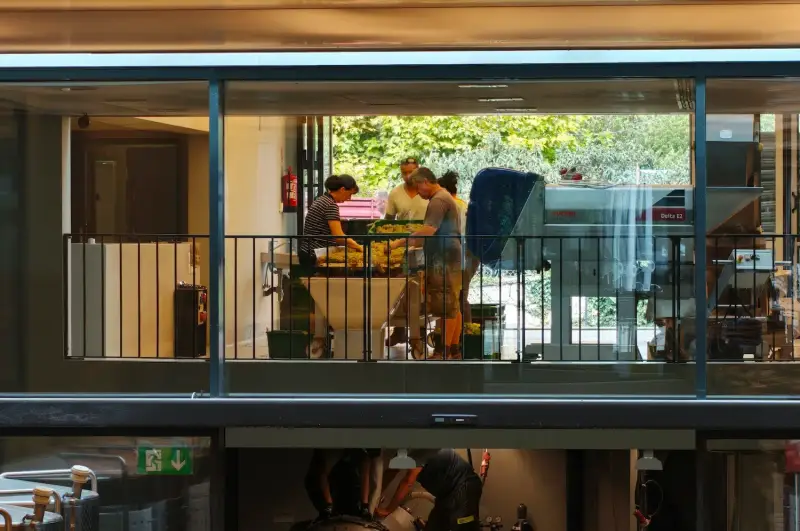
View through the glass window of the cellar door to the winery where just harvested grapes are being sorted – the tank room is below
Why Holdvölgy Matters.
Holdvölgy represents Tokaj’s creative evolution: innovation in architecture, hospitality, and stylistic expression.
Conclusion: Four dimensions of Rediscovery and Evolution.
Barta was the ideal starting point because it embodies Tokaj’s modern shift toward dry, terroir‑driven Furmint. The revival of the historic Öreg Király (Old King) vineyard is central to their identity: steep, south‑facing, and long recognised as one of Mád’s great sites. My walk through the vineyard embraces how the Barta wines should be understood - through the land itself. The minerality, energy, and tension noted in their dry wines are geological signatures of the volcanic slopes. Barta represents Tokaj’s new grammar — purity, salinity, and site transparency — and demonstrates how dry Furmint has become a world‑class category.
Royal Tokaji sits at the opposite pole: the guardian of classical Tokaj and one of the estates most responsible for restoring the region’s international reputation after 1990. The winery focus on benchmark Aszú and Essencia, re‑establishing quality standards and reintroducing Tokaj to collectors and critics is not just about making great sweet wines, but also preserving Tokaj’s cultural identity while participating in its evolution. Their portfolio bridges eras: classical Aszú alongside increasingly refined dry wines.
If Royal Tokaji rebuilt Tokaj’s reputation, István Szepsy redefined its intellectual foundations. Often described as the father of modern Tokaj, Szepsy’s work on single‑vineyard and single‑parcel wines pushed the region toward a Burgundian understanding of terroir. My tasting of wines from individual plots within vineyards was quintessential Szepsy. These wines are not just expressions of Tokaj — they are arguments: that Furmint is one of Europe’s great terroir transmitters, that volcanic soils deserve granular interpretation, and that Tokaj’s future lies in precision. Szepsy represents Tokaj’s philosophical evolution, where terroir is a lifelong study.
Holdvölgy offers a completely different lens: Tokaj as experience. Their “treasure hunt” tasting through the cellar is not a gimmick but a deliberate reframing of how visitors engage with Tokaj’s heritage. The estate’s labyrinthine cellars echo the region’s medieval underground networks, but the presentation is modern, curated, and theatrical.
Holdvölgy’s wines often blend multiple sites and varieties, positioning the estate as a composer rather than a cartographer. Where Szepsy isolates terroir, Holdvölgy also layers it. Where Barta focuses on purity, Holdvölgy focuses on narrative. Their approach shows Tokaj’s creative evolution, proving that innovation in the region extends to architecture, hospitality, and storytelling.
Taken together, these estates show Tokaj as a region that honours its historic sweetness while embracing a new grammar of site‑driven precision, intellectual terroir mapping, and creative hospitality. Tokaj today is not a relic of the past but a living laboratory of volcanic soils, noble varieties, and visionary producers — a region simultaneously preserving its crown jewel, Aszú, and redefining itself for the future of world wine.
-------------------------------------------------------------------------------------------------------------------------------------------------------------------------------------------------------------
If you enjoy reading in‑depth guides to wine regions you may not have visited, you might also enjoy my series on Sicily — starting with my first Etna Explorations article.
About the Author
John Penney is a wine experience guide based in Martinborough-Wellington, New Zealand. His lifelong passion for wine is shaped by extensive international wine travel, formal study (WSET Level 3), and a career in adult learning. He writes about wine from both technical and cultural perspectives, drawing on real-world tasting, wine travel, and extensive research. Through his wineinsights business he provides Wairarapa wine tours, wine tasting in Martinborough, and wine education experiences for wine lovers and enthusiasts.
Add comment
Comments