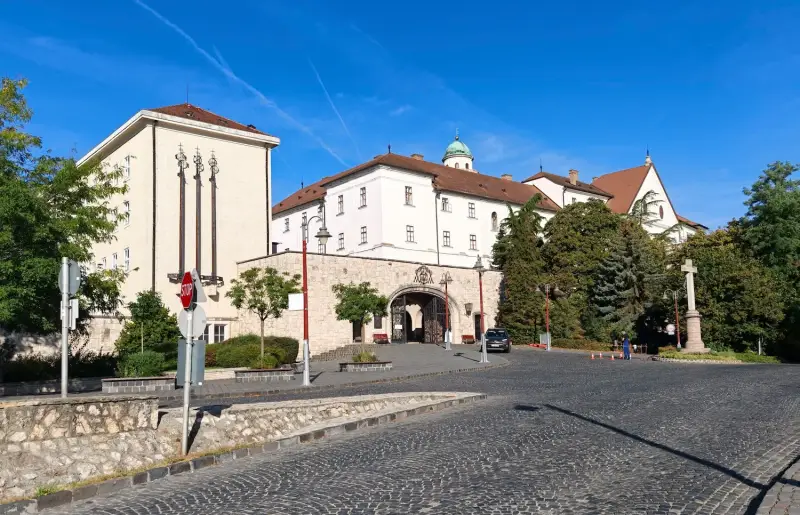
In September 2026, I took a break from my Martinborough wine tours and exclusive Wairarapa wine experiences to explore some of Hungary's most exciting wine regions. Following my previous article on Villány this sixth instalment visits Pannonhalma, where wine, faith and continuity have been intertwined for more than a millennium.
Few wine regions in Hungary possess a history stretching back a millennium. Fewer still can point to a single institution that has shaped that history almost continuously throughout its existence. In Pannonhalma, the story of wine is inseparable from the story of the Benedictine Archabbey that dominates Saint Martin's Hill. Founded in 996, four years before the coronation of Stephen I and the formal establishment of the Kingdom of Hungary, the abbey remains the oldest continuously operating institution in the country and one of Hungary's most important cultural landmarks. Today recognised as a UNESCO World Heritage Site, it has served for centuries as a centre of religion, education, scholarship and agriculture while preserving a connection to viticulture that has endured through much of Hungary's history.
Pannonhalma occupies a distinctive position within Hungarian wine. Unlike Tokaj, Villány, Eger or Badacsony, it is not defined by a large number of competing producers or by a continuing debate over regional identity. Modern Pannonhalma is, to an extraordinary degree, synonymous with the Archabbey itself. Yet this should not be interpreted as a weakness. If anything, it gives the region a clarity and coherence that few others possess.
The abbey's significance extends well beyond wine. Over successive centuries it has functioned as a monastery, a school, a library and a centre of learning. Nonetheless, wine has remained a constant thread running through its history. The vineyards have survived political upheaval, changing dynasties, war, occupation and eventually communist confiscation. Although the continuity was interrupted during the second half of the twentieth century, the revival of the estate in the modern era represents one of the most remarkable restorations in Hungarian wine.
For visitors today, the experience can feel somewhat unusual. The journey to Pannonhalma is rarely motivated purely by wine. Many arrive because of the abbey's religious, cultural or historical significance and only subsequently discover the wines. Yet that relationship is precisely what makes Pannonhalma fascinating. The wine is not a separate enterprise attached to a heritage site. Rather, it forms part of a much broader story encompassing faith, scholarship, stewardship and cultural continuity.
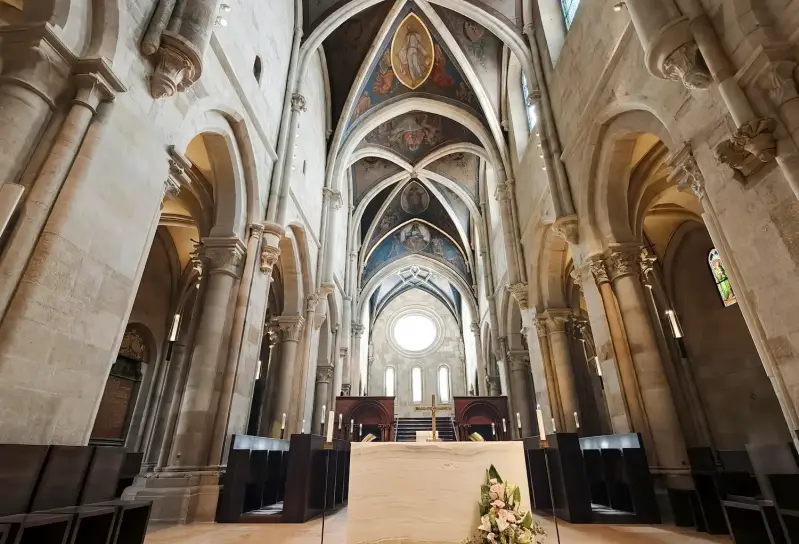
The sanctuary of St Martin's Basilica reflects Pannonhalma's blend of tradition and renewal, combining medieval architecture with contemporary ecclesiastical design.
The Birth of Hungarian Monastic Viticulture
The Benedictines who arrived at Pannonhalma in 996 brought considerably more than religious devotion. Throughout medieval Europe, Benedictine monasteries served as repositories of learning and centres of agricultural innovation. Guided by the principle of ora et labora - prayer and work - the order regarded manual labour as an essential element of spiritual life rather than a distraction from it.
Viticulture fitted naturally within this framework. Wine was required for the celebration of the Eucharist, but vineyards also embodied many of the virtues valued within monastic life. Successful winegrowing demanded patience, discipline, observation and a willingness to think across generations. A vineyard planted by one generation of monks might only reach maturity under the care of the next.
The Benedictines were not introducing viticulture to an untouched landscape. The region formed part of the Roman province of Pannonia and wine had almost certainly been cultivated here long before the arrival of the monks. The Benedictines instead inherited and enhanced an existing tradition, bringing with them the advanced agricultural knowledge that monasteries had accumulated throughout Western Europe.
Over succeeding centuries the abbey grew in influence and prosperity. The vineyards expanded alongside its religious and educational activities. Like many monastic institutions across Europe, Pannonhalma became an important landowner and agricultural enterprise. Its vineyards formed only one component of a broader economic system but remained among its most visible and enduring activities.
By the beginning of the twentieth century the abbey controlled around one hundred hectares of vineyards in the Pannonhalma area and also possessed vineyard holdings in other notable Hungarian regions. The wines achieved a reputation extending beyond local markets and formed part of a wider tradition of monastic wine production whose roots stretched back centuries.
From Confiscation to Revival
The continuity of this tradition was ultimately broken not by war or invasion but by politics. Following the Second World War and the establishment of communist rule in Hungary, church properties were confiscated and the abbey lost its vineyards. A winemaking tradition that had survived for nearly a thousand years was effectively extinguished.
For decades, the vineyards and winery ceased to operate under monastic ownership. Yet unlike many historic estates that disappeared permanently, Pannonhalma retained something more important than buildings or vineyards: institutional memory. The Benedictine community never abandoned the idea that the vineyards might eventually be restored.
Following the political changes of 1989, that possibility became reality. The abbey gradually reacquired vineyard land and began rebuilding its winemaking tradition. Replanting commenced around the turn of the millennium and a new winery was completed in 2003, marking the beginning of the modern chapter in Pannonhalma's history.
An important figure in this revival was Tibor Gál, one of the most influential personalities in modern Hungarian wine. Gál's experience, including his work in Italy and his role in elevating the reputation of Eger, helped ensure that the reborn Pannonhalma would not simply be a museum piece. The ambition was to create a contemporary winery capable of producing wines of genuine quality while remaining connected to the abbey's traditions.
Today the public face of that vision is chief winemaker Zsolt Liptai. Widely regarded as one of the leading figures in modern Hungarian wine, Liptai has overseen a period in which Pannonhalma has become both critically acclaimed and commercially successful, earning recognition as Hungary's Winery of the Year on two occasions while he himself was named Hungary's Winemaker of the Year. Under his stewardship, the estate has established a distinctive identity built around freshness, balance and a clear sense of place. Rather than pursuing fashionable styles or attempting to imitate more famous regions, the winery has gradually refined an approach that feels increasingly confident in its own character.
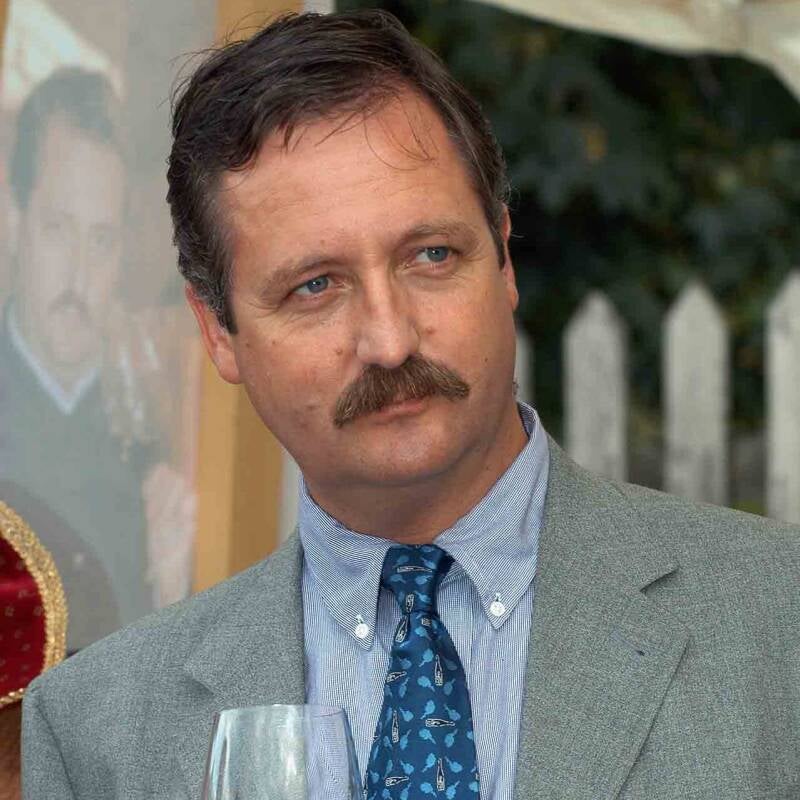

Portraits of Gal Tibor and Zsolt Liptai
Terroir
Located between Budapest and Vienna and not far from the city of Győr, Pannonhalma occupies a distinctive corner of north-western Hungary. The landscape differs noticeably from many of the country's better-known wine regions. Instead of dramatic volcanic hills or broad river plains, the vineyards occupy a series of gently rolling slopes surrounding Saint Martin's Hill and the abbey itself.
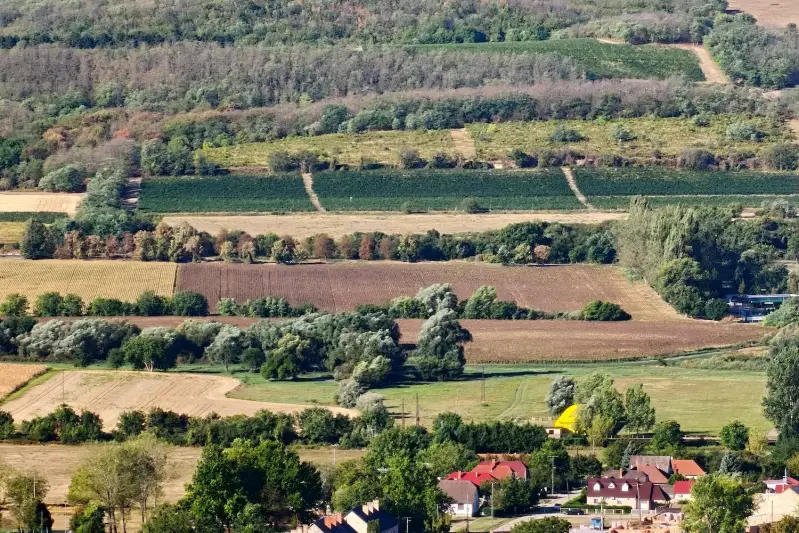
Seen from Pannonhalma Archabbey, vineyards weave through a mosaic of woodland and farmland, illustrating the mixed agricultural landscape that defines the region.
The climate is relatively moderate by Hungarian standards. Western influences help temper extremes of heat, while the rolling topography provides varied exposures and mesoclimates. The growing season is long enough for full ripening but generally cool enough to preserve acidity and aromatic complexity.
The soils are similarly varied. Loess, clay, sand and limestone-derived materials all contribute to the mosaic of vineyard conditions found throughout the region. Although Pannonhalma is one of Hungary's smaller wine districts, the diversity of soils and exposures provides considerable flexibility when matching grape variety to site.
These conditions have had a profound influence on the style of wines produced here. Rather than favouring heavily structured reds or high-alcohol whites, the climate tends to encourage freshness, aromatic precision and balance. The resulting wines often display more affinity with cooler regions of Central Europe than with the richer styles commonly associated with warmer parts of Hungary.
Most importantly, these conditions have shaped the grapes that now define the region.
Grape Varieties and Regional Identity
One of the most striking aspects of modern Pannonhalma is the confidence with which it embraces international varieties. In an era where many discussions of Hungarian wine focus heavily on indigenous grapes, Pannonhalma has adopted a more pragmatic approach. The modern vineyard contains both Hungarian and international varieties, but the estate appears primarily concerned with identifying those grapes best suited to its terroir.
This distinction is important. The abbey is not rejecting Hungarian tradition. Rather, it is expressing a belief that authenticity comes from faithfully interpreting place rather than pursuing any particular ideological vision of what Hungarian wine should be.
Among white varieties, Sauvignon Blanc has emerged as one of the winery's most significant successes. The climate allows the grape to achieve aromatic intensity while retaining freshness and structure. Rather than producing overtly tropical examples, the wines often emphasise precision, purity and balance. It is telling that Sauvignon Blanc occupied a prominent place in the visitor tasting, suggesting the winery regards it as one of the clearest expressions of modern Pannonhalma.
Equally significant is Rajnai Rizling, or Rhine Riesling. Few varieties communicate terroir as transparently as Riesling. Its ability to combine acidity, longevity and site expression makes it particularly well suited to cooler climates. The importance attached to Riesling becomes especially apparent when one considers that visitors are presented not with one Riesling but two. Alongside Rajnai Rizling sits Prior Rizling, a wine occupying a more elevated position within the range.
That decision appears meaningful. Visitor tastings are rarely random. They generally reflect the wines a producer considers most important to understanding its identity. Presenting two different Rieslings strongly suggests that the variety occupies a central role in the estate's vision.
Riesling is also perhaps the grape most closely aligned with the broader ethos of the abbey. It rewards patience rather than immediacy, develops complexity over time and expresses site with remarkable clarity. These are qualities that resonate naturally with an institution accustomed to thinking in terms of centuries rather than vintages.
The red wine story is no less interesting. While much of Hungary's international reputation for red wine rests on varieties such as Cabernet Franc, Merlot and Kékfrankos, Pannonhalma appears increasingly committed to Pinot Noir.
Again, this reflects terroir. Pinot Noir thrives in environments where ripening is gradual and acidity can be preserved. It rewards restraint in both vineyard and cellar and is particularly sensitive to site. The inclusion of both Estate Pinot Noir and Selection Pinot Noir within the tasting programme suggests that the abbey sees Pinot Noir not simply as another variety but as an important vehicle for expressing regional identity.

Fresh Pinot Noir must awaits fermentation in temperature controlled stainless steel tanks
Indeed, one could reasonably argue that if Sauvignon Blanc has become the defining white variety of modern Pannonhalma, Pinot Noir has become its defining red.
This emphasis does not mean indigenous or traditional Central European varieties have disappeared from the story. Olaszrizling remains part of the vineyard mix and provides an important connection to broader Hungarian wine culture. Yet the overall impression is of a producer willing to prioritise what performs best in its vineyards rather than what convention might dictate.
The resulting portfolio is therefore neither wholly international nor wholly indigenous. Instead, it reflects a thoughtful matching of grape variety to climate, soil and landscape. That willingness to let the vineyard guide decisions may be one of the defining characteristics of modern Pannonhalma.
Winemaking Philosophy and Practice
The revival of Pannonhalma's vineyards was never intended as a historical reconstruction. Although the estate is rooted in tradition, the wines themselves are unmistakably modern. The opening of the new winery in 2003 symbolised this outlook, combining contemporary technology with a philosophy shaped by more than a thousand years of monastic history.
At the centre of that philosophy lies a concept that could best be described as stewardship. Most commercial wineries inevitably focus on growth, profitability and market position. Pannonhalma operates within a broader framework. The vineyards are viewed not merely as assets but as responsibilities. The objective is not only to produce quality wine today but to preserve the estate for future generations.
Such an outlook naturally encourages long-term thinking. Decisions regarding vineyards, winery investment and style can be approached with a perspective rarely available to businesses measured primarily by quarterly results. The abbey has existed for more than a thousand years. It is therefore hardly surprising that its approach to wine often appears patient and measured.
Technically, however, the winery is thoroughly contemporary. The gravity-flow design minimises unnecessary handling during production. Stainless steel fermentation provides the precision required for aromatic varieties such as Sauvignon Blanc and Riesling, while selective use of oak contributes structure and complexity where appropriate.
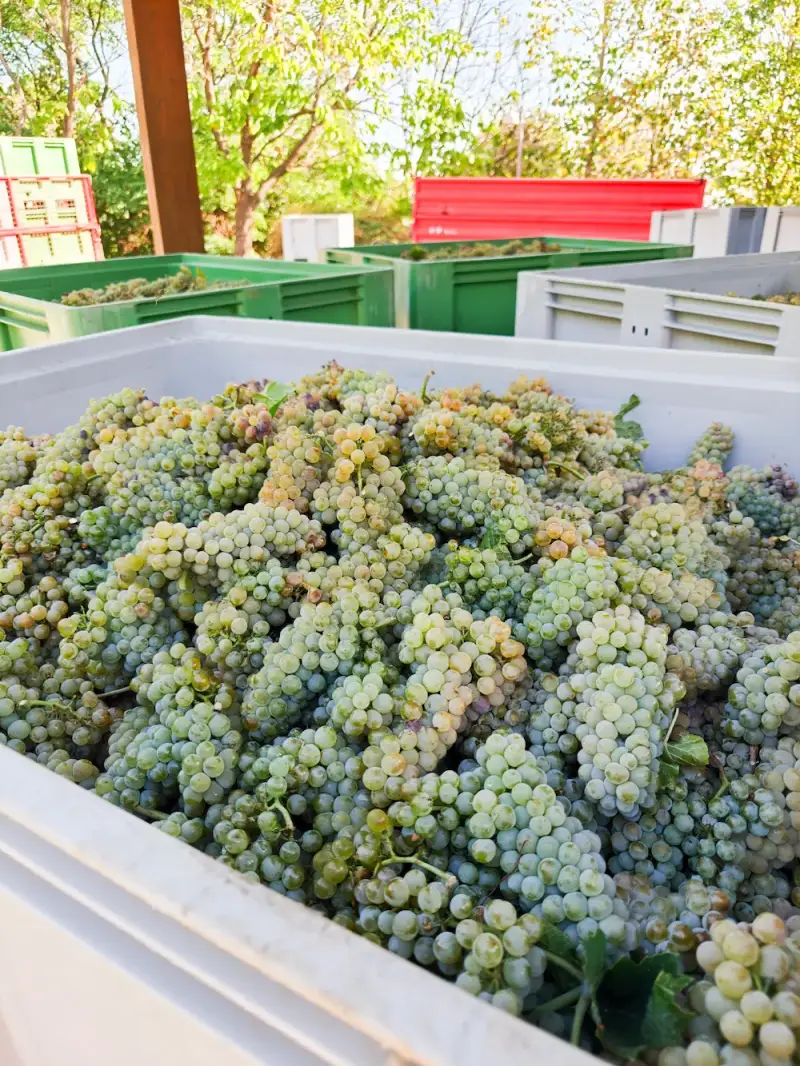
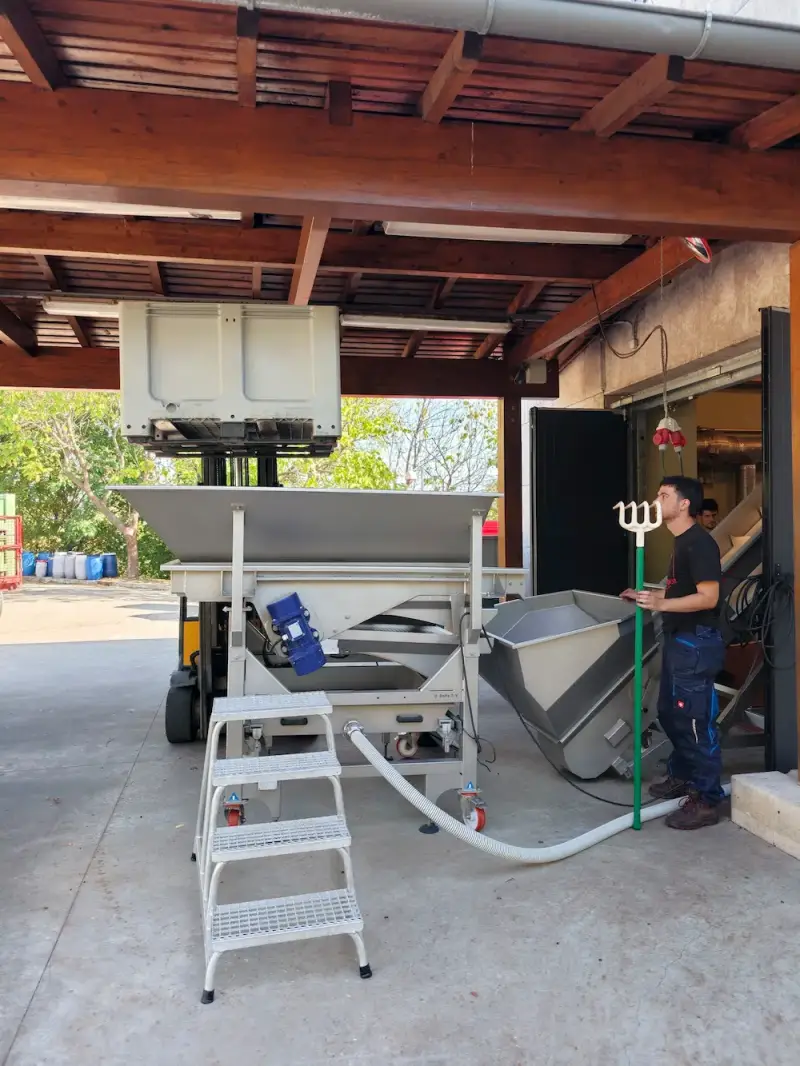
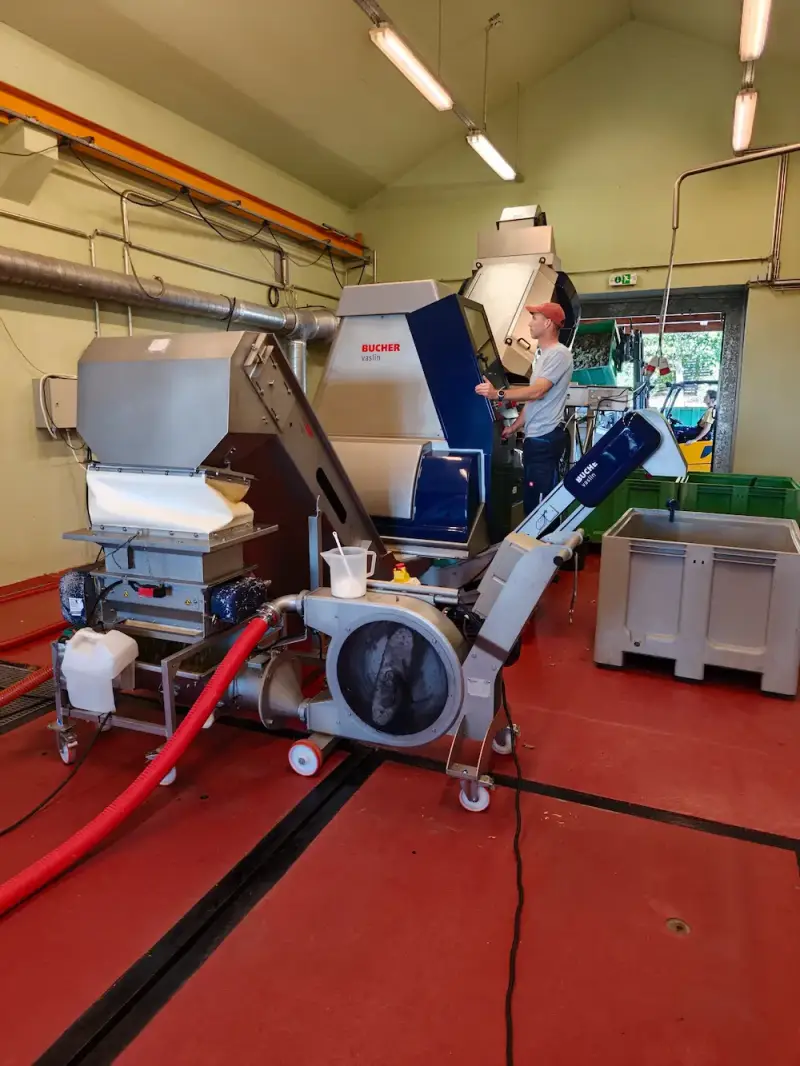
Harvested Riesling arrives in bins from vineyards. Bins are mechanically tipped into the reception hopper. Grapes enter a sophisticated Bucher Vaslin processing line
What stands out across the portfolio is not any particular technique but a consistent attention to balance. The aromatic white wines favour freshness, precision and lively acidity, with oak generally used as a supporting rather than dominant element. Elsewhere in the range, particularly in Hemina and the red wines, the winery is prepared to embrace greater ripeness, texture and concentration. Despite this stylistic diversity, the wines rarely feel excessive, instead reflecting carefully considered winemaking choices tailored to each variety and style.
Pinot Noir nevertheless occupies a fascinating place within the range. By producing both an Estate Pinot Noir and a Prior selection, the winery clearly regards the variety as central to its identity. Rather than pursuing an overtly Burgundian interpretation, both wines emphasise ripeness, texture and concentration. The exceptionally hot conditions of the 2024 growing season undoubtedly contributed to this character, producing wines of unusual richness and elevated alcohol levels by Pinot Noir standards. The Estate wine offers generous fruit and accessibility, while the Prior bottling adds further depth and richness. Together they demonstrate a house style that is comfortable pushing Pinot Noir into fuller-bodied territory while retaining sufficient balance to remain convincing.
More broadly, the entire range exhibits a degree of coherence that is often difficult to achieve. Despite the diversity of grape varieties and styles, the wines rarely feel disconnected from one another. Instead, they appear linked by a common emphasis on harmony, drinkability and balance.
Understanding the Portfolio
One important piece of context should also be borne in mind when evaluating many of these wines. The 2024 growing season was exceptionally hot across Hungary, creating significant challenges for growers and winemakers alike. Speaking as chairman of the 2025 VinAgora International Wine Competition, chief winemaker Zsolt Liptai noted the difficulties posed by over-ripeness, elevated potential alcohol and the challenge of preserving acidity and balance. Those conditions inevitably shaped several of the wines tasted during my visit, particularly the richer expressions of Riesling and Pinot Noir.
The tasting presented during my visit provided a revealing insight into how the winery views itself. Visitors were guided through Tricollis White, Sauvignon Blanc, Rajnai Rizling, Prior White, Hemina, Estate Pinot Noir, Prior Red and Infusion.
Viewed collectively, the line-up functions almost as a statement of intent.
Perhaps the first thing one notices is the emphasis on white wines. Four of the eight wines poured were whites, including Sauvignon Blanc and two Rieslings. This immediately highlights the importance of white wine within the estate's identity, with freshness, aromatics and acidity forming recurring themes across much of the range.
Equally revealing is the prominence afforded to Pinot Noir. By presenting both its Estate and Prior bottlings, the winery effectively invites visitors to explore different expressions of the same variety. Such a decision would be unusual if Pinot Noir were merely another grape in the vineyard. Instead, it suggests a conviction that the variety occupies a particularly important place within the future of the region.
Tricollis serves as an accessible introduction to the house style, while Hemina bridges the gap between the aromatic varietal wines and the estate's more ambitious offerings. Infusion, meanwhile, provides a fitting conclusion, demonstrating that although Pannonhalma has built much of its reputation on white wines and Pinot Noir, it is equally capable of producing richer Bordeaux-inspired blends.
Just as significant as the diversity of styles on show was the coherence of the overall range. Fresh, mineral-driven whites sat comfortably alongside richer barrel-aged wines and unexpectedly powerful reds, yet the transition never felt disjointed. Rather than pursuing a single stylistic formula, the winery appeared comfortable adapting its approach to different varieties while maintaining a recognisable house character.
Taken together, the wines suggest a producer that understands exactly what it is trying to achieve. Pannonhalma is not seeking to emulate Villány, Tokaj or Burgundy. It is instead pursuing a distinctly local interpretation of modern Hungarian winemaking, rooted in a landscape and institution unlike any other in the country.
Wines tasted.
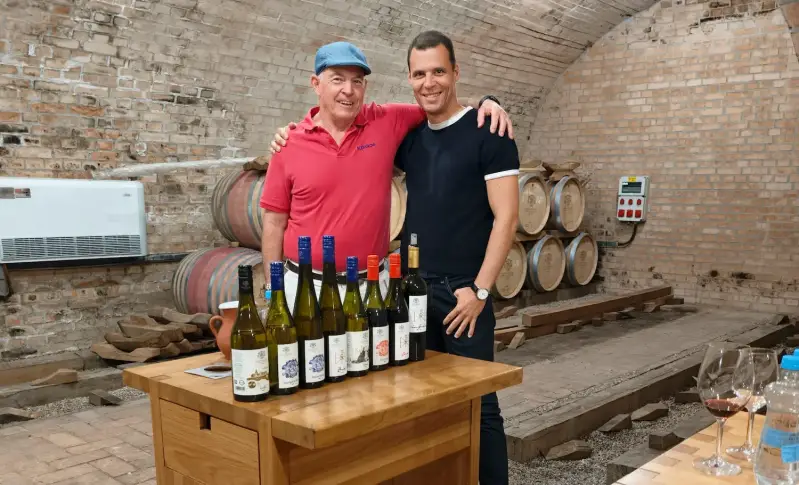
My visit and tasting was perfectly curated by Tamás Illés, Marketing & Sales Manager
Pannonhalma Abbey Tricollis White 2025.
A trilogy indeed, grapes from three hills surrounding Pannonhalma Abbey, three vineyards, three predominant varieties – Olasrizling, Riesling and Gewurztraminer with smaller amounts of Sauvignon Blanc and Pinot Blanc. Protected cool ferment and aging in stainless steel to preserve fruity aromas. Lemon in the glass with delightfully fragrant aromas of rose petal, citrus zest and peach. An uncomplicated fruity palate with good freshness and decent length.
Pannonhalma Abbey Sauvignon Blanc 2025
Grapes from two different vineyards harvested at different stages of ripeness and fermented partly in stainless steel and partly in old oak. Pale lemon in the glass with aromas of cut grass, gooseberry and nettles and a bit of musky floral lift. The mouth filling palate has a crunchy kaffir lime acidity with a nice minerality softened by the oak treatment and good length.
Pannonhalma Abbey Rajnai Rizling 2024
The most heavily planted variety in the region, grapes picked from several good sites fermented in stainless stell to day with a few months aging on the fine lees. Pale lemon in the glass with an immediate hit of green apple, grapefruit and limezest followed by a hint of mint and developing petrol edge. The palate is crispy dry and flinty with a lovely balance of lime fruit and minerality that drives a long, persistent finish.
Pannonhalma Abbey Prior White 2024
100% Riesling, a selection of the best bunches of the vintage harvested from the premium Babszökő vineyard over several passes. Controlled cool ferment in stainless steel followed by 8 months on the fine lees before bottling. Pale lemon in the glass with an intense nose of lime, tangerine and jasmine, with a touch of petrol. The palate is round and mouthfilling with the barest hint of residual sugar perfectly balancing the crunchy acidity The long, complex, wet-stone finish has hints of honey and petrol.
Pannonhalma Hemina White 2024
An unsual take on Burgundy styled dry white wines, this is a blend of Chardonnay 70%, Pinot Blanc 15% to provide a creamy full-bodied structure with 5% each of Sauvignon Blanc, Olaszrizling and Rahnai rizling to provide freshness and drive. Hand harvested grapes from the premium Széldomb and Packalló vineyards were fermented and aged in 500 litre used Hungarian oak barrels with full malolactic conversion and batonnage. Lemon in the glass with aromas of peaches and cream, ripe golden delicious apples and buttered toast. The rich round and creamy palate has a gently chalky mineral spine and the long finish is lifted with a touch of citrus. Lovely now but better in another three years.

Signature wines of Pannonhalma
Pannonhalma Abbey Pinot Noir 2024
Four different clones of Pinot Noir sourced from 15–20-year-old vines on sand loess and clay soils. Handpicked grapes destemmed and given a 6-day cool maceration in stainless steel tanks before a controlled warm ferment, followed by 9 months aging in a mix of new and second use Hungarian oak barriques. Deep ruby in the glass with aromas of black cherry and forest berries laced with smoky oak spice, vanilla and milk chocolate. The structured palate is quite ripe and rich with plum and Dawson cherry fruit, big soft tannins and a broad mouthfeel. A whopping 15% alcohol was not overt at the cellar temperature but I’d lean to serving this on the cool side.
Pannonhalma Abbey Prior Red 2024
A special selection of Pinot Noir featuring best bunches from three handpicked, destemmed and sorted before a 7-day cold maceration and then a controlled warm ferment in stainless steel before transfer to a mix of new and second use Hungarian oak barriques for 9-10 months aging. Only the best barrels selected for the Prior bottling. Dark ruby in the glass with plum and blackberry, vanilla, baking spice and forest floor aromas. The palate is plush, rich and concentrated with soft ripe tannins, plum and berry fruits and a long rich finish. The alcohol is approaching 16% and I am not sure I would have recognised this blind as Pinot Noir but it is rather delicious all the same.
Pannonhalma Abbey Infusion 2023
One of the flagship wines of the Abbey made from 60% Merlot and 40% Cabernet Franc from the best vineyards. Hand picked grspes, destemmed, sorted and an initial hot ferment in stainless steel tanks followed by 19 months aging in a mix of new (50%) and second use Hungarian oak and a small proportion of American oak to add aromatic sweetness. Ruby purple in the glass with rich aromas of plum, cinnamon, vanilla and sweet pipe tobacco. The full-bodied palate has soft round tannins with rich plum, vanilla & coconut, dark chocolate and cinnamon flavours that lead to a long, layered and satisfying finish with some savoury coffee notes.
Conclusion
Pannonhalma occupies a unique position within Hungarian wine. It is simultaneously one of the country's oldest wine stories and one of its most modern. The abbey's history stretches back to the very foundations of the Hungarian state, yet the wines themselves are unmistakably contemporary in outlook.
What makes Pannonhalma compelling is not simply the age of the institution or the beauty of the setting. Nor is it merely the remarkable revival that followed decades of communist confiscation. Rather, it is the way in which the estate has reconciled tradition and modernity. The grapes may be international, the winery contemporary and the market global, but the underlying values of stewardship, patience and continuity remain recognisably Benedictine.

The colourful Peacock Stained Glass (Pávaablak) above the entrance to St Martin's Basilica is also evocative of the finish of many of the wines.
More than a thousand years after the monks first established themselves on Saint Martin's Hill, wine continues to play an important role in the life of the abbey. Not as a relic of the past, but as a living expression of a tradition that has repeatedly adapted, survived and renewed itself. For a region that effectively revolves around a single producer, that may ultimately be its greatest strength.
About the Author
John Penney is a wine experience guide based in Martinborough–Wellington, New Zealand. His lifelong passion for wine is informed by extensive international wine travel, formal study (WSET Level 3), and a career in adult learning. He writes about wine from both technical and cultural perspectives, drawing on real‑world tasting, wine travel, and deep research. Through his wineinsights business he provides Martinborough wine tours, Wairarapa wine tours, private wine tasting experiences, and wine education for wine lovers and enthusiasts.
Add comment
Comments