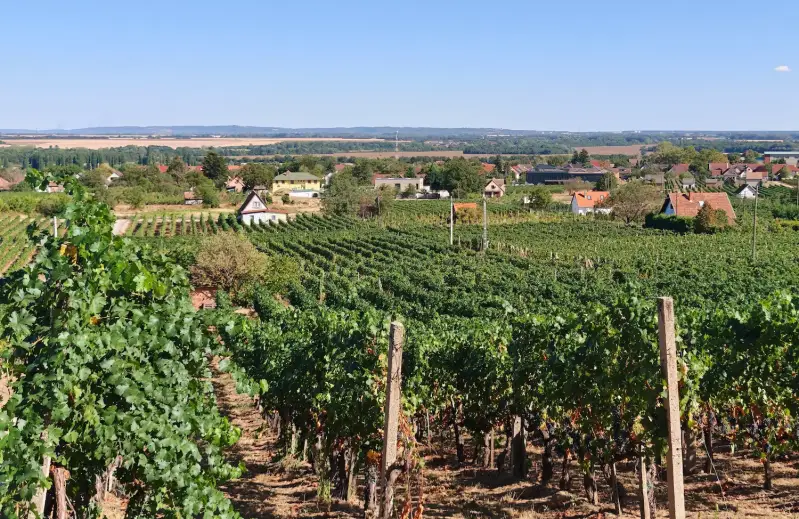
Last month I took a break from my Martinborough wine tours and exclusive Wairarapa wine experiences to explore some of Hungary's most exciting wine regions. This week's article on Villány is the fifth in the series and follows previous visits to Tokaj, Eger, Badacsony and Szekszárd.
If Szekszárd represents the elegant, spice-driven face of southern Hungarian red wine, Villány is its richer and more sun-filled counterpart. Situated against the Croatian border at Hungary's southernmost edge, Villány is the warmest and most Mediterranean-influenced of Hungary's major wine regions. Here, long hot summers, abundant sunshine and extended autumns create conditions that allow later-ripening red varieties to achieve a level of maturity rarely possible elsewhere in the country.
Viticulture in Villány stretches back more than two millennia. The Romans planted vines on the southern slopes of the Villány Hills, recognising the area's exceptional exposure and favourable climate. Through the Middle Ages, winegrowing remained central to local life, but the region's identity was profoundly shaped by German-speaking settlers known as Danube Swabians, who arrived during the eighteenth century. They introduced new vineyard practices, established many of the region's distinctive cellar villages and helped cement wine as the economic and cultural foundation of the region.
Like other wine regions across Europe, Villány was devastated by phylloxera in the late nineteenth century. Vineyards were replanted, varieties changed and ownership patterns evolved. The twentieth century brought further disruption through two world wars and the communist period, when collectivisation shifted the focus from quality to volume. Yet unlike some regions where traditions were almost completely dismantled, Villány retained a stronger continuity of red-wine production, partly because its climate made it one of Hungary's most reliable sources of richly coloured, fully ripe red wines.
The modern renaissance began after 1990. Family wineries reclaimed vineyards, private ownership returned, and ambitious producers invested heavily in both vineyard and cellar. Early success came through Cabernet Sauvignon, Merlot and Bordeaux-inspired blends, which brought international attention to a region that was largely unknown outside Hungary. Over time, however, a consensus emerged that one grape seemed uniquely capable of translating Villány's climate and terroir into something distinctive: Cabernet Franc.
Today Villány is regarded as Hungary's leading red-wine region and one of the few places outside France where Cabernet Franc has established a compelling claim to world-class status. The region's finest wines combine ripe black-fruit richness with freshness, structure and limestone-driven elegance. While international varieties dominate, Villány's leading producers are no longer trying to imitate Bordeaux. Instead, they are increasingly confident in expressing a style that is unmistakably their own.
Terroir: Limestone, Warmth and Southern Exposure
The Villány Hills form a relatively low east-west ridge running just north of the Croatian border. While less dramatic than the volcanic landscapes of Badacsony or Somló, they exert a profound influence on the vineyards below. The finest sites occupy south- and south-west-facing slopes that maximise sunlight exposure and encourage complete ripening.
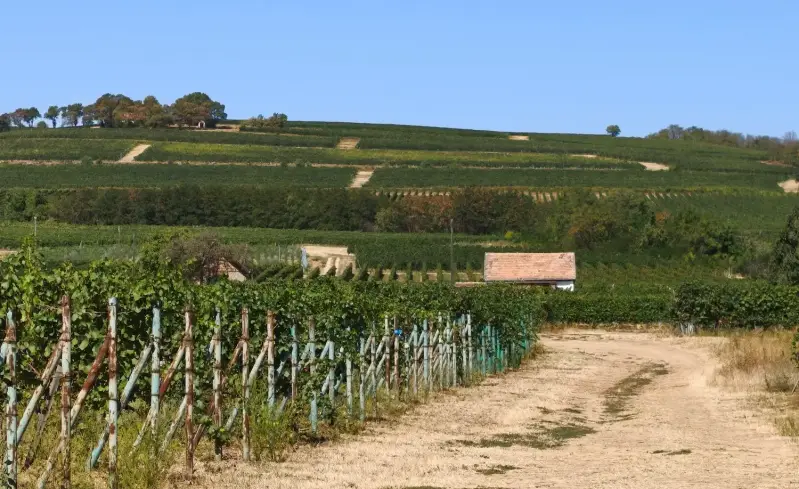
The Villány Hills run east-west along Hungary's southern border, creating a series of south-facing vineyard slopes
Unlike Badacsony, where volcanic basalt underpins the region's identity, Villány's story begins with limestone. The hills are primarily composed of limestone and dolomite bedrock, covered in varying combinations of loess, clay and marl. This calcareous foundation is widely regarded as one of the keys to the region's success with Cabernet Franc.
The limestone soils provide excellent drainage while helping preserve freshness and structure in a climate that could otherwise produce overly broad wines. Clay contributes body and power, while loess moderates water availability and supports steady ripening. Together, these soil types allow growers to produce wines that combine concentration with balance.
The climate itself may be Villány's greatest viticultural asset. Annual sunshine hours are among the highest in Hungary and the growing season is significantly longer than in most other Hungarian wine regions. Summers are hot, autumns are prolonged and frost arrives relatively late. These conditions favour later-ripening Bordeaux varieties, especially Cabernet Franc, Cabernet Sauvignon and Merlot.
The challenge for modern producers is therefore not achieving ripeness but preserving freshness, balance and site expression. The best Villány wines succeed because they combine generous fruit with restraint, allowing the freshness provided by limestone soils to moderate the warmth of the climate. These differences become especially apparent in the region's leading vineyards, where variations in aspect, soils and mesoclimate contribute distinct expressions of Villány's red-wine character.
The Great Vineyards of Villány
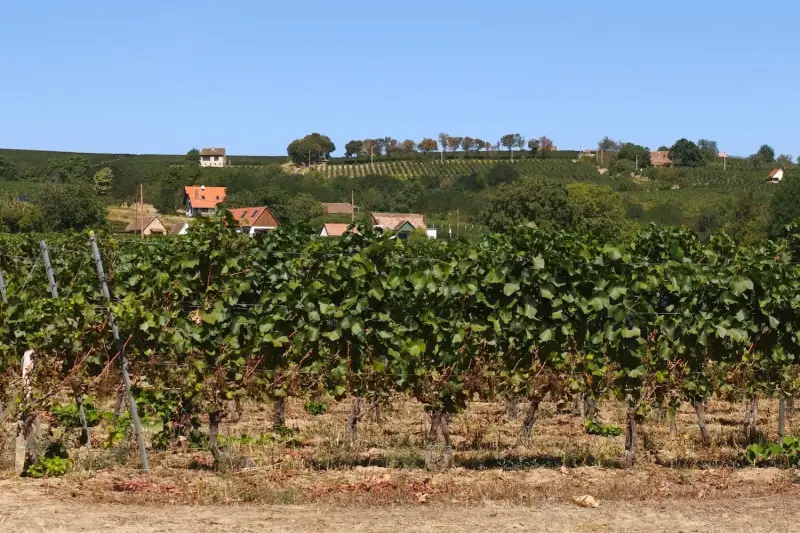
The Csillagvölgy dűlő vineyard.
Just as certain slopes define the reputations of Burgundy or Barolo, a handful of vineyard names have become synonymous with Villány's finest wines. Visitors quickly encounter names such as Kopár, Jammertál, Ördögárok, Csillagvölgy and Konkoly, while sites including Bocor, Makár, Fekete-hegy, Sós-hegy and Kút-patak have also helped shape the region's modern reputation.
Kopár is perhaps the most famous. Shared by several leading producers, including Gere, Bock and Csányi, it combines limestone, clay and loess to produce wines of remarkable concentration and longevity. Historically associated with some of Villány's greatest Bordeaux-style blends, it remains one of the region's benchmark sites.
Ördögárok, meaning "Devil's Ditch", is another celebrated vineyard. South-facing and exceptionally warm, with loess and clay over limestone soils, it produces structured wines with depth, concentration and notable ageability. Many of the region's leading Cabernet Francs originate here.
Csillagvölgy (Star Valley) vineyard tends to produce somewhat more aromatic and elegant wines and remains particularly important to the Gere family, while Konkoly contributes freshness and finesse. Together these sites illustrate the diversity possible within Villány despite the region's relatively compact size.
Jammertál occupies an almost mythical place in Villány. Its sheltered position and exceptional sun exposure allow grapes to reach extraordinary ripeness while maintaining balance. Wines from this vineyard consistently rank among Hungary's most ambitious and sought-after reds.
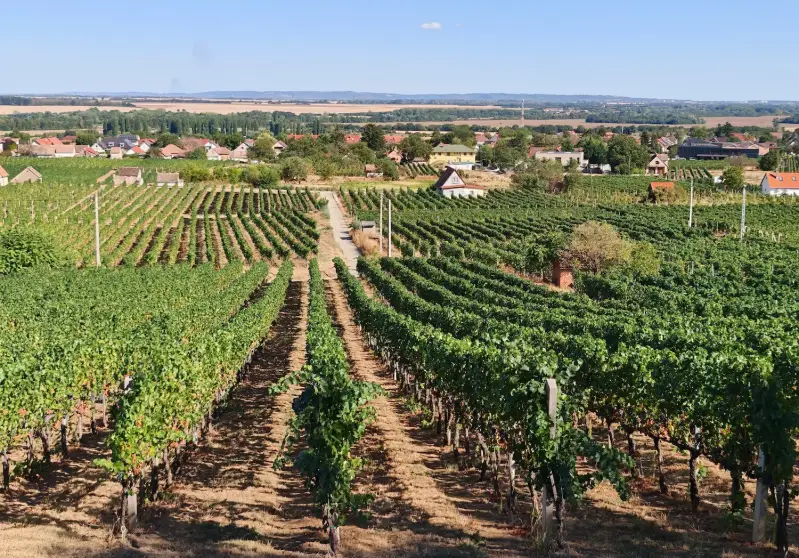
The Jammertál vineyard looking towards Croatia
These vineyard names appear frequently on labels, tasting notes and winery tours because they have become central to how Villány understands itself. Increasingly, the region's finest producers are shifting attention away from simple varietal labelling and towards expressing the distinctive character of these historically important sites.
Grapes of Villány: An International Accent with Local Character
Villány is often associated with Cabernet Franc, yet the region's vineyards are home to a broader range of varieties that together reflect its warm climate and long winemaking history. The dominant plantings today are largely international red grapes, particularly Cabernet Sauvignon, Merlot and Cabernet Franc, which thrive in the region's extended growing season and reliably achieve full ripeness.
Merlot often provides some of Villány's most approachable and generous wines, combining ripe plum and black-fruit flavours with supple texture. Cabernet Sauvignon contributes structure, concentration and ageing potential. Kékoportó, known internationally as Portugieser, remains an important part of the region's identity. Traditionally the first variety replanted after phylloxera, it produces lighter, fruit-forward wines that are typically enjoyed younger than Villány's more ambitious reds.
A handful of other varieties are also planted, including Pinot Noir. However, Villány's greatest successes have generally come from grapes that thrive in warmer conditions. Syrah has shown increasing promise in the region's warm climate, while Pinot Noir tends to yield a richer, darker-fruited and more structured expression than the lighter, more delicate styles for which the variety is best known.
Although international varieties dominate the landscape, the region's leading producers increasingly view one grape as uniquely suited to expressing Villány's combination of warmth, limestone soils and southern exposure. That variety is Cabernet Franc.
Cabernet Franc: Villány's Defining Variety
Cabernet Franc is grown throughout the wine world, but few regions have embraced it as completely as Villány. While Bordeaux generally treats it as a supporting component in blends and the Loire Valley produces lighter, cooler-climate expressions, Villány has elevated the variety to centre stage.
The region's warm south-facing slopes allow Cabernet Franc to achieve complete phenolic ripeness with remarkable consistency. Tannins become velvety, green herbal notes largely disappear, and the variety develops an appealing combination of blackberry, black cherry, plum, Mediterranean herbs and spice. At its best, Villány Cabernet Franc offers both concentration and refinement, delivering the generosity associated with warm climates while retaining freshness and structure.
International critics have taken notice. Michael Broadbent MW famously described Villány as "Cabernet Franc's natural habitat", a phrase frequently quoted by the region's producers. Steven Spurrier was similarly impressed, arguing that Villány was capable of producing some of the finest Cabernet Franc wines in the world. Over the past two decades, major international publications and critics have repeatedly highlighted Villány as one of the most exciting sources of the variety outside France.
In 2014, the region formalised that belief through the creation of the Villányi Franc designation. Rather than treating Cabernet Franc as simply another international variety, the category established production standards intended to define a unique regional expression. The move reflected a growing confidence that Cabernet Franc had become not merely successful in Villány, but central to the region's identity.
That confidence is perhaps best understood not through regulations or statistics, but through the producers who have championed the variety and helped shape Villány's modern reputation.
During my one-day visit to Villány, I was fortunate to spend time with two of the region's most respected wineries, Gere Attila Pincészet and Bock Pince. Both have played significant roles in the region's post-communist renaissance, helping transform Villány from a little-known Hungarian wine region into an internationally recognised source of premium red wines. While each winery expresses its own distinct philosophy, together they provide an excellent introduction to the ambition, confidence and quality that define Villány today.
Gere Attila Pincészet (A.Gere Winery)

The attractive tasting area in the A.Gere Winery complex
Few individuals have had a greater influence on the modern reputation of Villány than Attila Gere. Although the Gere family's roots in the region extend back seven generations, Attila was originally trained as a forester and worked at the local co-operative before studying at the Pécs wine school in 1980. The modern story of the estate began in 1978 when he and his wife Katalin received a small parcel in the Csillagvölgy vineyard as a wedding gift. At a time when much of Hungary's wine industry remained constrained by collectivisation and the legacy of communist rule, Gere recognised the untapped potential of Villány's warm climate and south-facing slopes.
The family produced its first commercial wines in 1986, and following the political changes of the early 1990s, Attila established the winery that would become one of the defining names of modern Hungarian wine. Alongside contemporaries such as József Bock, he helped transform Villány from a largely domestic wine region into an internationally recognised source of premium red wine. His achievements were recognised in 1994 when he was named Hungary's Winemaker of the Year, an early indication of the confidence returning to Hungary's fine-wine sector.
The winery, located at the south-western end of Villány on the north-western side of the town's main road, is increasingly shaped by the next generation. Andrea Gere, who has worked within the family business for more than two decades, now leads the estate together with her husband Kristóf Csizmadia. Their stewardship reflects continuity rather than revolution, building on the foundations laid by Attila while refining the winery's focus on sustainability, terroir and regional identity.

The sleekly modern A.Gere Winery barrel hall
The family's activities now extend beyond wine production alone. Through the separately located A.Gere Hotel in the centre of Villány, they have created a broader hospitality offering that combines luxury accommodation, a restaurant showcasing regional gastronomy and a wellness spa. Together with the winery, the hotel reflects the role the Gere family has played in establishing Villány not only as one of Hungary's leading wine regions but also as an attractive destination for wine tourism.
Today the family cultivates vineyards across some of Villány's most celebrated sites, including Kopár, Csillagvölgy, Konkoly and Ördögárok. These vineyards form the foundation of the estate's reputation and showcase the diversity possible within Villány's terroir. Kopár is often associated with power and longevity, Ördögárok with structure and mineral tension, while Csillagvölgy frequently contributes greater aromatic elegance. Together they form the backbone of many of the winery's flagship wines.
Since 2010 the estate has farmed its vineyards organically, reflecting a philosophy that places long-term vineyard health at the centre of wine quality. High planting densities, strict yield limitation and careful canopy management are combined with vineyard-by-vineyard decisions on picking dates to ensure each site is harvested at its optimum. In the cellar, gentle handling aims to preserve fruit character and vineyard expression. Only the best fruit is selected for the winery's flagship and single-vineyard wines, reinforcing a reputation built on quality rather than volume.
Gere's reputation was originally built on Bordeaux-inspired blends, particularly the flagship Kopár Cuvée, first produced in 1997 and still regarded as one of Villány's benchmark red wines. Drawn from the estate's leading vineyards and typically based on Cabernet Franc, Merlot and Cabernet Sauvignon, it emerged at a time when many of Villány's top producers looked to Bordeaux as the model for fine red wine. Attila Gere was also among the earliest champions of Cabernet Franc, recognising the variety's exceptional affinity with Villány's climate and limestone-based soils long before it became the region's defining grape. As Villány has matured, the estate has increasingly focused on Cabernet Franc, becoming one of the leading proponents of Villányi Franc both domestically and internationally. The estate's flagship single-vineyard wine, the Villányi Franc Ördögárok, represents that evolution, expressing Cabernet Franc through one of the region's most highly regarded vineyard sites.
During my visit it became clear that the estate's philosophy has evolved beyond simply reproducing Bordeaux-inspired wines. While concentration and structure remain important, there is now a stronger emphasis on vineyard expression, balance and regional identity. Cabernet Franc is no longer merely one component among many but a variety that increasingly defines the estate's vision. That evolution seems to reflect the transition between generations: the foundations established by Attila Gere remain firmly in place, while Andrea Gere and her team continue to refine how the winery expresses Villány's distinctive character.
In the winery, careful fruit selection, temperature-controlled fermentations and extensive barrel ageing remain central to production. While Bordeaux once provided an important point of reference, the modern focus is increasingly on expressing Villány's own identity through site and variety. Sustainability also extends beyond the vineyard and cellar, with grape seeds and other by-products finding new uses rather than being discarded. The resulting wines are unmistakably Villány in their ripeness and generosity while displaying the elegance, complexity and sense of place that have made the estate one of Hungary's most respected producers.
Wines tasted
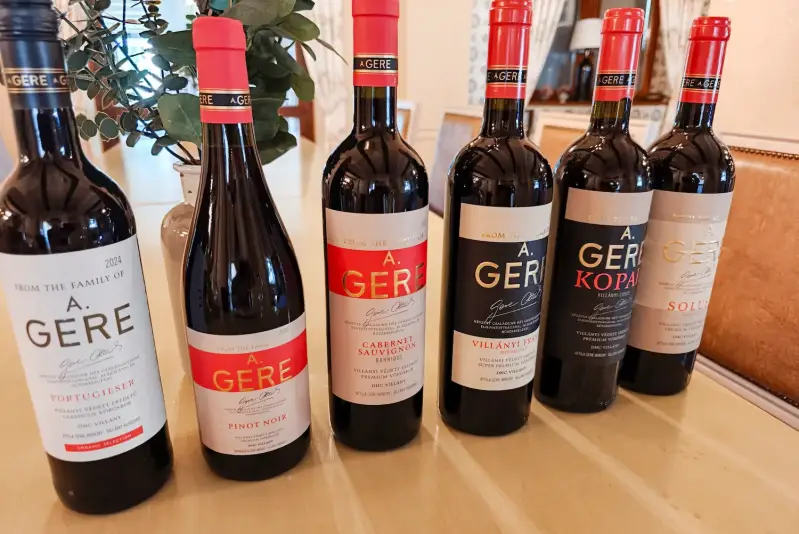
A.Gere Portugieser 2024
Produced from organically certified grapes grown in the Ördögárok (Devil's Ditch) vineyard, the wine was fermented in tank before spending seven months in 20,000-litre foudres. Despite the exceptionally hot conditions of the 2024 vintage, the variety retained good acidity, allowing for an early harvest. Ruby purple in the glass with red and black berry fruit and baking spice aromas. Blackberry, plum and liquorice fruit on the medium-bodied palate with soft tannins, good acidity and a salty liquorice edge on the long finish.
A.Gere Cabernet Sauvignon Barrique 2023
Handpicked organic grapes from the limestone and loess soils of the Csillagvölgy vineyard. Fermented in open-top vats before spending 18 months in 300-litre oak barrels, 60% of them new. Deep ruby purple in the glass with aromas of cassis and blackberry, followed by vanilla, graphite, tobacco and roasted red capsicum. The palate is soft and plush with black cherry, plum and blackcurrant fruits laced with dark chocolate and a long, spice-infused fruit finish.
A.Gere Villányi Franc Ördögárok 2023
Regional flagship. 100% organic Cabernet Franc from the loess, clay and limestone soils of the Ördögárok vineyard. Fermented in stainless steel before spending 16 months in barrel, 80% of them new. Dark ruby-purple in the glass with spicy aromas overlaying rich black and blue fruit. On the plush palate, concentrated Doris plum, blackberry and sweet vanilla flavours are edged with smoky mocha, while a lift of acidity brings freshness to the long finish.
A.Gere Kopár Cuvée 2022
The estate's flagship wine, comprising 50% Cabernet Franc, 40% Merlot and 10% Cabernet Sauvignon from the Csillagvölgy, Konkoly, Kopár and Ördögárok vineyards. Fermented in large wooden vats before ageing for 16 months in oak barrels, 80% of them new. Inky purple in the glass with aromas of dark berries, cocoa, liquorice, baking spices and tobacco. The full-bodied palate shows sweet ripe fruit, vanilla and cedar oak nicely integrated with the tannins, while good acidity adds drive and lift to the finish.
A.Gere Solus 2023
One of the estate's most sought-after wines, produced only in the best vintages, Solus is 100% Merlot from the stony, limestone-rich soils of the Kopár vineyard. The wine is fermented in large wooden vats before ageing for 16 months in 100% new Hungarian oak barrels. Inky purple and viscous in the glass with spicy blackberry and Doris plum fruit, mocha and cedary aromas with a whiff of salt spray. The concentrated palate shows rich, ripe black fruit, smoky oak, plush soft tannins and mocha-chocolate flavours, the acidity nicely balanced with the fine tannins framing the lush finish.
Bock Pince
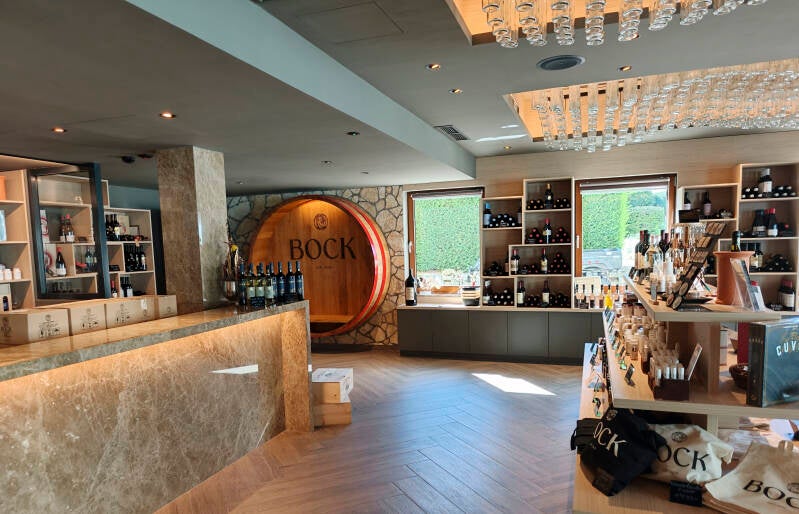
If Attila Gere helped establish Villány's modern reputation, József Bock has become one of its most enduring ambassadors. The Bock family's connection to the region stretches back to 1850, reflecting the deep Danube Swabian roots that have shaped Villány's wine culture for generations. Following the restoration of private ownership after communism, József Bock transformed the family estate into one of Hungary's most recognised wine brands while maintaining a strong connection to the traditions and history of the region.
Born in nearby Kisjakabfalva, Bock initially pursued a technical career while tending vineyards after work, as many local families did during the communist era. He began making wine independently in the early 1980s and was among the generation of producers who seized the opportunities created by Hungary's political and economic transformation in the 1990s. His rapid success culminated in being named Hungary's Winemaker of the Year in 1997, and in 2024 his contribution to Hungarian wine was further recognised with a Lifetime Achievement Award from the Hungarian Wine Academy.
Today, while József Bock remains an active presence in both vineyard and cellar, the next generation plays an increasingly important role in guiding the estate. His son Valér Bock oversees vineyard operations and helps shape the winery's future direction, ensuring continuity between generations while building upon the foundations laid by his father.
The estate farms approximately 120 hectares of its own vineyards together with around 50 hectares managed through long-term grower partnerships. These holdings include several of Villány's most highly regarded vineyard sites, including Jammertál, Ördögárok, Kopár, Fekete-hegy, Bocor and Makár. Together they provide the diversity of fruit sources necessary to support one of the region's broadest and most ambitious portfolios.
While Villány is best known for its red wines, Bock works with a remarkably wide range of grape varieties. Alongside aromatic whites such as Sauvignon Blanc and Hárslevelű and fuller-bodied examples of Chardonnay and Olaszrizling, the estate cultivates many of the region's most important red varieties, including Portugieser, Kékfrankos, Kadarka, Cabernet Franc, Cabernet Sauvignon, Merlot and Syrah. This breadth allows the winery to produce everything from approachable everyday wines to cellar-worthy flagship bottlings.
At the top of the range sits Magnifico, a single-vineyard Merlot sourced from the prestigious Ördögárok vineyard. Alongside wines such as Bock Cuvée, Royal Cuvée, Libra and Capella, it reflects the estate's long-standing commitment to producing wines capable of standing among Hungary's finest reds.
Like Gere, Bock recognised early that Villány's future depended not only on producing great wine but also on attracting visitors to the region. Over time the family has developed the estate into one of Hungary's leading wine tourism destinations, integrating wine production, historic cellars, the Óbor Restaurant, event facilities and on-site four-star accommodation into a single visitor experience. Following our cellar tour, the formal tasting took place in the restaurant, although we also sampled selected wines directly from barrel during our exploration of the cellars.
One of the highlights of visiting Bock is the remarkable network of historic and modern cellars that illustrate both the estate's growth and the evolution of Villány itself. Over several decades the family has expanded its underground facilities into one of the region's most impressive cellar complexes. During my visit I was privileged to explore all three principal cellar areas, including the extensive barrel cellars, the distinctive circular cellar known as the Bock Chapel, and the historic Jammertál cellar.
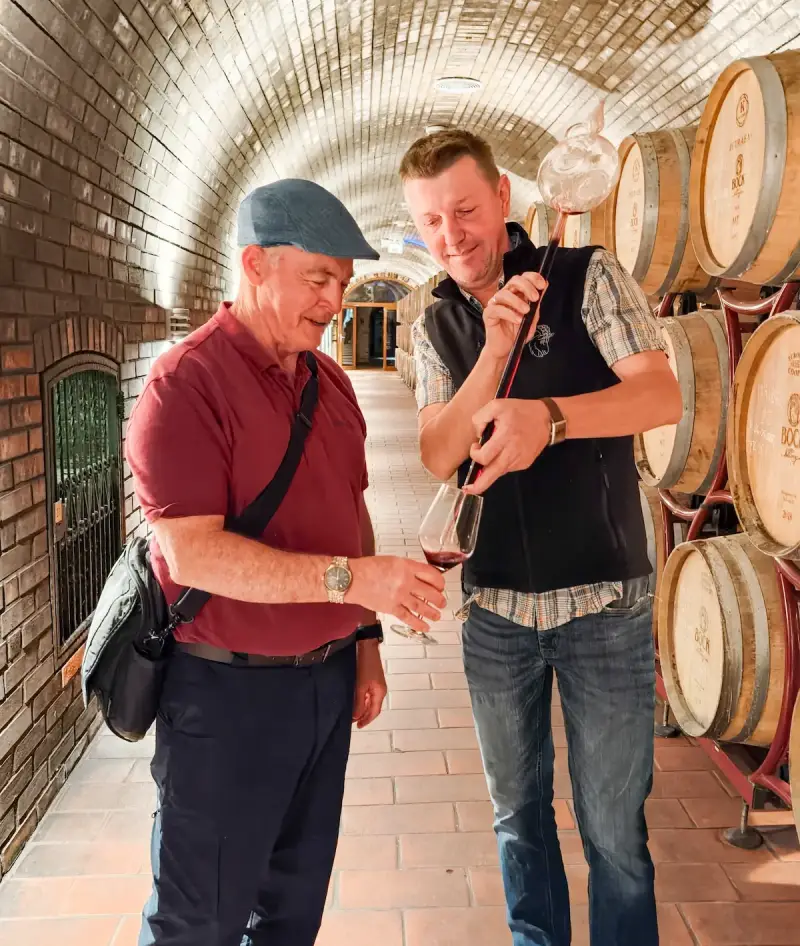


Left to right: 1. Tasting from barrel with Head Sommelier Róbert Tamás. 2. Bock Chapel. 3. Jammertál cellar
The Jammertál cellar is particularly significant. Associated with the family since the nineteenth century, it was confiscated following the Second World War before eventually being repurchased in 1958. Today it houses some of the estate's most treasured wines, including museum vintages dating back to 1981. Standing among these bottles provides a tangible connection not only to the history of the winery itself but also to the resilience required to preserve family winemaking traditions through some of Hungary's most turbulent decades.
While Bock's reputation was originally built upon powerful Bordeaux-inspired wines and ambitious barrel-aged blends, Cabernet Franc has increasingly become central to the estate's identity. Alongside producers such as Gere, Bock has helped demonstrate that Villány can produce world-class expressions of the variety, combining concentration and structure with increasing elegance and refinement. At the same time, the winery continues to maintain a broader stylistic range than many of its peers, reflecting both the diversity of its vineyard holdings and its longstanding commitment to showcasing the full potential of the region.
In both vineyard and cellar, quality remains the guiding principle. Hand harvesting, rigorous fruit selection, temperature-controlled fermentation and extended maturation in Hungarian and French oak continue to shape the estate's premium wines. The resulting style remains unmistakably Villány in its ripeness, generosity and depth, while retaining the balance and freshness that have helped establish the region among Central Europe's most compelling red wine destinations.
Together, the celebrated vineyard holdings, historic cellars and multigenerational family story make Bock one of the most complete expressions of modern Villány: a winery that honours its heritage while continuing to shape the region's future.
Wines tasted
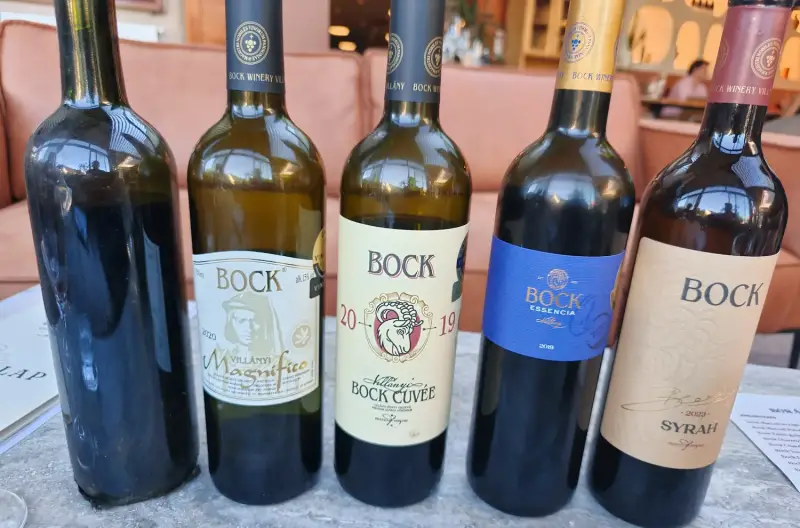
Bock Syrah 2023
Select bush vine Syrah grapes from the Bocor vineyard, controlled ferment in closed top vats to protect aromatics before 18 months aging in 100% new oak barrels. Deep ruby purple in the glass with aromas of blackberry, baked Doris plum, black pepper-dusted baking spice, some minty herbs and a whiff of vanilla. The dry, full-bodied palate features concentrated ripe blackberry, blue berry and Doris plum fruit flavours, sweet vanilla oak and some gentle spice on a frame of velvety tannins with good freshness, drive and persistence.
Bock Villány Franc Essencia 2019
100% Cabernet Franc from the limestone and loess soils of the Black Mountain, Makár, Ördögárok vineyards fermented in vats with 24 months new small barrel aging. 15% ABV. Deep ruby in the glass with a garnet edge. Aromas of red berries, roast meat, cassis, tobacco and spice. Quite a big opening statement of concentrated fruit which fell away to smoky oak and mocha notes with slightly drying tannins, I felt this to be at a slightly awkward stage where the primary fruit is fading but the full tertiary palate has not fully emerged. Will be better in 2-3 years.
Bock Cuvee 2019.
Blend of 60% Cabernet Sauvignon, 30% Cabernet Franc and 10% Merlot from several Villány vineyards, aged 24 months in new small oak barrels and then at least a further year in bottle before release. Deep ruby in the glass with aromas of cassis, dark berries, vanilla, tobacco and graphite. The full bodies palate features a nice combination of blackcurrant, dark berries and Doris plum with a roasted red pepper edge emerging. The tannins are firm but fine, there is good freshness and the fruit persists on the finish before giving way to chocolate and vanilla, brown spice and sweet cigar tobacco.
Bock Magnifico 2020
Made only in outstanding vintages, 100% Merlot from the Ördögárok (Devil’s Ditch) Vineyard. Aged 24 months in new oak barriques. Deep ruby-purple in the glass with Doris plum, prune, milk chocolate and vanilla bean aromas with a whiff of sweet cigar tobacco. The palate is rich, round and plush with sweet ripe fruit reminiscent of brandied prunes in dark chocolate, giving way to a milkier chocolate vanilla and coffee bean finish. Old school but delicious!
Bock Cabernet Sauvignon 1999.
We were introduced to this in the Jammertál cellar and returned to it again as the grand finale of the tasting in the restaurant. Ruby-garnet in the glass with cassis, cedar, tobacco and dried paprika aromas. On the palate the tannins are softly resolved, with some brambly fruit, dried plum, walnuts and cedarwood with along and satisfying finish.
Conclusion: Villány Comes of Age
My visit to Villány reinforced the impression that this is no longer simply Hungary's warmest red wine region, but one of the country's most confident and distinctive wine destinations. While Bordeaux varieties first helped establish its international reputation, the region has increasingly moved beyond imitation to embrace a style that is unmistakably its own. Limestone soils, abundant sunshine and a long growing season provide the foundation, but it is the growing confidence of its producers that now defines Villány's character.
Cabernet Franc sits at the centre of that story. Few regions outside its French homeland have adopted the variety so wholeheartedly, and fewer still have made such a compelling case that it can achieve world-class status in a new environment. Yet Villány's success extends beyond a single grape. From approachable Portugieser to ambitious Bordeaux-inspired blends and increasingly site-focused wines, the region continues to demonstrate both breadth and depth.
The two estates visited during my stay illustrate different but complementary expressions of modern Villány. Gere and Bock share a commitment to quality, a belief in the region's potential, and a pivotal role in Villány's post-communist renaissance. Both wineries helped establish the foundations of the region's modern reputation and both continue to rank among Hungary's leading producers.
Yet their individual identities remain distinct. Gere increasingly looks forward, with a strong focus on sustainability, organic viticulture, vineyard expression and Cabernet Franc as the defining voice of the estate. Under Andrea Gere and Kristóf Csizmadia, the winery is refining a vision that places terroir and regional identity at the forefront.
Bock, by contrast, offers a stronger sense of continuity and historical depth. Its story is rooted in a family legacy that stretches back to the nineteenth century, expressed through historic cellars, extensive vineyard holdings and a broad portfolio that showcases the full range of Villány's potential. While Cabernet Franc remains central, there is a slightly wider lens through which the region is viewed, balancing innovation with a deep respect for tradition.
Together, these two producers demonstrate why Villány has become Hungary's benchmark red wine region. They also show that there is no single path to success. One emphasises evolution and terroir-driven precision, the other continuity and heritage. Both produce wines of genuine character, and together they help explain why Villány has emerged as one of Central Europe's most compelling destinations for lovers of fine red wine.
About the Author
John Penney is a wine experience guide based in Martinborough–Wellington, New Zealand. His lifelong passion for wine is informed by extensive international wine travel, formal study (WSET Level 3), and a career in adult learning. He writes about wine from both technical and cultural perspectives, drawing on real‑world tasting, wine travel, and deep research. Through his wineinsights business he provides Martinborough wine tours, Wairarapa wine tours, private wine tasting experiences, and wine education for wine lovers and enthusiasts.
Add comment
Comments