Elephant Hill began with a restored Jaguar and has grown into one of Hawke’s Bay’s most ambitious wineries — uniting striking architecture, meticulous winemaking, and a terroir‑driven vision shaped across Te Awanga, Bridge Pa, and the Gimblett Gravels.
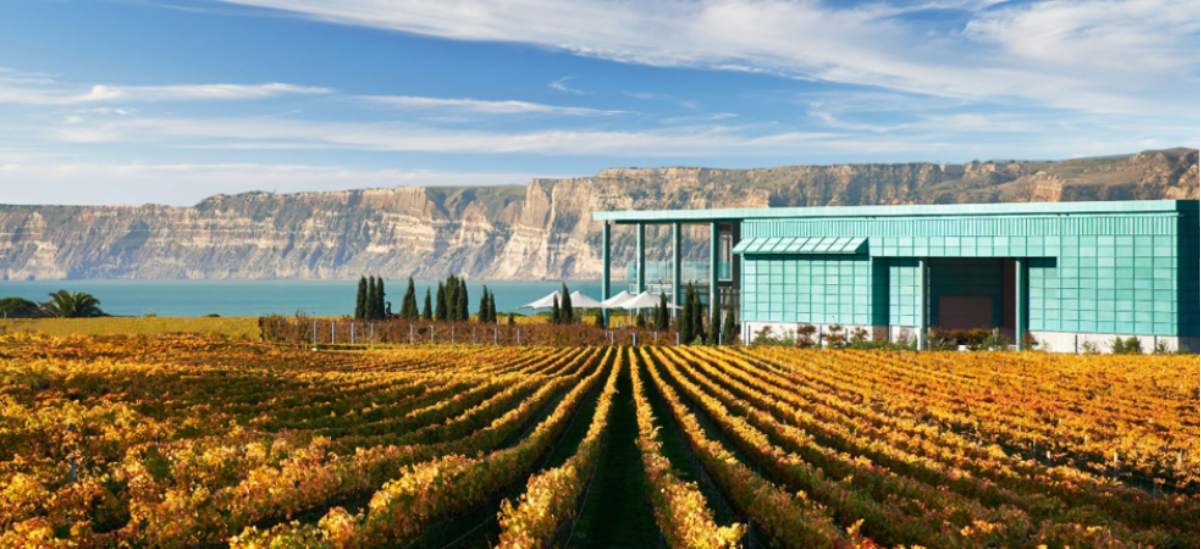
Architecture, vineyards and coastal cliffs meet in a stunning single frame – the essence of Elephant Hill’s Te Awanga site and HQ. (Photo supplied by Elephant Hill, used with permission)
Elephant Hill’s origins are unusually personal for a winery of its scale. The story begins in the late 1990s, when German businessman and vintage car collector Roger Weiss met Napier-based award-winning classic car restorer Greg Beacham at the annual Techno Classica vintage automobile fair in Essen, Germany. Roger had long desired to add a Jaguar Mk II to his collection and in Greg found his sourcing and restoration solution. Greg duly tracked down a 1956 Mk II, painstakingly and beautifully restored it in Napier ready for Roger to collect. That visit proved pivotal. Roger and his wife Reydan found themselves drawn deeply into the Hawkes Bay region’s light, its maritime calm, its people and its emerging wine culture. They purchased a plot of land on the coast at Te Awanga, initially thinking of simply building a holiday home.
On discovery that their purchase inadvertently was somewhat larger than first appreciated, ambition took over. They recognised in the Te Awanga site, a place where they could build something lasting: a modern, design‑driven estate that combined architectural ambition with meticulous viticulture. And so, in 2001, Elephant Hill was born — named after the Asian elephant whose cause the Weiss family had long supported. Vineyards were planted and plans for an architecturally distinctive winery were drawn.
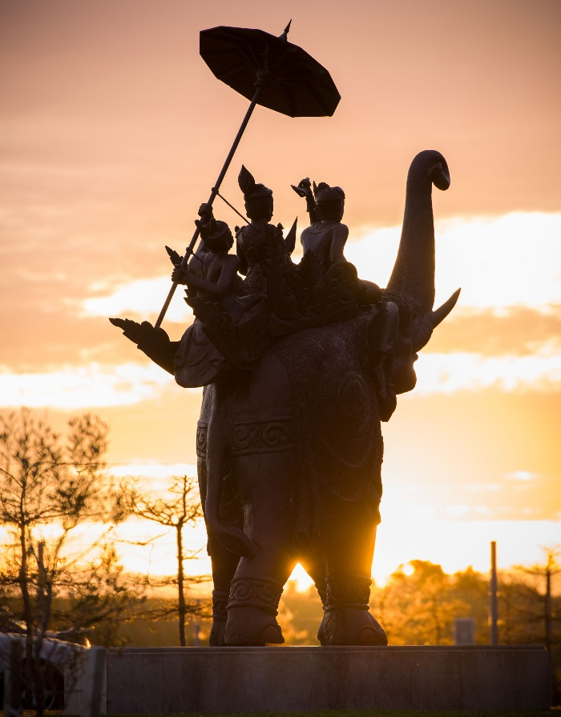
Heritage & identity: Top left, the iconic Elephant in front of the winery at sunset. Top right, founder Roger Weiss. Bottom right, successor and current CEO Andreas Weiss. Photos supplied by Elephant Hill used with permission
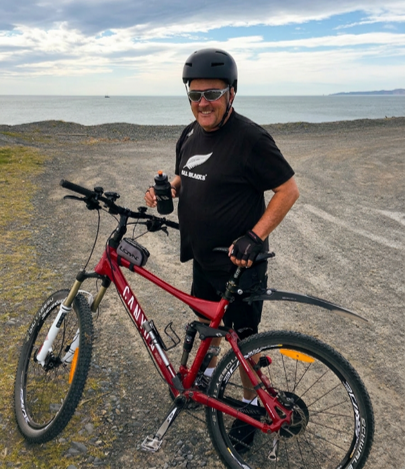
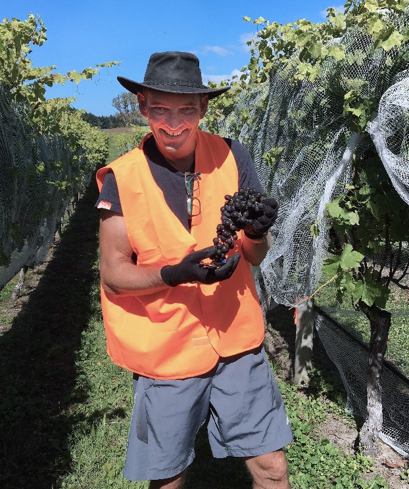
Roger remained closely involved in the estate’s development until his death in 2016. Since then, stewardship of Elephant Hill has passed to the next generation, with his son Andreas Weiss now leading the business as CEO. Under his direction, the estate has continued to evolve while staying true to the founding vision — a balance of precision, ambition, and a deep respect for the character of Hawke’s Bay’s coastal and inland vineyards. (Elephant Hill is also a highlight of the Classic New Zealand Wine Trail which I explore in more depth in my full guide.)
The copper‑clad winery opened in 2008, but the real foundation of the estate lay in its vineyards. From the outset, Elephant Hill committed to a multi‑site model, drawing fruit from three contrasting sub‑regions — the coastal Te Awanga, the warm and stony Gimblett Gravels, and the iron‑rich Bridge Pa Triangle. This gave the young estate an unusually broad palette, allowing the winemaking team to craft polished, varietal‑led blends while the vines matured and the character of each site became clearer.

The striking pre-patinated copper clad winery and cellar door-restaurant viewed from the coastal road.
From Varietal Blends to a Terroir‑First Philosophy
As the vineyards matured through the 2000s and early 2010s, the winemaking team began to see the three sites not merely as blending components but as distinct voices. For the first decade, Elephant Hill’s wines were largely varietal blends — polished, complete, and shaped by the winemaker’s intent. The prestige cuvées, Airavata (Syrah) and Hieronymus (Bordeaux blend), were assembled from the best parcels across the estate, reflecting a philosophy centred on balance and refinement rather than strict site delineation.
But by the mid‑2010s, a shift was underway. The vines had reached a level of maturity where the individuality of each site — the salinity and tension of Te Awanga, the density and graphite‑like structure of the Gimblett Gravels, the warmth and spice of Bridge Pa — could stand on its own. This led to the development of a more terroir‑driven framework, culminating in the Stone, Sea, and Earth labels:
- Stone — Gimblett Gravels: structure, concentration, dark mineral drive
- Sea — Te Awanga: coastal freshness, citrus line, saline precision
- Earth — Bridge Pa: red fruit, spice, warmth, supple tannins
This evolution marked a philosophical pivot: from varietal expression to place expression, allowing Elephant Hill to articulate the character of each vineyard with greater clarity while maintaining the prestige blends as the estate’s most complete expressions.
Inside Elephant Hill with Winemaker Hugh Crichton
My visit to Elephant Hill offered the chance to reconnect with Hugh Crichton, who has been the estate’s winemaker since 2021. I first met Hugh in Wellington in 2015, during his time at Vidal Estate, and even then his combination of technical precision, stylistic clarity, and personal generosity made a strong impression on me. Encountering him again a decade later — now guiding one of Hawke’s Bay’s most ambitious estates — felt like a natural continuation of that early conversation.

Inside the sleekly modern and beautifully laid out winery with open top fermenters, temperature-controlled tanks and oak foudres in the background
Hugh welcomed me into the winery and led me through a tour of the production spaces. Elephant Hill’s modern architecture is striking from the outside, but it is inside the winery that the scale of the operation becomes fully apparent: the clean geometry of the fermentation hall, the quiet order of the barrel rooms, and the sense of a facility built to handle multiple vineyard sites with precision. It is a space designed not for spectacle but for control — a technical instrument tuned to the estate’s evolving terroir‑driven philosophy.
After the tour, Hugh had prepared a carefully structured tasting that brought the three vineyard sites into sharp focus. We worked through current releases and yet‑to‑be‑released wines, concentrating on Chardonnay and Syrah, the two varieties that most clearly articulate the differences between Te Awanga, Bridge Pa, and the Gimblett Gravels. It was a tasting that revealed not only the character of the sites but also the quiet confidence of a winemaker who has spent years refining his understanding of Hawke’s Bay fruit.
Hugh Crichton: In His Own Words

The author tasting with Hugh Crichton, Winemaker at Elephant Hill
Before we began the tasting, Hugh and I sat down to talk about his own journey — from his early years in the industry to his time at Vidal, and now his role at Elephant Hill. Rather than paraphrasing or compressing his story, I’ve chosen to present our conversation in a Q&A format, preserving his voice, his phrasing, and the thoughtful way he reflects on the craft of winemaking. What follows is an unedited account of that discussion, offering insight into the experiences and philosophies that shape his work today.
- What was your first introduction to wine and how did it impact you?
My first real introduction to wine was through my then girlfriend’s father Dr Bruce Morrison, an avid consumer of wine. It was early days after university living and working in Wellington at a time, if I’m honest, when beer was my liquid of choice. Deb and I would often visit her family in Gisborne and would enjoy Bruce’s wine generosity. The first wine that made an impact was a bottle he shared with us - 1986 Robard and Butler Amberly Rhine Riesling from Waipara. Bruce convinced me to buy a six pack and put it away. It was the first case of wine I purchased but we drank it in the first week!
- What made you decide to become a winemaker?
My wife Deb and I were living and working in London, but I was coming to the end of my 2-year working visa and soon to be kicked out of the country. We weren’t ready to leave, and I discovered if you studied you could get a study visa. I was planning on doing a business course, but I thought, what the hell, why don’t I study something I’m interested in. After all, a year in your life is nothing. At the time I was getting “into” wine. Tasting, reading, etc. – full immersion. There is no better place than London when it comes to wine exposure. And with the proximity to Europe, we found ourselves visiting numerous wine regions. So, the long and short of it was I enrolled in a viticulture and oenology course at Plumpton College in West Sussex. A decision that was driven by interest and passion without much thought to what would be sensible!

Elephant Hill Chardonnay) wines aging gracefully in barrel
- Give us a short summary of your career from study to today?
Following my study at Plumpton I embarked on a vintage journey, trying to accumulate as much experience as possible all based from London/East Sussex; Multiple for Chapel Down in East Sussex, the hands on running of a small vineyard in East Sussex for one of the early “flying winemakers”, Montana in Gisborne, several vintages for James and Annie Milton in Gisborne, a short stint in Central Otago, and vintages in Sicily and Bordeaux. Outside of vintages I think it was the exposure of wine in London and the numerous “consumer” trips to wine regions that really had an influence.
In 2004 we returned to NZ to study and settle. I completed the Post Graduate Diploma in Viticulture and Oenology at Lincoln University and took on a Cellar Master role at Vidal Estate in Hawkes Bay, and then, shortly after, took on the wine making role and ended up staying there for over 16 years. A brief interlude of making my own Chardonnay at Trinity Hill in 2021 vintage then led to the winemaking role at Elephant Hill.

Sheep graze among dormant Viognier vines soon to be pruned.
- What do you most appreciate about your current role at Elephant Hill?
Quality focus. Producing single vineyard expressions from three distinct vineyard sites. The small size and hands on approach (just me outside of vintage) and the quality of the winery build leading to little compromise from vineyard to bottle.
- Who/what were critical influences on your approach to winemaking?
I think the wide exposure to European wine styles in the London days had a big influence on my palate.
The accumulation of vintage experience exposed me to different approaches and philosophies’ which no doubt played a part in formulating my own views.
There are so many people who have influenced my winemaking but the most significant has been Sir George Fistonich. His unwavering focus on quality combined with his vision and strong work culture in the viticultural and winemaking teams was impressive. His leadership and trust in people allowed individuals to thrive, take risks and learn.
- All careers combine continuous learning with important learning moments. Tell us how your winemaking has evolved. Were there any key learning moments/realisations which you look back on?
I don’t think there was one particular learning moment but over time I’ve learnt to stand back from the winemaking process, becoming less interventionist and allowing the process to take its natural path. Knowing when you need to act and when you can stand back is key. I think that comes more easily as experience/knowledge accumulates. There is no shortage of people trying to sell you stuff, but the key question is do you need it? I think each variety has its natural place depending on the style of wine you are trying to produce. For me natural is when you aren’t required to interfere to shape a wine. A natural place encompasses soil, climate and the human hand but in my view the hand should only gently guide and not dominate place.
I think my winemaking approach has evolved from being interventionalist to more natural with an increasing aspiration to produce wines with elegance and complexity.
- What would you like people to remember about you?
Ha, ha…. I don’t really have any aspiration for people to remember me although I would be happy if they thought I was a good guy! 😊
What I would enjoy the most is for people to share a wine that I’ve had a part in and for them to think hell, that’s a lovely wine. At the end of the day when you strip it back wine is purely a liquid refreshment with some relaxing benefits and core to its enjoyment should be flavour, refreshment and the automatic reaction from your brain – “wow, that tastes good”. Pure pleasure. No different to a great meal.
- It’s time for the last glass of wine you will drink, and you can choose anything at all. What will it be?
Oh, that’s a tough one. So many great wines from around the world but if just one then it would be a Chardonnay. Based on pure pleasure and with what I’ve tasted, my last glass would be Corton Charlemagne, from Domaine Bonneau du Martray. Sadly, many producers like these are unobtainable to all but a few due to extortionate pricing. Maybe some people buy these wines not for flavour pleasure but more for the pleasure derived from owning/drinking an expensive wine.
The Three Sites in the Glass

With Hugh’s personal story in mind, the tasting that followed took on a deeper resonance. What he poured was not simply a sequence of wines but a study in place — an exploration of how Te Awanga, Bridge Pa, and the Gimblett Gravels express themselves through Chardonnay and Syrah, and how those expressions shift across vintages and winemaking decisions. Across the line‑up, certain site signatures began to emerge: the coastal tension of Te Awanga, the warm spice of Bridge Pa, the darker mineral drive of the Gimblett Gravels. The notes that follow are organised by site to reflect the shape of that progression rather than to claim absolute conclusions.
Elephant Hill SEA Sauvignon Blanc 2024
A deliciously different expression of NZ stalwart Sauvignon Blanc, in Hawkes Bay more tropical fruit and more restrained grassy acidity are expected but this is also a partial barrel ferment with 17% aged in new oak, made from grapes grown in the cool coastal SEA vineyard at Te Awanga. Pale lemon in the glass with aromas of peach, mango, lime and a sprinkle of pepper spice. The palate was quite rich and silky with pineapple and lemon curd fruit perfectly balanced with restrained acidity and a saline edge, the finish long, dry and satisfying. Unlike most SBs in New Zealand best drunk young, this is beginning to show some benefits from aging and will improve further still.
Elephant Hill SEA Sauvignon Blanc 2025 (tank sample to be bottled July/August)
Cool fermented partly in barrel with 15% matured in new oak and the balance on light lees in tank. Pale lemon in the glass with a hint of daffodil florals over kaffir lime, green apple and gooseberry aromas. On the palate the fruit is supported by a crisp fresh acid line with a bit more grip than the 24 reflecting its youth, the finish is long and dry with a distinct minerality. Will probably reward mid-term cellaring.
Elephant Hill SEA Chardonnay 2023
From handpicked clone 15 grapes on the SEA vineyard whole bunch pressed and naturally fermented in barrel, aged 10 months in barrel. with some barrels undergoing a natural malolactic conversion, followed by a further 7 months on lees in tank. Lemon gold in the glass with aromas of white flowers, sea spray and lemon verbena. The wine has lovely freshness and drive with predominantly citrus and apple flavours, a creamy texture and a hint of cashew on the long mineral edged finish.
Elephant Hill SALOME Chardonnay 2022.
A careful selection from the best vineyard blocks in the SEA vineyard 98% and EARTH Bridge Pa vineyard 2%. Hand-picked, whole bunch pressed to barrel for a natural ferment then aged a further 11 months in French oak 62% new with some barrels going through a natural malo. Lemon gold in the glass with a nose of yellow peach, citrus zest, hazelnut and some smoky, spicy oak. The full-bodied palate is rich, round and mouth-filling with concentrated peach, lime zest, grapefruit pith flint and spice flavours, that characteristic lick of sea spray, beautifully balanced acidity and a long, layered finish. A wine of real intensity and power that perhaps needs another year or so for the oak to be fully integrated and likely to last at least a decade more in the cellar.

Views from the outdoor tasting and dining area towards the Te Awanga Hills behind the winery and Sauvignon Blanc vines.
The next four wines were all tank or barrel samples from the 2025 vintage.
Elephant Hill Estate Chardonnay 2025
Part barrel, part tank fermented. Pale-mid lemon with distinct citrus and stone fruit aromas, nicely balanced on the fruit-forward palate with some saline minerality and gentle acidity. Medium length, an easy-drinking style.
Elephant Hill Stone Chardonnay 2025
From hand-picked clone 15 grapes grown on the warmer, faster ripening gravels, whole bunch pressed and fermented completely in barrel. Aromas of orange blossom, grapefruit, white peach, and vanilla oak. The palate is rich and round yet still lively with a lovely fruit-oak balance, some mealy/cashew complexity and excellent length.
Elephant Hill Earth Chardonnay 2025
A mix of clones 15, 548 and 1066 grapes from the Earth vineyard at Bridge Pa.
A distinctly earthy, spicy edge is evident on the nose as well as palate with distinct yellow peach and melon aromas with some grapefruit pith and toasted nuts. Ripe peach flavours predominate on the palate with some oak spice and vanilla, good acid balance and length, with an earthy flintiness.
Elephant Hill SEA Chardonnay 2025
100% clone 15 grapes from the SEA vineyard at Te Awanga.
Shy at first, with Meyer lemon, white peach and sea spray aromas. The palate significantly developed depth of flavour with aeration, lemon verbena, granny smith apple and the now familiar salinity emerging, supported by a firm acid line leading to a long satisfying finish.
Elephant Hill Earth Syrah 2024
Not yet released this delicious wine is produced from 99% Syrah grown on the EARTH vineyard co-fermented with 1% Viognier from the SEA vineyard. Handpicked grapes spent 44 days on skins with a springtime malo before pressing to French oak barrels, 40% new to age for 18 months, followed by a further 3 months on light lees in tank. A small portion of whole bunches were included in the ferment.
Deep purple in the glass with lifted aromas of violets, Doris plum, blackberry and soft black pepper. Soft and rich concentrated black and blue berry fruit and baking spices on the palate with fine silky tannins and a long finish.
Elephant Hill STONE Syrah 2024.
Also not yet released, made from 96% Syrah from the STONE vineyard on Gimblett Gravels co-fermented with 4% Viognier from the SEA vineyard. 28 days on skins with a springtime malo before pressing to French oak barrels 45% new to age for 18 months followed by a further
Deep purple in the glass with very floral aromas of violets and dianthus over the dark berry fruits. The palate is intense and structured with a bit more minerality to accompany the concentrated ripe berry and plum fruit, a touch of pepper spice and a deep, complex long finish.
Elephant Hill STONE Merlot, Malbec, Cabernets 2021
A blend of 44% Merlot, 28% Malbec, 24% Cabernet Franc and 4% Cabernet Sauvignon from the STONE vineyard on the Gimblett Gravels, hand-picked and naturally fermented before aging in French oak barrels for 22 months (32% new).
Deep ruby in the glass with aromas of Doris plum, blackcurrant, chocolate, vanilla and spice. The palate reveals delicious plush and concentrated fruit on a frame of firm chalky tannins and well-judged acidity, with chocolate, olive tapenade, clove and wet stone complexity leading to a layered satisfying finish.

Harvest approaches in another iconic view of Elephant Hill against coastal cliffs. (Photo provided by Elephant Hill used with permission.
Where Elephant Hill Stands Today
Elephant Hill is often described in terms of architecture and ambition, but spending time with the wines — and with Hugh — reveals something quieter and more enduring. The estate’s three‑site model is no longer an abstract idea but a lived framework, one that continues to sharpen as the vines mature and the winemaking becomes ever more attuned to place. What impressed me most was not the scale of the operation but the clarity of intent: a commitment to precision, to patience, and to letting Hawke’s Bay speak in its own dialects. In a region that is still defining its future, Elephant Hill feels both grounded and forward‑looking — a winery confident enough to evolve without losing sight of where it began.
About the author
John Penney is a wine experience guide based in Martinborough, New Zealand. His lifelong passion for wine has been deepened through extensive international wine travel, formal wine study (WSET3) and a career in adult learning. Through his Martinborough-based business wineinsights, he provides exceptional wine tour, wine-tasting and wine education experiences for wine lovers and enthusiasts.
Add comment
Comments
Thanks, John, for the great write up and sharing your insights. Was nice to have you here and we appreciate the exposure such visits give.
Thank you, John, for the great article! It was lovely tasting wine with you. Looking forward to next time, cheers!
Thanks Hugh & Lee, it was truly a pleasure!